Category Archives: Mike H

Books on politics

I’m guessing (hoping) many of you tuned into the first presidential debate last night, and if you’re anything like me, you probably cycled through a range of emotions from frustration and anger to despair and hope. Now I won’t get into my personal political views here—although I’d just like to reiterate that choosing between an unpredictable lunatic with the vocabulary of a 5-year-old and a history of discriminatory tendencies and zero political experience (or knowledge) and a proven policy expert with a lifetime of experience in public service shouldn’t be that difficult. But I digress.

Regardless of who you vote for in November, you have a responsibility to yourself and your country to be as informed as possible. First off, get your facts straight. It’s bad enough that politicians lie and conceal their meaning behind half-truths, but allowing yourself to be lied to is worse. Consult nonpartisan fact checking organizations to verify any and all claims. FactCheck and PolitiFact are both great resources, but there are others.

Second, read books about politics. Know the players AND the game. Here is a list of some of my favorites, in no particular order:

  • On Democracy in America by Alexis de Tocqueville
  • Team of Rivals by Doris Kearns Goodwin
  • Republic by Plato
  • Dark Money by Jane Mayer
  • The Prince by Niccolo Machiavelli
  • The Federalist Papers by Alexander Hamilton, James Madison, and John Jay
  • The Fix by Jonathan Tepperman (just started but so far so good)
  • The Souls of Black Folk by W.E.B. Du Bois
  • The Wealth of Nations by Adam Smith
  • The Clash of Civilizations by Samuel P. Huntington
  • The New Jim Crow by Michelle Alexander
  • Two Treatises of Government by John Locke

Some of these are difficult reads, but they should give you an outstanding foundation on which to approach political discourse. (And yes, I realize some of the above aren’t strictly about politics, but they’re relevant and revealing reads nonetheless.)

So now I ask our readers: What did you think of the first debate? What are some of your favorite political books?

2

Reflections on my first writer’s conference

I attended my very first writer’s conference this past weekend: The Writer’s Digest Annual Conference and participated in the Pitch Slam. During the Pitch Slam, writers received 3-4 minutes with an agent—half of that time was meant for their pitch and the other half was allotted for the agent to provide feedback on the pitch and viability of the book. Many of the pitches I heard on Saturday were very well thought out, concise and clear. However, I did also make several observations that I hope aspiring authors reading this will take to heart when attending their next conference.

Unfocused pitches were not nearly as ubiquitous as I would have expected, but there were still some writers who delved into plot specifics way too deeply. Now usually this wouldn’t be so bad, but remember that writers only had 90-120 seconds to pitch their book, and those with meandering, seemingly aimless, pitches often ended up speaking the entire time, which left agents, such as myself, no time to respond. The whole point of a pitch slam is to provide writers with feedback and help them perfect their pitch. That’s not possible if the agent doesn’t get a chance to respond. Instead, the truly standout pitches told me everything I needed to know in a short amount of time: genre, word length, comp titles, and quick character and plot descriptions. And the best of the best also incorporated a nifty tagline to capture my attention. (Click here for more helpful advice how to pitch your book.)

Now my conversations with writers who didn’t take too much time to pitch their book typically went one of two ways. Either I was impressed with their pitch and preparation and we engaged in a short, but lively, discussion, or I mentioned a few areas where he/she could improve. Most took my suggestions into consideration and were very grateful for the advice. After all, that’s what the event is for. Yet, there were some who became defensive, if not downright argumentative. Criticism is never easy to hear, and you absolutely shouldn’t take anything one person says as gospel, but there’s a time and place for lengthy explanations and vehement disagreements. During a 3-minute pitch session isn’t one of them.

Lastly, don’t be so uptight and competitive with your fellow aspiring authors! People line waiting to pitch their book often gave others dirty looks or were so noticeably anxious that I felt a little bad. It’s not the end of the world if someone inadvertently goes over the time limit during their pitch. Remember that another aspect of these conferences is to try and make some connections, so present yourself in an amiable, professional manner. And relax. Agents put their pants on one leg at a time, just like you.

All in all, my first conference was very enjoyable and quite productive. I heard a lot of great pitches, and sample pages from writers I met on Saturday are starting to flood my inbox. I’m looking forward to my next one!

What I’m looking for in fantasy

Science fiction and fantasy, more so than other genres, rely on worldbuilding. And worldbuilding is hard. Novels in this genre don’t just need the usual—good writing with complex characters and compelling plot—but they also need to introduce readers to a believable new world, whether that new world is completely foreign or nearly identical to ours with one or two minor changes. So how can authors accomplish this?

Personally, I find that descriptive imagery goes a long, long way to immersing me in a new world. For example, the opening lines of Robert Jordan’s The Eye of the World go like this:

“The palace still shook occasionally as the earth rumbled in memory, groaned as if it would deny what had happened. Bars of sunlight cast through rents in the walls made motes of dust glitter where they yet hung in the air. Scorch-marks marred the walls, the floors, the ceilings. Broad black smears crossed the blistered paints and gilt of once-bright murals, soot overlaying crumbling friezes of men and animals which seemed to have attempted to walk before the madness grew quiet.”

There’s a lot to unpack in the those first four sentences, but the main takeaway is this: Jordan doesn’t simply write that the palace had been destroyed, or even that holes in the walls let bars of sunlight in. Instead he paints the reader a picture with strong language and a focus on the smalls details, the little individual pieces that make up the whole. “Rents” and “holes” have two very different connotations, and based on the other word choices and contextual clues, one can reasonably guess that the palace has seen terrible violence recently. Jordan never explicitly says this, but the tone of his writing establishes a certain mood and allows the reader to draw inferences, making him or her an active reader and a willing participant of Jordan’s world.

This excerpt also does a great job demonstrating the old “show don’t tell” adage. Its vivid imagery accomplishes a small measure of worldbuilding by enabling the reader to visualize the world, which is an obvious, yet very crucial, aspect of worldbuilding. If your story takes place on a different planet, I want to be able to imagine what that planet looks like. If your story opens in a palace courtyard, I should be able to see that palace courtyard in my mind’s eye.

None of this should come as groundbreaking, but it has been some time since I’ve been transported to a different world like Jordan’s. And I hope to visit another someday soon. I’d love to hear from our readers. Which worldbuilding techniques do you prefer? Anyone have a favorite author particularly adept at this skill?

3

What’s missing in fiction?

I admit that sometimes I grow frustrated with the seemingly endless homogeneity of submissions. Then I ask myself what it is that I want to see. The easy answer is that I want to see something that hasn’t been done a million and one times before. But are there any underrepresented subjects in fiction?

Well, this was actually the topic of a recent NYTBR “Bookends” piece, and it’s one I’ve been considering for a while because, honestly, not that many come to mind. Sure, it would be nice if fiction had a smidge more joy, but I wouldn’t go so far as to say it’s underrepresented. Novels need conflict after all. Deb’s desire to see fiction about finding a place to live gave me some interesting ideas though.

Where are the novels about the exorbitant cost of high education in America, and the average college student’s struggle to pay off student loan debts while working a low-paying job for which they’re overqualified? Or the ones about aging baby boomers sequestered in nursing homes, forced to adapt to a new way of living? Those novels likely exist already, but not in the same abundance as those about dysfunctional families.

Can our readers come up with some more underrepresented subjects? What would you like to see more of in contemporary fiction?

5

When to put down a book

Some people have to finish every book they start reading. I am not one of those people. There are so many amazing books out there that I want to read that it feels wrong, even irresponsible, to spend time finishing a book that has completely lost my interest.

For instance, if a novel’s written in the first person and I can’t relate to that character, then I’m going to stop reading. If a plot is dragging or meanders without a clear end in sight, I’ll usually put the book down unless I’ve become emotionally invested in the characters. Stories and characters that feel familiar are also begging to be dropped and forgotten. Very rarely will I put a book down because of the writing or an unlikable character. I can power through subpar writing if the story is that good—the kind of good that keeps you up at night and practically forces you to turn the page to find out what happens next. Plus if it’s published, then the writing can’t be that bad…right? And I love unlikeable characters, especially a flawed protagonist, which seems to be a hallmark of good fiction.

A book needs to force me to put it down. It’s not easy, but it happens and I’ve learned to recognize when it’s time to move on. What do our readers think? Do you ever stop reading a book? What makes you stop? And if you’re also a writer, are you aware of the possibility that someone might start and stop reading your work? What impact does this have on your writing?

8

How do you read?

And by that I mean, do you read one book at a time or multiple books at once?

As for myself, I’m always reading at least 3 books at any given time, not counting those for work. It’s a tendency fed by both practicality and whim. When I’m on the go, I’m reading a book on my Kindle or iPhone. When I’m home it’s always print books—I’m curling up on the couch with a nice new hardcover or lying in bed with a paperback before going to sleep. But I also shuffle between books based on mood. Sometimes I’m just not in the mood for nonfiction and would rather read a fun, fast-paced espionage thriller instead of that critically-acclaimed National Book Award nominee.

reading-balancing-gif

Average readers might find the habit odd—I know many of my less literate friends do—but book lovers, more often than not, couldn’t imagine reading any differently. I polled a few coworkers, and all of them responded with the “multiple books at once” answer. Not a fair poll, I’ll give you that, considering we all work in publishing, but I think you’ll find that most serious readers are in the middle of a few books. Which brings me to my next question.

Is this an efficient reading habit? Is it the “right” way to read?

Although several studies have looked at multitasking and its harmful effects on the brain, I’m not sure you can consider reading multiple books as “multitasking.” At least in the sense of rapidly switching attention from one task to another. However, I could also easily see how shuffling between books might decrease reading speed. Regardless, I won’t be changing my reading habits any time soon. Not only is reading multiple books at once both practical and enjoyable, but it’s also rewarding in the sense that sometimes the books play well off one another—whether it be a juxtaposition of different writing styles or books with similar settings or the structure of nonfiction books.

I’d like to hear what our readers think. How do you read? Have you seen a dramatic difference in reading efficiency reading one way over the other? Let us know in the comments!

0

Common query and writing mistakes to avoid

I’ve been seeing a lot of no-no’s recently so here we go: what not to do. Buckle up.

  • Long queries that ramble on will significantly hurt your chances. Agents receive a lot of queries, and we don’t have a lot of time to read them. Get to the point—4-5 short paragraphs max should be enough. We don’t need a scene by scene rundown of the book. The idea is to hook us and make us want to actually read your book.
  • On a somewhat related note, before you add your writing credentials to your query, ask yourself if they’re truly credentials worth mentioning. If you have an MFA and your short fiction’s been published, by all means let us know. If your grandma read the first 5 chapters and loved it, we don’t need to know.
  • There’s nothing wrong with self-publishing, but for the most part, we usually won’t represent a book you’ve already put up on Amazon. Publishers want original works, which means we want original works. So write an amazing new manuscript and send us that!
  • Word count isn’t important except when it is. Stay in the average range for your genre and category. This helps show that you’re familiar with your market. Yes, of course there are exceptions, but your 600,000 word thriller isn’t one of them.

The good news is that we outline our query instructions here. Unfortunately though, a good query doesn’t necessarily guarantee a good book, so here are a few common writing pitfalls to avoid.

  • Infodumping is a big no-no, and I often receive SFF sample pages that make this mistake. Blurting out everything about your world and characters at once is telltale sign that your novel isn’t quite there yet. Conversely, many sample pages read like an entirely different language with invented concepts and terms that strewn throughout the prose with no explanation. Can’t represent what I can’t understand.
  • Don’t overly describe your characters’ actions and emotions. The reader doesn’t need to know all the little movements that entail Joe boarding a bus. Likewise, the reader doesn’t need lengthy explanations of Joe’s innermost feelings. Better yet, don’t tell me your characters’ emotions at all. Good writing describes; truly great writing evokes.

Finding an agent is hard enough. Give your work the best shot it deserves by steering clear of the literary atrocities above. Have any other tips for our readers? Share ‘em in the comments.

0

Five publishers have disappeared

Nearly a year ago I wrote about censorship in China’s publishing industry in this blog post. Now five people have disappeared in recent months—all of them employees of Mighty Publishing House, which is known for publishing books critical of the Chinese government. Don’t worry though, according to a cryptic letter one of the missing persons is “fine.”

If it turns out that the Chinese government is responsible, state-sanctioned kidnappings are on a whole different level than censoring  certain passages in a book. In a weird way, could this be a positive sign that the Far East’s freedom of speech battle is gaining momentum if the government is responding so drastically? I have no idea, but I do know that it’s a lot easier to work in this industry when you don’t need to worry about such things. And for that, I’m grateful and as Lee Greenwood would say, proud to be an American.

12

First person vs. third person

It seems like I’ve been receiving a lot of manuscripts/sample chapters written in the first person lately, and while this is absolutely fine if it works for that particular story/genre, I wanted to use this blog post as an opportunity to explain some common misconceptions about the different narrative points of view.

  • The idea that a third person narrator is not as intimate as a first person narrator is false. When I ask authors why they chose to write in first person, the response usually has to do with telling an intimate story. A third person narrator can be just as intimate—he/she can express the thoughts, fears and dreams of the character, as well as take a bird’s eye view of the action, which leads me to my next point
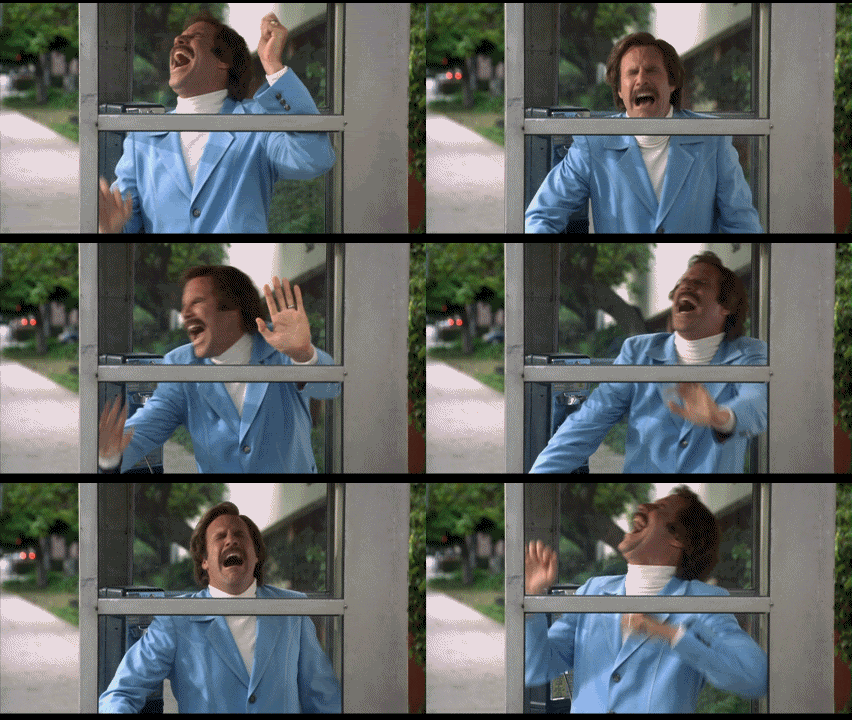
  • First person isn’t easier to write than third person. In fact, you could argue the opposite. As mentioned, writing in the third person grants you a lot more freedom—it allows you to write a story from any perspective you want. On the other hand, first person narratives can severely limit the author’s options. The author can’t write about events that the character doesn’t witness or the emotions and thoughts of other characters. It can be restrictive. Worse yet, if a reader doesn’t connect with a character’s voice, that kills the book right there. But perhaps most difficult of all, I find that writers tend to overemphasize emotions, which quickly becomes unbearable. Don’t, I repeat, DON’T put me in a glass case of emotion.


will ferrell glass case of emotion


  • Third person isn’t necessarily better than first person. While it should seem clear by now that I prefer the third person, it is in no way, shape, or form the better point of view. Certain genres work very well in first person, particularly YA. Furthermore, some books just work in first person regardless of genre. Think about your classic unreliable narrator, Holden Caulfield (although The Catcher in the Rye would probably be considered YA nowadays). The Martian and The Bookseller, and The Rosie Project were great in the first person…or so I’ve heard (only actually read The Martian). First person can work, don’t get me wrong. I just prefer third person.

I’d like to hear from our readers. Which point of view do you prefer to read? To write? Why?

0

Winter cleaning

If you’re anything like me, you have too many books—a disappointing number of which remain unread. Books fill my apartment. They are on my coffee table. Spilling out of a floor-to-ceiling bookcase (because the last one couldn’t cut it and literally collapsed from the weight). Littered across my bedroom and on my desk. So when I came across Jessica Pryde’s Book Riot blog post about cleaning up her bookshelves it really struck a chord.

Usually around this time of year I like to set aside time to do a little housecleaning. And I don’t think I can overemphasize “little” enough. I simply take a few boxes and fill them with all the books I’ve never read and have admitted to myself that I will never read, plus those books which I’ve read and don’t feel the intense need to keep. Then off they go to friends and/or charity. There’s no labeling or organizing involved. My method is a lot less ritualistic than Jessica’s, but her process sounds a lot more effective and fun than my own. I might very well keep it mind this year. Plus, drunk weeding sounds awfully tempting.

How do our readers manage their book collections? Any tips?