Category Archives: submissions

2

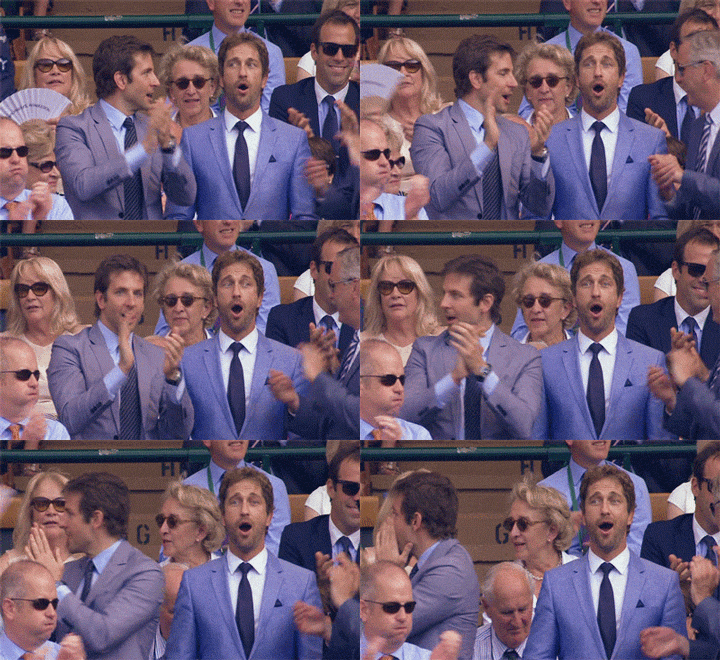
The Gerard Butler Guide to Agenting

The best thing about being a literary agent is that there’s always so much to read.

The worst thing about being a literary agent is that there’s always so much to read!

Sometimes, when faced with a particularly daunting pile of manuscripts, I turn to GIFs for inspiration in staying focused and fired up. This week, hoping to get enough done to leave the work reading behind when I go away for the weekend, I am channeling the élan of Gerard Butler:


And when I find one of those mind-blowing, can’t-put-it-down, I-gotta-represent-this manuscripts:


Who are your GET IT DONE inspirations? Do you have any GIFs or characters you turn to when you need to power through an intimidating to-do list?


0

Common query and writing mistakes to avoid

I’ve been seeing a lot of no-no’s recently so here we go: what not to do. Buckle up.

  • Long queries that ramble on will significantly hurt your chances. Agents receive a lot of queries, and we don’t have a lot of time to read them. Get to the point—4-5 short paragraphs max should be enough. We don’t need a scene by scene rundown of the book. The idea is to hook us and make us want to actually read your book.
  • On a somewhat related note, before you add your writing credentials to your query, ask yourself if they’re truly credentials worth mentioning. If you have an MFA and your short fiction’s been published, by all means let us know. If your grandma read the first 5 chapters and loved it, we don’t need to know.
  • There’s nothing wrong with self-publishing, but for the most part, we usually won’t represent a book you’ve already put up on Amazon. Publishers want original works, which means we want original works. So write an amazing new manuscript and send us that!
  • Word count isn’t important except when it is. Stay in the average range for your genre and category. This helps show that you’re familiar with your market. Yes, of course there are exceptions, but your 600,000 word thriller isn’t one of them.

The good news is that we outline our query instructions here. Unfortunately though, a good query doesn’t necessarily guarantee a good book, so here are a few common writing pitfalls to avoid.

  • Infodumping is a big no-no, and I often receive SFF sample pages that make this mistake. Blurting out everything about your world and characters at once is telltale sign that your novel isn’t quite there yet. Conversely, many sample pages read like an entirely different language with invented concepts and terms that strewn throughout the prose with no explanation. Can’t represent what I can’t understand.
  • Don’t overly describe your characters’ actions and emotions. The reader doesn’t need to know all the little movements that entail Joe boarding a bus. Likewise, the reader doesn’t need lengthy explanations of Joe’s innermost feelings. Better yet, don’t tell me your characters’ emotions at all. Good writing describes; truly great writing evokes.

Finding an agent is hard enough. Give your work the best shot it deserves by steering clear of the literary atrocities above. Have any other tips for our readers? Share ‘em in the comments.

0

I’ll tell you what I want, what I really really want

My clever colleagues Stacey and Jessica used this space to share their wish lists for the coming year and I’m going to avail myself of their example! Here are some of the categories I’m eager for right now:

Can’t put it down narrative non-fiction. Whether it’s a gripping personal narrative about key current events, or an exquisitely reported work of journalism, I want it! Send me your Five Days at Memorial or your Missoula, your Irritable Hearts or your A House In the Sky.

Tell me something I don’t know explanatory / exploratory non-fiction. Are you really good at something everyone is curious about right now? Do you have a new approach to save money or reset your memory, a new explanation of why we need love or what scares us most….and the platform to back it up? Rip it from the headlines and explain it to me. I’m not looking for gimmicks, but for accessible experts with fresh ways of looking at our world, the things we do, and what we care about most, like Caitlin Doughty’s Smoke Gets in Your Eyes, Scott Stossel’s My Age of Anxiety and Kate Bolick’s Spinster.

OMG! book club fiction. I will never not be hungry for character-driven page turners and well-written plots that keep you guessing. Got a closed community, like a boarding school or fishing village? Bring it on. Is a lifelong group of friends falling apart? Is a family struggling to keep a secret from the outside world…or from each other? YES PLEASE. Bring me your Big Little Lies, your Secret Histories, your Tana Frenches and Beatriz Williamses yearning to breathe free.

This is by no means a comprehensive list of the types of writing I am interested in, so don’t be discouraged if the thing you’re working on doesn’t fall meet these descriptions. If you’ve done your research and think I’m right for it, send it to me – sometimes the favorite projects of all are ones we never would’ve thought to wish for…

And those of you who do fall into these categories…I can’t wait to read your work!

1

Connections

Last week, I got a submission over the transom for a YA novel. The query was well structured, a sample was attached, and while it wasn’t for me, I did appreciate that the author took the time to research and follow our submission guidelines. End of story, until a few days later I got another email from the same author—turns out her son was a very close friend of my sister from college, and could I help her out with suggestions for other agents who might want to take a look?

Well, of course I’d be happy to help—but why didn’t she make the connection in the first place? Yes, it was a couple of degrees of separation, but I think if she’d dug just a little bit deeper, she would have connected me to my sister, and then she could have included that connection in her original query. And with that, while I still wouldn’t have taken on her project, I might have written her a personal note when I responded, or offered some editorial advice, rather than sending my form rejection.

The point is, connections are a major part of the publishing game. It’s why I stress to authors at every conference I attend that if they’re going to submit to me, make sure they reference meeting me or hearing me talk at that conference. And thanks to Facebook, Instagram, Twitter, Linkedin, etc., making those connections has never been easier.

If you really need further proof of the power of connections, go back and watch the MAD MEN finale again—or stop reading if you haven’t (SPOILER ALERT). For me, the most gratifying wrap-up by far was for Joan’s success in her new business—which is based, as they stress several times, on her Rolodex, i.e., her connections. Yes, it’s fictional and set 45 years ago, but the power of connection endure; after all, the job of a literary agent at root is to connect authors with publishers…

So while we always encourage authors to do their homework before submitting and check out the website, submission guidelines, etc., I’d urge you to go the extra mile and look for a more personal connection as well. Look around on-line, ask your friends and family if they know anyone in the publishing industry, check your college’s alumni listings—even the wedding listings in the Times can suggest a contact. Sure, at the end of the day it’s the work that matters, but that common link definitely helps get your foot in the door. And who knows where that connection might lead in the future?

2

A call for more sports literature

As some of you may know, I’m a little into sports, and as a fan of the Mets, Nets, and Jets, things are looking surprisingly good. The New York Mets own the best record in baseball, at least for now (probably won’t last…or will it?). The Brooklyn Nets beat the Atlanta Hawks last night to tie up the series at 2 games apiece against the best team in the Eastern Conference (though their chances of advancing are still small). And with the offseason moves the Jets have made, they are, in my opinion, just a decent quarterback away from being potential playoff contenders (a tall order, I know).

So, with that said, I’d like to request/plead for sports-related queries. If you have a novel or nonfiction work on sports, I would love to take a look at your material.

Fair warning: books about sports are tough to sell for a very simple reason: the market. Publishers won’t buy a book that they cannot definitively say will appear to X number of readers or Y demographic. It’s no secret that women tend to read more than men, and it also isn’t a secret that men tend to be more interested in sports than women. Except that—and this is a secret—neither are true. Well okay, maybe the former is, but I have male friends who read voraciously and female friends who bleed red and blue (NY Giants, NY Rangers).

Sports are universal. There is a market. And when books about sports work, they really, really work. In fact, they often work themselves onto the big screen. Yeah, I’m looking at you FRIDAY NIGHT LIGHTS by H.G. Bissinger, MONEYBALL and THE BLIND SIDE by Michael Lewis, and SEABISCUIT by Laura Hillenbrand. Oh, and novels can work too—case in point: THE ART OF FIELDING, Chad Harbach’s wildly successful debut and one of my favorite novels in recent years.

Notice any commonalities between any of those books mentioned above? They’re great sports stories, told beautifully, and aren’t really about sports. Query me if you think your book fits the bill.

2

My 2015 Wish List

Jumping on the bandwagon to tell you all what kind of projects I would love to see fly into my inbox!

(Reminder: Submission guidelines here. )

  • Historical fiction with a believable voice like Vanessa and Her Sister and Euphoria. It’s not easy to get the dialogue right when you’re setting your story in a century you never saw. Even manuscripts with every detail perfect from shoe buttons to breakfast menu have lost me the second the characters opened their mouths (visit our archives for more from Rachel on this). So if you have a fantastic historical setting and you’ve really nailed your characters’ thoughts and conversations…I want to read it!
  • Narrative nonfiction with a personal angle like Brain on Fire, Full Body Burden, and Irritable Hearts. If you are the right person to explore a little-known story, expose an injustice, or explain something fascinating, and you can blend your expertise and careful reporting with the emotion and passion of memoir-type nonfiction…send it to me!
  • A smart, edgy literary thriller that I can’t put down and can’t stop talking about like Dear Daughter and The Weight of Blood. A story that will make me scream “whaaaaaaaaat!” or “NO!!!” when I’m reading on the train.  I’m a complete sucker for unreliable narrators, and would also love some more procedural but still twisty mysteries like the work of Tana French or Brad Meltzer. (BONUS: combine bullet points 1 and 3 for an authentic historical suspense like The Paying Guests and I will love you forever.)
  • Nonfiction on any of the following topics: feminism/gender politics, contemporary religion, little-known historical figures with a BIG story.

Of course, if you have an absolutely fabulous project that you’re sure is right up my alley, send it right along even if its category is not mentioned above.  Find me at spelletier@dystel.com.


I can’t wait to see all of your fantastic (and carefully proofread) queries!


3

Read Your Work

Fall is upon us, my children are back in school, and I am actively looking for new material.

As ever, I’m on the hunt for plot driven literary fiction—think Ann Patchett’s STATE OF WONDER or David Mitchell’s THE BONE CLOCKS, but I’m keen to find more than fiction.  I represent a real range of narrative nonfiction, including but not limited to memoir, big-think economics, women’s issues, history, science (and history of science) and lots of other subjects besides.

Perhaps it is ironic (given that there are many writers who might rather give them up) but I am particularly interested in people’s day jobs.  If it so happens you are seated beside me at a wedding, I’m the gal who is happy to hear you go on and on about your job, so long as I can pepper you with questions. For me, shop talk beats small talk, and most people are better at discussing their work than the weather (unless you’re a meteorologist). This past month saw the publication of two books by clients of mine who were writing about their work: Judy Melinek and TJ Mitchell’s WORKING STIFF, about Judy’s training as a forensic pathologist, and BEHIND THE GATES OF GOMORRAH: A YEAR WITH THE CRIMINALLY INSANE by psychiatrist Stephen Seager.

Being an agent is usually regarded as a selling job–and it certainly is that.  But before the pitching can commence, ours is a listening job.  So if you’ve got an interesting career (vulcanologist, code-breaker, bike-messenger, rock-climber, epidemiologist, hostage negotiator, hotel manager etc. etc.) have a story to tell and the ability to tell it, I’d love to read your work.  Literally.

0

Some tips on query letters

I will never understand sloppy query letters. It’s a familiar song and dance at this point: author writes manuscript, revises manuscript, generally pours heart and soul into manuscript, and then misspells agent’s name on query letter—or even worse, author opens with “Dear Agent.”

Why?

Your book might ooze literary genius, but a generic, lazily written query could put you at a serious disadvantage. It’s a first impression, so make it good, because agents might not give you a second chance. At the very least, show that you put some effort into the query by following some simple advice, courtesy of a couple DGLM interns.

Ashley believes that you should “try to keep your query to a neat and trim four paragraphs: the first two paragraphs being a short, concise summary of your book with a great hook at the beginning, the third paragraph being why you chose DGLM and the particular agent, and the last paragraph should be about you, your writing history, and your credentials. Be polite, be sure to check your grammar on your query (and your manuscript!), and be patient.”

Kelsey advises writers “to be original but not over-the-top.  We have to read through a lot of submissions so it’s important to keep queries simple and straightforward.  Also, do not compare your work to bestsellers and classic works of literature.  Your query is not going to be taken seriously if you compare yourself to someone like Shakespeare.  Overall, when writing your query, aim to portray your work in an honest and concise manner.”

For those interested in querying a particular agent here, please refer to our newly revised submission guidelines. You worked hard on that manuscript. Make sure your query letter reflects that.

4

Tips from a former editor, now published author

Following up on my last blog post, I’m writing today with more advice from a (in this case former) big-house editor. I worked with Chris Pavone when he was an editor at Clarkson Potter, as well as when he was at Artisan, and now he can add bestselling author to his resume since his first novel, THE EXPATS, has hit the list.

I really like seeing the insider information from WritersDigest.com and was especially curious to see Chris’s tips on how to avoid editors rejecting your work. There is some solid if basic (and blunt) advice here, mostly for beginning authors. Much of what he suggests it seems to me is really more for authors before they’ve pitched to agents. I’d hope that most agents submitting projects to editors have made sure their authors have corrected all of these holes before the proposal or manuscript hits the desk of an editor.

What I love most about the piece is the comments. Writers are so grateful for seasoned feedback, and it’s clear from Pavone’s background that he knows of which he speaks since he rejected hundreds if not thousands of proposals and manuscripts in his day.

It got me to thinking of asking the question of our readers – what’s the best publishing advice you’ve ever received? From whom? And the worst? Where do you go when you need advice on how to pitch your work? Please share your stories and ideas here and let us know what’s helpful, and maybe more importantly, what isn’t.

32

Everything you ever wanted to know about middle grade…and were willing to ask

As promised, editor Molly O’Neill and I are going to have a dialogue about middle grade. After a lot of thought, we decided to have a conversation via email that we’d transcribe (minus our distracting tangents). Your questions as we go will help shape the discussion, just as your questions are getting us started, so let us know what you think!

MB: It seems only natural to start with this question (plus, you told me to): What is middle grade? It seems a much simpler question at first glance. If we’re looking at bookstore sections, it’s the 9 – 12 part of B&N. These aren’t chapter books or early readers, which are usually quite short, often in series, usually contain education content, and are aimed at a slightly younger audience, 6 – 8 year olds. But they’re also not teen novels, which are usually categorized as 12 and up (though can be 14 and up when there’s more “content”). YA novels often deal with more “controversial” subject matter, and often involve romantic story lines. But that brings us back to the question, what is middle grade? We can define it by age group, but I’d argue that classifying by content is more difficult.

MO: As you know, I have a marketing background, which means that whether or not I intend it, one of the first things my brain starts thinking about for a book is its readership: who is a book FOR? What kind of reader is it going to reach, and how? Maybe instead of asking “What is middle grade?” it’s easier to think about “Who is the middle grade reader, and what is he/she looking for in a book?”

I think that a middle grade reader is often (and note, I’m speaking BROADLY, here) reading for one of two reasons: to understand, or to escape. Middle grade readers who read to understand look for stories that help them piece together the truths that seem to be opening up all around them, about the world and their place in it, and the connections between themselves and their family, their community, their friends, etc. Or they’re reading to understand about a different time/ place and what it was/would be like to be a kid then. Or they’re reading to just understand how stuff works, period—from the everyday mundane stuff to big concepts like justice and honesty and friendship and happiness and love.

The middle grade reader who reads to escape is the kid who is commonly BORED—like middle-of-summer-vacation-bored!—with his/her ordinary life, yet has no means for alleviating that boredom, or even escaping his/her house or classroom. Or maybe he/she is craving excitement or adventure or entertainment or a sense of power and autonomy that family and school simply don’t offer. So that reader dives into an epic story, or something quirky or witty or fantastical or humorous, in order to escape and live in someone else’s world for a while.

The trick is, most middle grade readers are BOTH of those readers at various points, one who wants to understand AND to escape (I certainly was, anyway). So there’s not just one kind of story that appeals to them, which means that middle grade books can be ABOUT anything. So maybe the line between middle grade and YA maybe has more to do with perspective than content?

MB: As publishing professionals, we’re always asking ourselves the question Molly posed above (paraphrasing): Who is the reader for this book? On the one hand, I sometimes wish writers wouldn’t ask themselves that question, at least not at the outset. Too many times, I get a submission and it’s clear that the writer is writing to a specific market or reader. A symptom of this problem that I see very often in middle grade submissions is “writing down” to the reader. This is can take the form of trying-too-hard dialogue (“Zoinks, bud! We need to skedaddle out of here before our ‘rents come biz-ack.”), narrator-as-character (think Lemony Snicket done badly), or message-driven novels (books written only to teach a lesson). On the other hand, it’s important to think about your reader, especially during revision. I always encourage my clients to be as creative and rule-breaking as they want when conceiving of ideas or writing initial drafts, but I wouldn’t be doing my job if I didn’t then rein things in based on market expectations. For instance, one of the mistakes I see all too often is a mismatch between the age of the protagonist and the intended reader. A 12 year old doesn’t want to read about a protagonist who’s 8 or 80–they want to read about someone in the same general age group.

How to figure out what the audience wants? Do what I always recommend: read. Go to the bookstore and buy some of the recently-published* middle grade. This will give you a good idea of what the audience is looking for, and just how broad the category is.

*Please, please, please: don’t reference books published decades ago as comparisons for your books. What worked years ago probably doesn’t work now–trends and tastes change. “But The Lion, the Witch and the Wardrobe still sells!” you say. Classic books sell because they are classics, and I would argue that many of them would not find an audience today.

MO: Oh, I heartily second the need to read recently-published books, even if you’re a great appreciator of the classics! Unless you have a time-travel machine to go back to a different era in publishing to sell your book, it’s today’s market and audience a new book you’re trying to sell it to. Someone asked in the comments about whether there’s a middle grade canon and I think there’s a canon in every genre of literature, even if its an informal one—that’s why it’s so important to read widely, to have a sense of where your book fits and be able to articulate the things that both make it a natural fit within the genre AND a stand-out addition to the genre.

Speaking of problems you often see, I think one of the most common ones I run across in middle grade is “low stakes.” I think this can happen as a result of writers wanting to make a story feel familiar, but when I was a kid, other people’s lives always felt more interesting than my own, so why would I want to read about everyday, average things like homework and piano lessons and third-period math class all over again? I guess I’m trying to say that there can be a fine line between stories that feel familiar and those that feel, well, dull. This is a big reason I often encourage my authors to push past their initial ideas and explore the unknown creative wilds beyond the very first idea/solution/problem/mystery/story point/etc that they think of – because often the really fresh ideas live deep in writer’s minds, not at the very forefront. Like you said, Michael, you can always rein an idea in later, but too much of the middle grade that crosses my desk in submission feels like it never got a chance to be as creative as it maybe could have been.

Of course, sometimes it’s not always the idea that is the magical part of the story—an incredible voice or character can make even the most average story-moments feel vivid and memorable. But that’s just it—memorable is important. I think about middle grade being the time when a lot of readers discover “that book”—the one that turns them into a lifelong reader, or explodes their world open with new ideas, or shares exactly the right truth at exactly the right moment in a way they’ll never forget. You know, any time I tell people at a social event like a wedding or a party what I do for a living, there’s an odd compulsion—people simply HAVE to tell me what their favorite book was as a kid. And as an editor, those are the kind of books I want to publish—the ones that a reader of today will recall decades from now as being “that book.”

MB: I think it’s great that you bring up the issue of stakes, which can be an issue in any sort of novel. What’s on the line for the protagonist? What makes this story important enough to tell? To be clear, that doesn’t mean that you can’t be writing wonderful, contemporary, realistic middle grade. One question we got (perhaps from a client of mine) was, is there room for a “quiet” middle grade novel? I’d argue that the best books, even when they’re not deal with the end of the world or magic, aren’t really “quiet.” They may be a smaller story, with very real, relatable stakes. But if the story is constructed well, and the voice is strong, the writer can make us care very much what happens in these more everyday struggles. While not contemporary, The Wednesday Wars by Gary Schmidt comes to mind.

As an agent, I too have spent my my career looking for those kinds of books. Books that have a lasting impact on readers, that stick with them long after they’ve turned the final page. It’s why I keep hunting for great middle grade.

MO: And as a matter of fact, I think it’s why we’re doing this blog conversation. And it’s getting good! But now we have to get back to work. Check back late next week for a second installment, on Molly’s blog.