Category Archives: voice

12

First person vs. third person

It seems like I’ve been receiving a lot of manuscripts/sample chapters written in the first person lately, and while this is absolutely fine if it works for that particular story/genre, I wanted to use this blog post as an opportunity to explain some common misconceptions about the different narrative points of view.

  • The idea that a third person narrator is not as intimate as a first person narrator is false. When I ask authors why they chose to write in first person, the response usually has to do with telling an intimate story. A third person narrator can be just as intimate—he/she can express the thoughts, fears and dreams of the character, as well as take a bird’s eye view of the action, which leads me to my next point
  • First person isn’t easier to write than third person. In fact, you could argue the opposite. As mentioned, writing in the third person grants you a lot more freedom—it allows you to write a story from any perspective you want. On the other hand, first person narratives can severely limit the author’s options. The author can’t write about events that the character doesn’t witness or the emotions and thoughts of other characters. It can be restrictive. Worse yet, if a reader doesn’t connect with a character’s voice, that kills the book right there. But perhaps most difficult of all, I find that writers tend to overemphasize emotions, which quickly becomes unbearable. Don’t, I repeat, DON’T put me in a glass case of emotion.
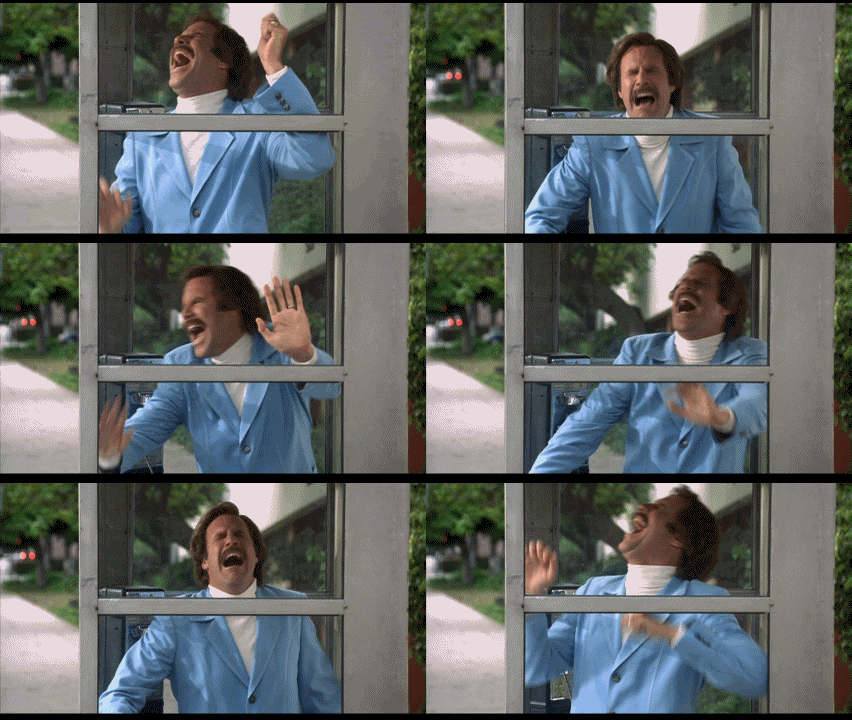
 

will ferrell glass case of emotion


  • Third person isn’t necessarily better than first person. While it should seem clear by now that I prefer the third person, it is in no way, shape, or form the better point of view. Certain genres work very well in first person, particularly YA. Furthermore, some books just work in first person regardless of genre. Think about your classic unreliable narrator, Holden Caulfield (although The Catcher in the Rye would probably be considered YA nowadays). The Martian and The Bookseller, and The Rosie Project were great in the first person…or so I’ve heard (only actually read The Martian). First person can work, don’t get me wrong. I just prefer third person.

I’d like to hear from our readers. Which point of view do you prefer to read? To write? Why?
Girl power!

Having four daughters and working in book publishing presents both opportunities and challenges as far as finding appropriate books for the girls to read. They are all at different levels, and they all have different interests so it’s not as simple as passing on a sweater or pair of pants from one to the next. What I find happens is that if a kid isn’t interested in the book that’s up for discussion, it sits on a shelf or next to the bed or worse!

I recently came up on this really great website, amightygirl.com, that aims to empower girls by offering a range of resources that relate to books for girls. Its tagline is “The world’s largest collection of books, toys and movies for smart, confident, and courageous girls”. It’s fun to play around and see what they’ve come up with, like a list of best female book characters, which includes the likes of Madeline, Hermione Granger, Nancy Drew and Ladybug Girl (impressive to find a way to fit all of those lovely girls into one sentence). I was also pleased to see a book listed on the same subject as an upcoming book on my own list about the inspiring Irena Sendler who saved 2,500 Jewish children in Poland during WWII, which means they must have great taste!

I wonder if any of you have thoughts on wonderful book ideas for girls? There was this book I read over and over as a kid that so resonated with me called Somebody Else’s Kids by Torey L. Hayden, a psychologist who writes nonfiction accounts of her work with children. It’s about four kids of varying ages with serious and very different issues and how their remarkable teacher goes to great lengths to help them. I suppose my love of narrative nonfiction started when I was young. I just ordered it for my oldest to read and look forward to finding many more books with strong, female protagonists that will empower my girls and help them reach their highest potential.

1

What I’m looking for in 2015

Happy New Year everyone! I’m a bit swamped catching up on work that accumulated over the holidays, so I’ll keep my blog post today short and sweet.

I’m looking to acquire character driven fiction.

I’m currently reading David Mitchell’s THE BONE CLOCKS, and the first thought I had was: wow, this is a character (referring to Holly Sykes—one of the many characters in THE BONE CLOCKS). Holly Sykes is vividly drawn; she has her own slang and mannerisms, has hopes, dreams, desires—in short, she comes across as real person. She has a voice. Of course, Mitchell has a voice too, an exceptional one, and it’s the way he writes his characters, it’s his voice that gives Holly a voice.

All great books have a great voice. Some are plot-driven. Some are character-driven. I’m looking for the latter. Is anyone currently working on a project that fits this description? If so, please query me and reference this blog post in the subject line. I’d love to read what you’ve got.

3

Finding your writing style

Fiction is so subjective and it’s often hard to articulate what precisely isn’t working for a book that is good, but not quite good enough. There are so many lists out there about what to do and not to do to improve your novel and a lot of the advice is valid. But it’s also sometimes hard to apply general advice to your own work. So when I see something that feel it summarizes some big ideas in a unique or thoughtful way, I like to share it here.

That’s how I felt when I came upon this blog post by Dr. Stephen Carver, a British writing teacher and multi-published author who reviews manuscripts across categories to see if they are viable for publication. So here you have an authority on the craft of writing who reads extensively and across categories offering his top ten list of common mistakes in unpublished manuscripts. A lot of the advice is valid. So why can’t you just follow all the rules to write a perfect book that agents and editors will fight over? It seems simple and yet we all know it’s elusive, creating that perfect mix of elements that work throughout an entire book-length work.

I really liked this conclusion at the end: ‘Any halfway decent creative writing course or guide will tell you more about all these areas. But they cannot teach you style – that you have to find yourself. There is no big secret to good writing. All you have to do is read widely and critically, understand narrative structure, and then keep practising until your individual style emerges.”

I agree and have said here before how important it is to know your category or categories, and read everything you can to learn the market. How do you create your own voice or style that makes your work unique to you?

2

Teenage Dreams

One of the most important things an agent or editor values in a work of fiction, and something you’ll hear talked about ad infinitum is a resounding and real “voice” to a novel. Able writing, beautiful imagery or ingenious plotting are all well and good, but if a reader can’t connect to the protagonist and his or her voice, then a novel is left feeling flat, distant and, well, forgettable.

In reading queries and even published books, I find that the voice authors most seem to struggle with is the teen narrator—and this, of course makes sense. Most published authors and hopeful queriers have left their teenaged selves behind some (or many) years ago and so a lot of the thoughts and dialogue are supposed, remembered or possibly observed if the writer is lucky enough to hang around teenagers with some regularity. (Oof, did I say lucky?) The most impactful YA novels are those that have really captured what it’s like to be a teenager, the feelings, the impulses and the intense passion that can arise from those years. The slang needs to be perfect and not overdone or cliché and the same can be said for the characters’ predilections, motives and inner thoughts.

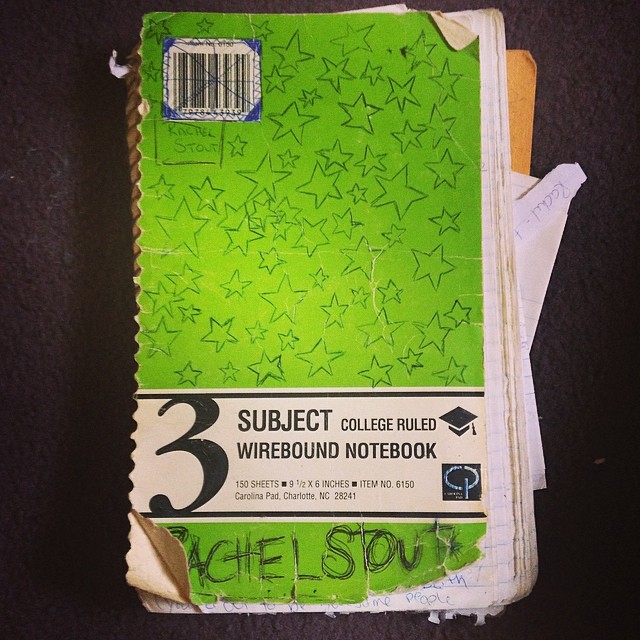
The best and worst part of reading good YA writing always hits me when I’ve been cringing at some of the supposed thoughts of teen girls thinking, “oh, god, who does this person think teenaged girls are, this is ridiculous,” and then I realize that the author is right and that’s what makes it so hard hitting. I was visiting my hometown last weekend and dug around my childhood bedroom a bit, unearthing the journal (I was too cool to ever call it a “diary” even though that’s exactly what it was) I wrote in faithfully when I was sixteen. As much as I wanted to punch/hug/kick/shake/comfort/congratulate the girl who was writing those words, I also had to admit that god, sixteen-year-old girls are annoying sometimes and yes, they do write and think and talk like those characters I had been scoffing at only hours before.

Herein lie the dreams of a sixteen-year-old.

Herein lie the dreams of a sixteen-year-old.

With this artifact, a true relic of my teenaged years in my hands, I realized something like this could really help a writer capture the youthful voice that may be escaping them in a current work in progress—an unmanufactured, unedited transcript of high school. Is this something that any of you YA writers do? If not, and if you don’t happen to be the parent or teacher of a teenager, then how are you able to write in a voice that is so far removed and so easily, tritely overdone and keep it sounding real? It’s something I’ve always had difficulty with, myself.

6

Life Stories

The other day I was excited to hear that Neil Patrick Harris is publishing a memoir this fall, and told my friend Brian about it. “What?!” Brian yelped. “Already? He’s only 40!” I was a little surprised by this reaction – NPH has been in every corner of showbiz, from TV to film to internet series to Broadway. I’m certainly interested in a behind-the-scenes glimpse of his fascinating and creative life.

But Brian’s response got me thinking about the genre of memoir itself, and whether there’s a difference between memoir and autobiography. For some readers, autobiography and memoir may be synonymous terms for any story of a life that is written by its liver. For others of us, autobiography is based on chronology, while memoir focuses on a theme, experience, or period. For example, Stephen Fry’s The Fry Chronicles is a hilarious and moving account of his upbringing and early career, peppered with anecdotes about his best friends Hugh Laurie and Emma Thompson – yes, that Hugh Laurie and Emma Thompson. I think of this as autobiography because of the linear narrative. In contrast, Unbearable Lightness by Portia de Rossi is both a Hollywood gossip-fest and a moving account of struggling with an eating disorder. And Cheryl Strayed’s Wild relates the months she spent hiking the Pacific Crest Trail, which turned into a powerful way to process and grieve her mother’s death. The latter two might not tell a full story of their authors’ lives – and those authors might not have as prominent a place in history – but they are still worth reading for their candor and introspection.

Whether you call it autobiography or memoir, many readers can’t resist the lure of a true story well-told. Keeping the nuances in mind might help you as you structure your own personal story or refine your narrative non-fiction projects.  (But I will tell Brain to cut NPH some slack considering that Justin Bieber has published TWO memoirs. At the age of 20, he’s not even old enough to enjoy a writerly glass of whiskey while he writes his third!)

Do you distinguish between autobiography and memoir? Whose yet-to-be-written memoir would you be most excited to read? What true stories do you recommend?


7

The power of the period. Or comma. Or colon. Or …

One of the things I stress most over, when writing, is punctuation. (WAIT, WERE THOSE COMMAS RIGHT, JUST NOW? IS THIS PARENTHETICAL OKAY IF IT’S  ITS OWN SENTENCE? OH GOD, AM I SUPPOSED TO PUT THE PERIOD INSIDE OR OUTSIDE THE PARENTHESES IN THIS SITUATION? I’LL JUST WING IT.)

It’s funny, because most of the time I just view punctuation as a banal necessity to make sure your words aren’t misinterpreted (See: either any and all arguments for the serial comma or this amusing article on Buzzfeed). It’s stressful because there is a generally agreed upon right way to do things and if you don’t know the right way to use a particular punctuation mark there’s the absolute horror of being called out on it at some point and coming up blank. I’m mostly sure I know when and why to use a semi-colon, but please, don’t ask me to explain in front of anyone.

I still remember the day I learned the difference between and em-dash and an en-dash (and to a lesser extent, the hyphen, only included because it’s visually similar) and it changed my world. The em-dash is now, I think, my absolute favorite punctuation, to the point where I actually have to go back and edit some of them out of things I’ve written so as not to overwhelm.

Vulture posted an article by Kathryn Schulz yesterday, “The 5 Best Punctuation Marks in Literature” that I just loved and that really got the wheels turning in my head. Of course, I suppose I’d always been aware of punctuation as a literary device, just as much as anything else, but because it’s something used in even the most ordinary of sentences, it’s never stuck out as particularly powerful to me before. After reading this, however, not only am I convinced, but I’ve started noticing the punctuation in everything I read—and write, which is bound to get distracting eventually, but I’ll cross that bridge when I come to it.

I think my favorite of the examples that Schulz presents are Nabokov’s parenthetical and Dickens’ colon—both are masterful and truly do change the sentiment and takeaway from each passage in which they appear. Reading through the comments, I notice someone lit upon just what I myself had been thinking of as I read—what about the lack of proper punctuation, or heck, punctuation at all to bring home a point or strengthen an emotion? One commenter referenced Molly Bloom’s monologue at the very end of Joyce’s Ulysses and her rushed, hurried, full of sensation, devoid of thought “and yes I said yes I will Yes” has always been one of my favorite closing lines in literature and it couldn’t have been as perfect as it was if there had been even a single comma betwixt the words—I’ll go on record saying that.

What about you? Any particular mark of punctuation just really not do it for you? Elude you in the proper way it’s meant to be used? Do you have any more literary references for its excellent use? I’d love to hear them.

33

De-gaying YA

**Updated 9/18/11**

There’s been a lot of talk in the YA world this week about an article over at Publisher’s Weekly about the difficulty in selling work with LGBTQ protagonists, and the story is even being picked up by non-publishing outlets. (There’s also now some controversy, seen here on the Swivet, about who the mystery agent is, and if, in fact, they ever said such a thing.)

In the interest of full disclosure, I passed on the manuscript in question. It had absolutely nothing to do with the gay character–in fact, it’s not something that even registered. Perhaps it’s having lived on the coasts for years, or perhaps being gay, but finding a gay character in a book rarely registers. An author of mine recently sent in a new manuscript in which the brother of the female protagonist is gay, and honestly, I wouldn’t have noticed if the author hadn’t mentioned it in relation to a plot point. The guy’s gay.  Ok.  Moving on. And I’ve sold more than one YA book with an LGBTQ protagonist, including a YA memoir.

The same is generally true when I get in submissions. I’m not looking for gay or straight protagonists, and I don’t pay much attention. I care about the concept, the plotting, the voice, the writing–the sexual orientation of the character is the last thing I’m thinking about. Please send me books with LGBTQ characters; I’d love to see anything good! I think just about every agent and editor out there would say the same thing; it’s it’s good, we want to see it.

That said, we also have to be honest about the realities of the marketplace. There are fewer gay readers than straight readers. “Gay books,” on average, sell less than “straight books.” Readers seem to be more interested in reading about straight people–at least that’s what sales indicate. So publishers thinking about what to publish have to take this into consideration. Despite appearances to the contrary, publishing is a business, and sales matter. But YA books with LGBTQ characters continue to get published, are published well, and find audiences well beyond gay teens.  For more on this issue, I really recommend you read Malinda Lo’s brilliant blog post “How hard is it to sell an LGBTQ YA novel?”, which was referenced in the Swivet post above, and gives a great view from an author on this subject.

Publishing has to be one of the least homophobic businesses around. The percentage of gay agents, editors, and other publishing professionals is much, much higher than the population in general (no matter which statistic you’re looking at), and people are fairly liberal. I can almost guarantee that there’s no one censoring gay content. ***

If you want to see more books featuring LGBTQ characters, I have a piece of advice: seek out and buy those books. If publishers are rejecting books with LGBTQ characters because they believe they won’t sell, the way to change their minds is by buying the books when they are published. Publishers are chasing after sales, which is why you see so many copycat books–vampire novels after Twilight, dystopian novels following Hunger Games. Vote with your dollars. The more LGBTQ books you buy, the more you’ll see. And I know that we publishing professionals will be happy to sell them to you.

*** I should have chosen my words more carefully in this sentence. I didn’t mean to say that there was never any suggestion that GLBTQ content be removed from a book; clearly, that isn’t true. I was trying to say that I didn’t think anyone was doing this with a set agenda; I don’t think any particular editor’s or agent’s homophobia (blatant, latent or internalized) is the reason that such suggestions are made.

I also never intended to offend anyone with this post, and while I still don’t think I’m being naive or ignoring a blatant issue, I will certainly be more aware and sensitive going forward. I appreciate your responses and comments on this post, whether you agree with me or not. As so many have pointed out, what matters here is that we’re discussing the subject openly. And that can’t be a bad thing. Thank you.

7

A strong voice

I’m thinking out loud here, so bear with me, but I had a moment today where I took a peek at the unread queries currently sitting in my inbox.  In a spontaneous move, I began opening attachments, or skipping down to the copy and pasted text underneath the cover letter of randomly selected emails.  Rather than starting from the top, reading introductions, pitchlines, etc., I dove right into the stories themselves. This is one of those tests that can help me decide if a submission will really pull me in, making me eager to keep reading.  I realize that the summaries and blurbs in a query matter–because they do–but at the same time, if a book has a strong voice, then I shouldn’t need to have the genre blatantly spelled out for me—the story should be able to tell me that all on its own.

So I wonder, in your writing process, how do you manage to keep the voice of your work strong? Do you write, but then go back and question it, or do you just let the words flow and let the voice (pun and all) speak for itself?

17

Queries: It’s not about the details

In my agent travels, I find that most of the questions I get from aspiring authors are about queries. And that makes sense: everyone (including myself) will tell you that your query is an important weapon in your agent-getting arsenal. So, having been told that the difference between publishing superstardom and form-rejection comes down to one page, authors obsessively work on their queries. But that’s not quite right: what they do is obsess. And I think a lot of times they can’t see the forest for the trees. They ask agents what font or paper stock they should use, whether HTML email or plain text is better, or if their bio should be longer or shorter or more personal or more formal. They receive conflicting advice from different websites, agents, editors, author friends, and spouses. And then they have a nervous breakdown.

Ok, that last part may have been a bit of an exaggeration, but I don’t think it’s that far off. Writers, who tend to be obsessive anyway, get downright crazy about query details, and I really don’t blame them. We publishing professionals haven’t helped the situation, what with all of our dire warnings about doing it perfectly or else. So I want all of the writers out there to pay attention: if you’re reading this blog, if you’re paying attention when publishing pros give you advice, if you’re going to good, appropriate conferences, you don’t need to panic. This is the catch-22 of it all: when agents go on and on about bad queries and what-not-to-do, they’re preaching to the choir! Anyone savvy enough to be paying attention is probably doing it right in the first place. I don’t mean that all of you have winning queries that will score them an agent and publication, but I doubt any of your are going to wind up the cautionary query tale that you hear at conferences.

But, the question the remains: what am I looking for, if it’s not all of those little details? What I’m looking for is a unique idea and good writing. I’m looking for an authentic, interesting voice–yes, voice in your query. I’m looking to get a feel for your style in just a couple of paragraphs. I’m looking for you to describe your book, whether it’s commercial or literary or in between, in a way that makes me want to keep reading. In October, I linked to a great query example, the one that Lisa McMann had written for Wake that was recently in Writer’s Digest. It was exactly I’m looking for: it was unlike any query I’d received before (or since). How so, you ask? It was entirely unique to Lisa and her book. It didn’t follow any formula or template. It gave me the information I ask for, but it did so in a way that was different. And I can promise you, all of the successful queries I’ve read have done the same thing.

I’m sure this will spur many questions, but I’d like to have a saner, more humane query discussion with aspiring authors, one that focuses on ideas, narrative, and writing instead of on boring details like font and word count. A little common sense in putting together a presentable query, plus a killer idea and great writing, and you’re all set!

– Michael