Category Archives: dialogue

0

Fifty Shades: The Movie

So FIFTY SHADES OF GREY by E.L. James finally hit the big screen this past weekend after what seemed like a million bumps in the road, including losing actors left and right. It made a splash in the box office just as it did in the publishing industry. The movie brought in $94 million its opening weekend: the highest-grossing President’s Day Weekend ever.

But how long will the film industry feel the ripples of this splash? The book was/is an absolute phenomenon. James’s Fifty Shades series has sold an absurd amount of copies—both when it was self-published and after Random House picked it up. Imitators and parodies of the books soon appeared on shelves and e-bookstores. It’s paved the way for other fan fiction and other self-published authors to have a chance to land with a big publisher and/or movie studio.

So will we begin to see more erotica made into films? Given the success of Fifty Shades on opening weekend, it’d be easy to definitively answer yes. However, reading is an intrinsically private experience, which lends itself to fantasy. Watching explicit scenes on a big screen in a room full of people is a different matter entirely. Could Fifty Shades be an exception?

Your guess is as good as mine: What do you think?

P.S. Saw American Sniper this weekend. The movie ended, and everyone walked out silently, somberly. No one said a word. A completely full theater, and not one sound was made. I’ve never experienced anything like that before. What did you think of this movie/book? I’d like to hear your thoughts on this one, too.

Tell us how we’re doing

A while back (a year, maybe more—my conception of time is shockingly horrible, bordering on nonexistent), Sharon did a blog post asking for feedback from our readers. What we heard was eye-opening to say the least.

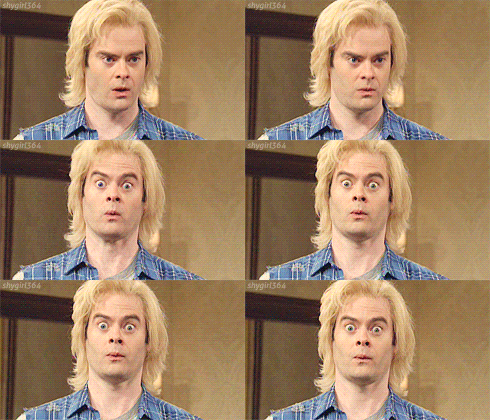
snl gif

All of it was informative and very helpful—and I believe it led to a better year in blogging for DGLM and our readers. So I will do so again here. Let’s call it our year-end review.

What do you guys enjoy about our blog? What keeps bringing you back for more? What would you like to see us do differently, do better?

This is your chance for some input. Our readers are important to us, and we want to blog about what you want to read about. So please, don’t hold back. What’s on your mind?

2

Reading goals for 2015

The New Year is fast approaching—way too quickly if you ask me—and with a new year comes new goals!

I have never before made reading one of my resolutions for the new year. Reading has always been such a huge part of my life that I never really felt it was necessary. It would be like resolving to drink more water or take more showers. But ever since I’ve started taking on clients of my own and representing more and more authors, I’ve found that I’ve had less and less time to read books by authors who aren’t my clients. So for 2015 I will make a very moderate reading goal: I will read one book every two weeks, in addition to the massive amounts of reading that comes with the territory of being a literary agent.

And then, I came across this thoughtful post about resolving to read less on Book Riot via Twitter. (I’m new to Twitter, by the way, so excuse this shameless plug: mike_hoogland.)

Now I’m certainly not at the point of “oversaturation” that Jeremy describes, but he makes a very compelling point. Reading should make you better informed, wiser, and possibly even funnier or more empathetic, so a better-informed, wiser, funnier, more empathetic person-turned-hermit is counterintuitive. I don’t think reading 24 books next year will lead to such a life either, but I’m wondering if there are people out there who have hit this reading tipping point.

Are you one of them? What are your reading goals? I’d like to know. Sound off in the comments.

3

National Novel Writing Month (or NaNoWriMo)

Happy National Novel Writing Month everybody! Writing a draft for a 50,000-word novel in a single month is no easy feat, so I figured I would help out those of our readers who are writers currently working on a project with some helpful tips and resources.

First things first, if you’re going to do this, don’t make excuses. Check out this advice about finding time to write. I especially like #2. As an iPhone 6 Plus user, one of the benefits a big screen provides is the ability read and edit manuscripts on the go. Smartphones do everything. They can be your pen and paper when you’re out and about.

GalleyCat also has some useful advice for writers. Their first writing tip this November can be found here.

Who better to take advice from than Ernest Hemingway? Ever heard of him?

And perhaps the most important tip of all: don’t get discouraged! You can do it! After all, it’s been done before. And if you need some inspiration, here’s a pep talk from James Patterson.

Show, don’t tell. This is a classic piece of advice. It’s also what I tell my clients on a consistent basis. Not only does showing the reader actions and emotions make your story come alive, but it’ll help you increase that word count so 50,000 words in a month seems like no big thing!

How many of our readers out there are currently partaking in National Novel Writing Month? Do you have any other tips for fellow writers? Let us know in the comments below.

Lastly, and on a completely unrelated note, we here at DGLM would like to express our sincere gratitude to all former and active members of the U.S. military. Happy Veterans Day!

1

The Blog Post with No Pictures*

Flipping through the internet today, I came across a Vanity Fair interview accompanied by a book trailer for B.J. Novak’s The Book with No Pictures, his children’s book with, well, no pictures. The video itself is completely adorable and the conceit of the book—emphasized in this interview—touches on something that though it should be obvious, gave me a bit of an “aha” moment.

Why do children’s books exist? Of course the first and most obvious answer is as a form of entertainment, as yet another vehicle to occupy a child, give them a venue for using their imagination. They are learning tools and foster creative thinking. However, children’s books are rarely without pictures—in fact you’re far more likely to come across completely wordless picture books than you are to come across anything geared toward a young child that has no illustrations at all.

Yet. That doesn’t mean that the words can’t be visual themselves. The words in Novack’s book are all different colors, sizes, fonts. Though that’s certainly an added bonus, that’s still not even the point I’m trying to get at here—and I think the point the author has as well. Reading for a young kid is about more than everything I’ve mentioned above. Reading as a child serves to foster a literary attraction that can exist and survive long into adulthood. By giving the words printed in a book an interactive agenda (and I really just mean the words—there are tons and tons of interactive Pat the Bunny style books that have their place, too), does this help to create a space where kids feel compelled at an early age to respond and discuss what they’ve read? Without the help of pictures or texture? Making adults say silly things is really fun (as the video clearly demonstrates), so does a book like this not then make the words themselves the funny part of the book, a book which in and of itself is having a conversation?

Of course, I don’t have a child and when I was little enough for picture books to be my sole literary companions, I would never have stopped to think about these things, but the idea will at least be one I’m thinking about for a little while. What say you?


* genius title credit to Sharon Pelletier

3

What do I read next?

It’s a question we’ve all asked ourselves. I often talk with friends, coworkers, and scour the internet looking for my next great read, but one avenue I almost never turn to is, perhaps, the most obvious: book reviews. Book reviews serve a variety of purposes, but their main objective is to help readers choose what to read next. I frequent the book review sections in papers, such as The New York Times, USA Today, and Wall Street Journal, as well as the “Briefly Noted” section in The New Yorker, but I can’t recall one instance in which I ever actually read a book recommended from one of these reviews.

So I’m wondering, am I alone in this tendency? Do others do the same thing: read book reviews but never actually pick up the books being reviewed? For some opinions on the matter, I turned to our interns. And I couldn’t have said it better myself.

When I’m trying to figure out what to read next, I don’t take reviews into great account. At bookstores, I make selections based on covers and jacket copy, but don’t pay much attention to endorsements and praise unless it’s coming from someone in whom I already have an interest (typically, authors whose books I have enjoyed.) On my iPad, I usually select from whatever Oyster recommends based on other books I’ve rated. A lot of other books I read come recommended by my grandmother and her gal pals. When I do look at reviews, it’s usually on Goodreads or Amazon, because many of those users post plot synopses that are more detailed than what the publisher offers. In the end, I try to make my own judgments and not let them be swayed by what others may think about a story. Weirdly, despite the fact that I don’t use reviews as a deciding factor in my reading choices, I still have made a point recently to post reviews of books I’ve read to my personal blog. 

As much as it pains me to admit, I primarily rely on Amazon when I am looking for book reviews. Generally, I don’t frequently read the reviews posted by users, but I do look to see how many stars a book has received. Anything less than three stars, and I get nervous about purchasing the book. But while I do look at the ratings, I primarily decide on what books to read based what my friends suggest. I trust that my friends will know more about my likes and dislikes when it comes to books than some random Amazon reviewer. For example, a book may have three stars on Amazon, but if my friend recommends it to me, chances are, I will still purchase the book. When I do read Amazon customer feedback, I generally read the one or two star reviews. I find those to be much more honest and entertaining. I also will use Publisher’s Weekly for suggestions and reviews, as well as some blogs.

Let’s face it: Amazon’s library and Barnes & Noble’s shelves are overwhelming. I can easily spend more time reading reviews than I’ll spend on the novel itself, and it’s hard to be sure reviewer K.Reader978 has more discerning taste than Good_Books4U. I solve this by starting my book hunts with someone’s personal recommendation. While that someone is often an enthusiastic friend, I found some of my recent favorites through a blogger’s musings, or buzz on my Twitter feed about upcoming debuts. It’s rare for a book to be a total flop if someone’s taken the time to rave about it for four paragraphs. Before buying, though, I get some groupthink insurance by scrolling through Amazon reviews. Weirdly, long-winded three-star-awarding purchasers are the most accurate. Fellow essay-trained humanities majors unite?

So now I’ll ask our readers: how do you decide what to read next? Do book reviews play a major factor? Sound off in the comments.

1

All you can read books

It’s been very interesting to watch the unveiling of Kindle Unlimited, Amazon’s new subscription-based e-book program. It’s not a new concept. In fact, entertainment and media industries have been heading this way for a long time. Netflix provides consumers with unlimited streaming of television and movies for a flat flee. Spotify provides the same for music. So why not books?

Kindle Unlimited isn’t even the first to offer the all-you-can-read buffet. Oyster and other similar companies have been around for some time; yet none have Amazon’s platform. Or its ability to stir up controversy.

Some of Kindle Unlimited’s critics have historically been Amazon’s staunchest supporters: self-published authors. They’ve claimed that they stand to be hurt the most from the program, in part because of the different royalty structure. Royalties will be allocated from a set fund divided across all borrowed units, which may mean lower royalty payments. Not only that, but self-published authors who choose to opt out of Kindle Unlimited so they can distribute to other vendors, such as Nook Press and Kobo, stand to drop in the Amazon bestseller rankings because Kindle Unlimited “sales” count towards those hourly standings. Pro Kindle Unlimited authors, on the other hand, argue that authors will benefit greatly from the discoverability that Kindle Unlimited and such rankings could provide. Unknown authors can potentially shoot up in rank, even if those “buying” their books never get around to reading them.

And what about on the consumer side? On the face of it, $9.99/month for an unlimited number of books seems like a great deal. But how many people subscribing to Kindle Unlimited actually read enough books every month to make it worth it? It’s one thing to binge-watch shows and movies on Netflix or binge-listen to music for hours on end on Spotify. But binge-reading is a whole different ballgame.

I’d like to hear what our readers think of Kindle Unlimited. Will you subscribe? If you’re an author, do you enroll?

0

The reality of publishing

Yesterday we had yet another successful Q&A lunch with our interns. At least from my point of view it was a success, but I was curious to hear what the interns thought. Here’s their reaction, courtesy of Brianna:

Today all of the interns at Dystel and Goderich had lunch with the agents and we learned some very eye opening things. All of us came to the table with a romanticized idea of what working in publishing would entail. This idea included, but wasn’t limited to, having a wooden desk with piles of manuscripts to read at one’s own leisure, talking on the phone with authors, and dreaming up brilliant ideas that will lead to surefire future bestsellers. Today, however, the agents taught us that there is much more to the process, and it involves a lot of work one wouldn’t necessarily expect.

First, we learned that there is a big difference between being an editor and being an agent. An agent’s number one job is to represent the author, first and foremost. They read query letters and sift through manuscripts to find projects worth pitching to editors at publishing houses. In everyday life, they communicate with their authors, and essentially have no higher-level “boss.” For the most part, agents work independently and have the freedom to reject manuscripts if the story just isn’t for them, or they can choose to help authors edit their work if he or she thinks it will make the project better and more saleable.

On the other hand, an editor’s primary loyalty is to the publishing house. Sure, editors edit, but they also act as a liaison to the agent, who represents the author, and the publisher, who ultimately rolls the book out to the public. And that sounded frustrating. I never thought that one of an editor’s jobs would be to convince the right people in house that they should spend X amount of money on a book proposal.

In both positions, though, most of the day is spent on the phone, conversing via email, or completing paperwork. It is key to be organized in all fields. Regarding the actual reading of manuscripts, reading projects usually happens outside of the workday—nights and weekends. That came as possibly the biggest shock of all.

In the end though, whether you think you might be interested in agenting, editing, or another job altogether in publishing, gaining invaluable work experience via internships, publishing programs, and informational interviews is key. I learned a lot today, and for me personally, it has only solidified my desire to learn more and fully immerse myself in the industry.

I wish I grew up reading…

It wasn’t too long ago that I became Uncle Mike. My cousin gave birth to a little baby girl, Eleanor. (I know that technically makes me her second cousin, but Second Cousin Mike doesn’t really roll off the tongue.)

It also wasn’t too long ago that a roommate told me he wished he read more growing up. He can’t remember the last time he read a book cover to cover and attributes this shortcoming to the lack of pages he turned as a kid.

Now I’m not a scientist, but it seems to me that if you develop a love of reading when you’re a child, you’ll be more likely to pick up a book in adulthood. And let’s face it, wouldn’t the world be a better place if everyone read more? Numerous studies show positive correlations between reading and intelligence, empathy and emotional health. This is just one of many.

So I’d like little Eleanor to grow up reading. And when she actually is able to read, I’d like to give her a basket full of books similar to the one in my childhood room at my parent’s place—only with fewer books about aliens, wizards, knights, and trains. But until then, I’m in the market for some good board books that her parents can read to her.

So please help! What do you read to your children?

2

Teenage Dreams

One of the most important things an agent or editor values in a work of fiction, and something you’ll hear talked about ad infinitum is a resounding and real “voice” to a novel. Able writing, beautiful imagery or ingenious plotting are all well and good, but if a reader can’t connect to the protagonist and his or her voice, then a novel is left feeling flat, distant and, well, forgettable.

In reading queries and even published books, I find that the voice authors most seem to struggle with is the teen narrator—and this, of course makes sense. Most published authors and hopeful queriers have left their teenaged selves behind some (or many) years ago and so a lot of the thoughts and dialogue are supposed, remembered or possibly observed if the writer is lucky enough to hang around teenagers with some regularity. (Oof, did I say lucky?) The most impactful YA novels are those that have really captured what it’s like to be a teenager, the feelings, the impulses and the intense passion that can arise from those years. The slang needs to be perfect and not overdone or cliché and the same can be said for the characters’ predilections, motives and inner thoughts.

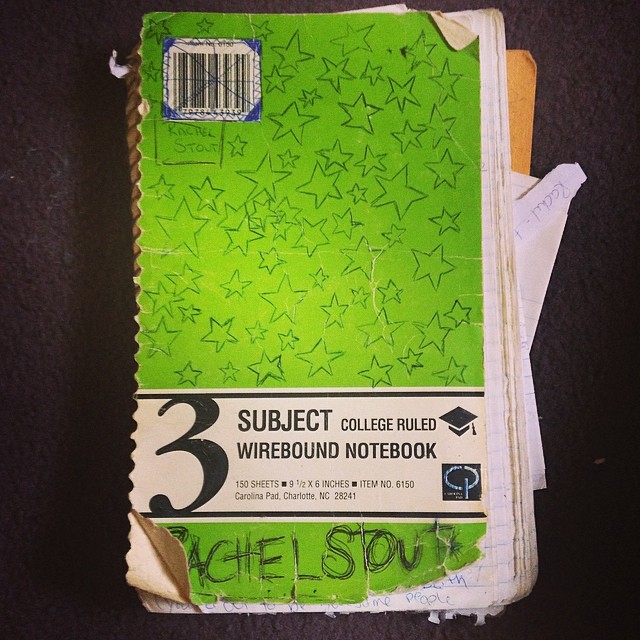
The best and worst part of reading good YA writing always hits me when I’ve been cringing at some of the supposed thoughts of teen girls thinking, “oh, god, who does this person think teenaged girls are, this is ridiculous,” and then I realize that the author is right and that’s what makes it so hard hitting. I was visiting my hometown last weekend and dug around my childhood bedroom a bit, unearthing the journal (I was too cool to ever call it a “diary” even though that’s exactly what it was) I wrote in faithfully when I was sixteen. As much as I wanted to punch/hug/kick/shake/comfort/congratulate the girl who was writing those words, I also had to admit that god, sixteen-year-old girls are annoying sometimes and yes, they do write and think and talk like those characters I had been scoffing at only hours before.

Herein lie the dreams of a sixteen-year-old.

Herein lie the dreams of a sixteen-year-old.

With this artifact, a true relic of my teenaged years in my hands, I realized something like this could really help a writer capture the youthful voice that may be escaping them in a current work in progress—an unmanufactured, unedited transcript of high school. Is this something that any of you YA writers do? If not, and if you don’t happen to be the parent or teacher of a teenager, then how are you able to write in a voice that is so far removed and so easily, tritely overdone and keep it sounding real? It’s something I’ve always had difficulty with, myself.