Category Archives: age

10

Getting lost in a book

My preferred activity as a kid was sitting somewhere (I always hoped for inside and air-conditioned during the summer) with my library bag stuffed with ten to fifteen new library books, and reading the day away. I would zip from one universe to another, skip centuries back in time, advance a few thousand light years in the future, face down a dragon or learn new magic words, be embroiled in the Civil War or Elizabethan England…the possibilities were endless. Changing worlds was as effortless as changing from wakefulness to dreams.

Given this, it’s unsurprising that this article from The New York Times piqued my interest. Two writers (Francine Prose and Benjamin Moser) ask whether or not it’s harder for readers to be transported by a book as they get older. Prose argues that children’s bigger imaginations and willingness to suspend disbelief allow them to become more wholly immersed in a book. Adults are more likely to analyze, cross-reference, and compare people and events in a book to things they’ve experienced. Moser says he discovered that he wanted to read the same books again and again, since, “the deeper you go into your own writing, the harder it becomes to enter someone else’s.”

Now of course, neither Prose or Moser’s points are true for everyone. Prose admits that some books still have the ability to totally immerse her in their reading experience and plenty of writers find new inspiration and motivation from reading other people’s work. Reflecting on my own reading trends, I realize that maybe I’m choosing a different kind of immersion as I’ve gotten older. I used to devour everything fantasy & sci-fi as a kid—I loved escaping to other (more exciting) worlds that had the possibility of magic glimmering at every turn. Now, I’m more interested in commercial fiction, “women’s” fiction, and more contemporary fiction, perhaps as a reflection of my own life. I’m turning to these genres for answers, other experiences and perspectives, and identification in my own life. It’s a different kind of immersion. (And I still love sitting down on a weekend and turning my attention to the stack of two or three library books I’ve checked out.)

What do you think? Can you mark a noticeable difference in your reading experience as a child and an adult? Do you think writing helps or hurts your reading?
0

It’s never too late to start writing

What do you think about waiting until you’re almost 80 to start a new career? If you’re legendary book editor Dick Jackson, the answer is no time like the present!

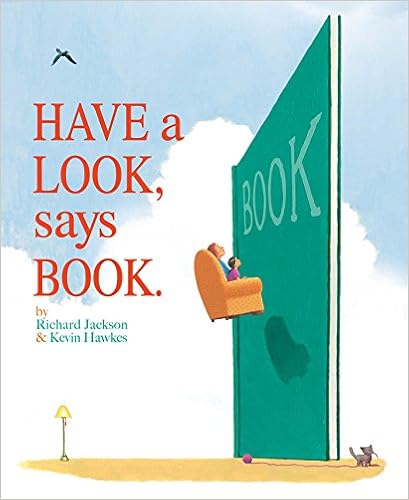
As reported in a fascinating article in Publisher’s Weekly, Jackson retired from book publishing in 2005 after a long and very successful career as a children’s book editor. It was in 2013 when he was being treated for cancer that this creativity as an author was piqued and he began pitching ideas to former colleagues. He is still in treatment and his cancer is not in remission, and yet he now has 8 (yes, that’s 8!) picture books under contract! The first of which, HAVE A LOOK, SAYS BOOK, has just been published by Atheneum, where he previously had his own imprint. At the age of 81, he is making his debut as an author! And what a debut it is, with illustrations by Kevin Hawkes. Future books will be illustrated by Jerry Pinkney and Laura Vaccaro Seeger. It helps to have the kind of deep experience and relationships in children’s book publishing that he has, but even so it’s an amazing journey he’s taken from editor to author, especially given the circumstances of his age and health.

I hope this story serves as inspiration for those of you aspiring writers who might be feeling discouraged or frustrated that the process isn’t always fun, fast or rewarding. You never know when or how that might change and you will get the spark that becomes your first published book. Keep on keeping on!

5

You’re reading WHAT?!?!

We’ve been going through a bit of a weird reading time lately in the Rudolph household. For the past few weeks, my four-year-old son George has insisted onHarry Potter and the Sorcerer’s Stone for his bedtime reading, no doubt inspired by his older brother Henry, to whom I’ve been reading all seven books in sequence for about a year now. While I’d like to believe that George is brilliant, precocious, and absorbing every word, the truth is that he consistently falls asleep after 5 pages or so–and since he falls asleep so easily, we aren’t going to discourage the routine!

Meanwhile, seven-year-old Henry wants to know about war–specifically, World War II. And since Dad can’t seem to explain WWII coherently without getting into a lot of evil stuff, he asked if we have any books on it instead, or if he could get some from the library. So it seems we’ve reached that fateful Parenting Moment where we need to think about what kinds of books are appropriate for our kids.

Now, like most of my publishing colleagues, I abhor censorship. One of my proudest projects from my early days at S&S was working with Judy Blume on Places I Never Meant to Be, an anthology that supported the National Coalition Against Censorship. But when it comes to Henry and George, is it right to feel concerned about what they read? Or am I being a total hypocrite if I tell Henry to wait on the war books until he’s older?

Fortunately, Roger Sutton of The Horn Book (and an outspoken anti-censorship advocate) pointed me to this little piece on Book Riot, where the author advocates letting kids discover books without restriction. And after reading it, I realized that I benefited from a laissez-faire book policy when I was a kid, too–discovering Lou Reed’s music in ninth grade led me to William Burroughs, and while I distinctly remember my Mom wasn’t thrilled when I took my copy of Junky on the plane to visit my grandparents in Florida, to her credit she didn’t stop me.

So while I might try to get age-appropriate book from the library on WWII, when Henry starts digging through our own shelves and comes across Ellie Wiesel and Primo Levi, I’m not planning on stopping him. And if George keeps up with Harry Potter through the somewhat disturbing ending, I won’t be the one to stop him either (even if manages to stay awake).

But maybe I’m being unrealistic and/or dogmatic here–how do you handle reading material for your kids? Do you keep an eye on them or give them free reign on your shelves? Where do you draw the line?   

2

Schoolday reading

With the summer season coming to a close (I know, I know, it’s a harsh reality, but we all have to accept it), I was thinking fondly on how excited I used to get to go back to school. Clean, fresh notebooks, brand new pens, new seat assignments and, of course, finding out what books we were going to be reading that year.

I remember in elementary school when there was a whole separate class called “Reading,” and that was amazing. I relished in having read a little ahead of the class and knowing what was coming next and learning about the culture surrounding each book. I think my favorite thing, however, was when we read aloud, a paragraph per student, which was excruciating when it got to those who didn’t care or couldn’t read as well (by “well” I meant with emotion as a performance because I also fancied myself a budding actress. Naturally.), but was empowering when it was my turn and I got an especially long paragraph to say.

Reminiscing about some of my very favorite books we read in grade school, my mind immediately went to Scott O’Dell’s Island of the Blue Dolphins which easily led me to the rest of the books in the series and will forever be remembered initially as the first time I learned what a cormorant was.

Number the Stars by Lois Lowry is another one that struck me hard and I think was the catalyst for my fervent love of middle grade and young adult fiction that centered on WWII, the Holocaust and wartime in general. The memories are coming back to me in floods now and my next immediate thought is of The Endless Steppe by Esther Hautzig about a family exiled to Siberia. I don’t remember too much about the plot (though I did just look it up), but I do remember declaring that it was my number one favorite book for a while…and of course it turns out that it also took place during the early 1940s.

And then there are those books that I remember pieces of, but have no idea what they might be. Struck with a thought, I just searched “wearing broccoli around your neck,” and weirdly, that worked. Apparently a fourth grade favorite of mine was called Be a Perfect Person in Just Three Days by Stephen Manes. I should have known that searching “everything you touch turns to chocolate” would provide me with a book titled The Chocolate Touch by Patrick Skene Catling. Should have figured that one out, Rachel. I think I just liked that book so much because it’s actually a dream of mine to have chocolate whenever I want it.

It’s funny the way certain parts of stories, especially stories from childhood, stick with us even if the rest of the book doesn’t. Vivid scenes, like the making a cape of cormorant feathers in Island of the Blue Dolphins or the main character in In the Year of the Boar and Jackie Robinson learning how to play stickball (also when I learned what stickball was, myself). Is it because there is so much new information that we’re learning for the first time or because a kid’s imagination works in overdrive, much more easily able to relate fantastical stories to his or her own life?

Whatever the reason, it was a nice little trip down memory lane—and a relief that my images of broccoli necklaces and chocolate mailboxes were based on something real and not a sign that I’m going insane. What books immediately come to mind for you when you think back to grade school? Were there any that you remember hating? Loving? Maybe it’ll jog my memory, too!

7

MG vs YA

Two weekends ago, I had the pleasure of attending the Pacific Northwest Writers Association conference in Seattle. At the opening Agent’s Panel, I gave my usual spiel of what I’m looking for–Adult nonfiction, a smattering of offbeat adult fiction, and the broad range of children’s projects–YA, Middle Grade, and picture books. After that, I settled into my seat in the ballroom for a long stretch of power pitching, where the writers line up for 4-minute pitch meetings one after the other in the hopes of getting a request to see a full MS.

As exhausting as power pitching can be, it does serve to give an agent a good idea of what writers are generally working on these days. Although we often recommend that writers NOT write for the market, it’s natural for writers to turn to what seems to be popular. And hence, I heard a ton of MG pitches, which makes sense, since a ton of editors seem to be focusing on it these days.

But what surprised me about these MG pitches is that a solid majority of them featured a main character who was 13 years old. Which, if you go by the traditional demarcations of MG as ages 8-12 and YA as 12 up, means that they’re really writing YA. At the same time, the stories seemed to be solidly MG–heavy on fantasy and school stories, light on teen issues and racy content.

So what gives? Do these writers not know the basic guidelines? Are they just trying to age down their YA novels for the market? Or has MG become more elastic and less constricted by age distinctions than in the past?

Frankly, I’m not exactly sure, so I was very interested to read this article from PW Children’s Bookshelf, which looks at how bookstores are struggling with how to shelve MG and YA. And from their survey, it seems that stores are making up their own rules–some are keeping YA and MG totally separate, some create overlapping sections of 8-12, 10-14, and 14 up, while others lump them all together. Different strokes for different customer bases, perhaps, but for me it seems like there’s just confusion all round about where books belong on the shelf.

So, what’s a writer to do? Well, like a lot of category distinctions in publishing, unfortunately, it doesn’t seem like there’s a clear answer. My personal feeling is that despite the shifting winds, a writer seeking representation is still better off adhering to the old guidelines–if your character is 12 or under, it’s MG, 13 and up, YA. Not that I’m trying to take the easy way out here, but the last thing I want to hear from an editor is that they love the book but aren’t sure where it would live on the shelf–that’s a classic rejection line.  So I’d much prefer an author adhere to what’s been done in the past when starting out and go genre-busting on book 2.

That said, others may have different ideas of what marks MG versus YA these days, so I’d love to know what you’ve been hearing. Are 8-12 and 12 up still recommended? If not, what are folks suggesting as new guidelines?


2

Teenage Dreams

One of the most important things an agent or editor values in a work of fiction, and something you’ll hear talked about ad infinitum is a resounding and real “voice” to a novel. Able writing, beautiful imagery or ingenious plotting are all well and good, but if a reader can’t connect to the protagonist and his or her voice, then a novel is left feeling flat, distant and, well, forgettable.

In reading queries and even published books, I find that the voice authors most seem to struggle with is the teen narrator—and this, of course makes sense. Most published authors and hopeful queriers have left their teenaged selves behind some (or many) years ago and so a lot of the thoughts and dialogue are supposed, remembered or possibly observed if the writer is lucky enough to hang around teenagers with some regularity. (Oof, did I say lucky?) The most impactful YA novels are those that have really captured what it’s like to be a teenager, the feelings, the impulses and the intense passion that can arise from those years. The slang needs to be perfect and not overdone or cliché and the same can be said for the characters’ predilections, motives and inner thoughts.

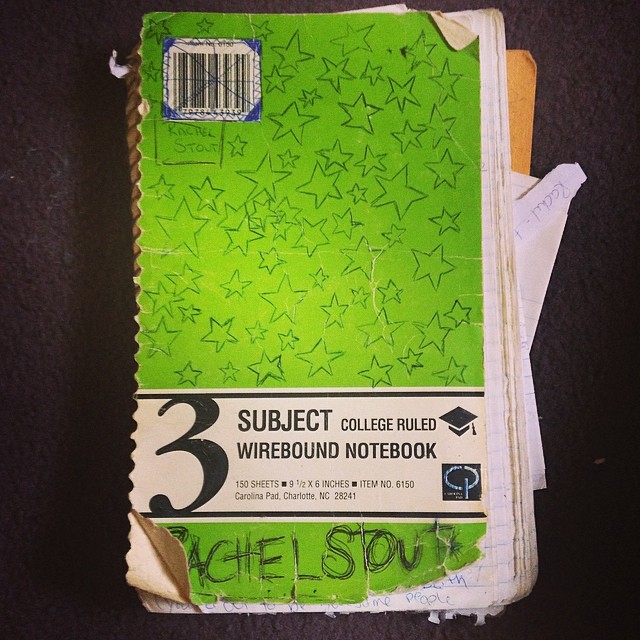
The best and worst part of reading good YA writing always hits me when I’ve been cringing at some of the supposed thoughts of teen girls thinking, “oh, god, who does this person think teenaged girls are, this is ridiculous,” and then I realize that the author is right and that’s what makes it so hard hitting. I was visiting my hometown last weekend and dug around my childhood bedroom a bit, unearthing the journal (I was too cool to ever call it a “diary” even though that’s exactly what it was) I wrote in faithfully when I was sixteen. As much as I wanted to punch/hug/kick/shake/comfort/congratulate the girl who was writing those words, I also had to admit that god, sixteen-year-old girls are annoying sometimes and yes, they do write and think and talk like those characters I had been scoffing at only hours before.

Herein lie the dreams of a sixteen-year-old.

Herein lie the dreams of a sixteen-year-old.

With this artifact, a true relic of my teenaged years in my hands, I realized something like this could really help a writer capture the youthful voice that may be escaping them in a current work in progress—an unmanufactured, unedited transcript of high school. Is this something that any of you YA writers do? If not, and if you don’t happen to be the parent or teacher of a teenager, then how are you able to write in a voice that is so far removed and so easily, tritely overdone and keep it sounding real? It’s something I’ve always had difficulty with, myself.

3

Better with Age?

Last week’s New York Times featured an article that I absolutely loved, a piece by musician and author Edward Kelsey Moore on making his fiction debut at age 52.   I’m always a little surprised at the way in which the media treats serious writers who produce their first works well past thirty (a literary debut at 52! Imagine that!) As if debut works should be written by actual debutantes.

I suspect that someone, somewhere has actually studied this, but by my unscientific reckoning, it seems to me that good writing gets better with age.  Sure there are plenty of literary wunderkind, from John Keats to Jonathan Safran Foer, but to steal a line from Wordsworth (who was himself obsessed with the dimming of his genius as he grew older)  I think it makes sense that folks who have an ear for “the still, sad music of humanity,” those who call upon decades of observation and experience in their work, who have perhaps been writing for years while pursuing other careers or raising families, should wish to write—and, amazingly enough–write well. Moore’s whole essay is worth reading, but at risk of ruining the punchline, I’ll include his final lines:


So, these days, the question “Aren’t you too old for this?” brings to mind a list of things that I’m definitely too old for. But I answer, “No, at 52, I’m not too old to be a debut novelist. But, luckily, I’m way too old to be the writer, musician or man I was at 30.”


How does your age inform your writing? Do you feel like you are coming into your own voice?