
 April 25, 2014
  Rachel
One of the most important things an agent or editor values in a work of fiction, and something you’ll hear talked about ad infinitum is a resounding and real “voice” to a novel. Able writing, beautiful imagery or ingenious plotting are all well and good, but if a reader can’t connect to the protagonist and his or her voice, then a novel is left feeling flat, distant and, well, forgettable.
In reading queries and even published books, I find that the voice authors most seem to struggle with is the teen narrator—and this, of course makes sense. Most published authors and hopeful queriers have left their teenaged selves behind some (or many) years ago and so a lot of the thoughts and dialogue are supposed, remembered or possibly observed if the writer is lucky enough to hang around teenagers with some regularity. (Oof, did I say lucky?) The most impactful YA novels are those that have really captured what it’s like to be a teenager, the feelings, the impulses and the intense passion that can arise from those years. The slang needs to be perfect and not overdone or cliché and the same can be said for the characters’ predilections, motives and inner thoughts.
The best and worst part of reading good YA writing always hits me when I’ve been cringing at some of the supposed thoughts of teen girls thinking, “oh, god, who does this person think teenaged girls are, this is ridiculous,” and then I realize that the author is right and that’s what makes it so hard hitting. I was visiting my hometown last weekend and dug around my childhood bedroom a bit, unearthing the journal (I was too cool to ever call it a “diary” even though that’s exactly what it was) I wrote in faithfully when I was sixteen. As much as I wanted to punch/hug/kick/shake/comfort/congratulate the girl who was writing those words, I also had to admit that god, sixteen-year-old girls are annoying sometimes and yes, they do write and think and talk like those characters I had been scoffing at only hours before.
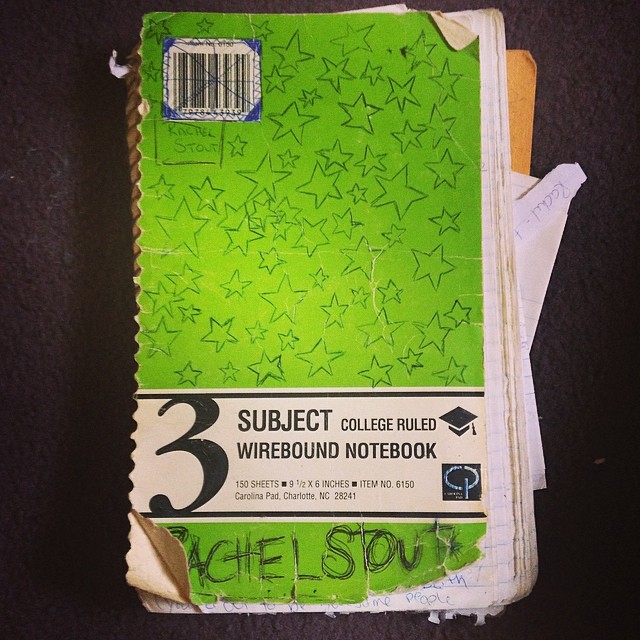
Herein lie the dreams of a sixteen-year-old.
With this artifact, a true relic of my teenaged years in my hands, I realized something like this could really help a writer capture the youthful voice that may be escaping them in a current work in progress—an unmanufactured, unedited transcript of high school. Is this something that any of you YA writers do? If not, and if you don’t happen to be the parent or teacher of a teenager, then how are you able to write in a voice that is so far removed and so easily, tritely overdone and keep it sounding real? It’s something I’ve always had difficulty with, myself.