Category Archives: critiques

3

Conference Tips

It feels like winter in NYC today so I’m dreaming of summer travel…and I’m excited to have a few writers’ conferences in my summer plans! I will be at Carnegie Books-in-Progress conference in Lexington, KY, and Killer Nashville in, well, Nashville in August! Conferences are wonderful opportunities for writers to learn more about their craft, connect with other writers for support, and meet industry professionals such as yours truly for advice and feedback. If you have a writers’ conference in your area I strongly suggest you consider attending!

But did you ever wonder what we, the agents, get out of it?

Hmmmm. Good question. 

After all, we’re giving up our time – our precious reading time! often our precious weekends! – to travel across the country and mingle with strangers! Well, I can only speak for myself, but I love getting out of NYC to see a different part of the country and meet editors and agents who might be based outside New York or whose paths I haven’t crossed yet. Most of all, though, I love meeting writers who are passionate about their stories and willing to spend their time and money to get better at telling them. As an agent, I’m always hungry for my next amazing project, and a conference offers me a veritable buffet of talent and hard work. Every project might not be to my taste, but I have pretty good odds of finding one or two or ten that I will be dying to sign up. The inspiration refill alone is well-worth a weekend of hotel coffee.

Candid shot of me, post-hotel coffee,
preparing to meet writers and hear pitches!

I always want to make sure, though, that I’m offering something valuable to the attendees who chose to meet me or attend my workshop or panel during their busy conference time! So I found this Tumblr post How to Panel Like a Lit Champ to be very detailed and helpful. I will for sure be bookmarking it to re-read next time I’m preparing for a talk or panel. And the final piece of advice applies to all of us, no matter what part of the industry we’re in, querying writer or autograph signer, editorial assistant or high-powered agent: “It doesn’t matter if you are the most famous or the least famous in the room / on the panel, be nice. Stay classy.”
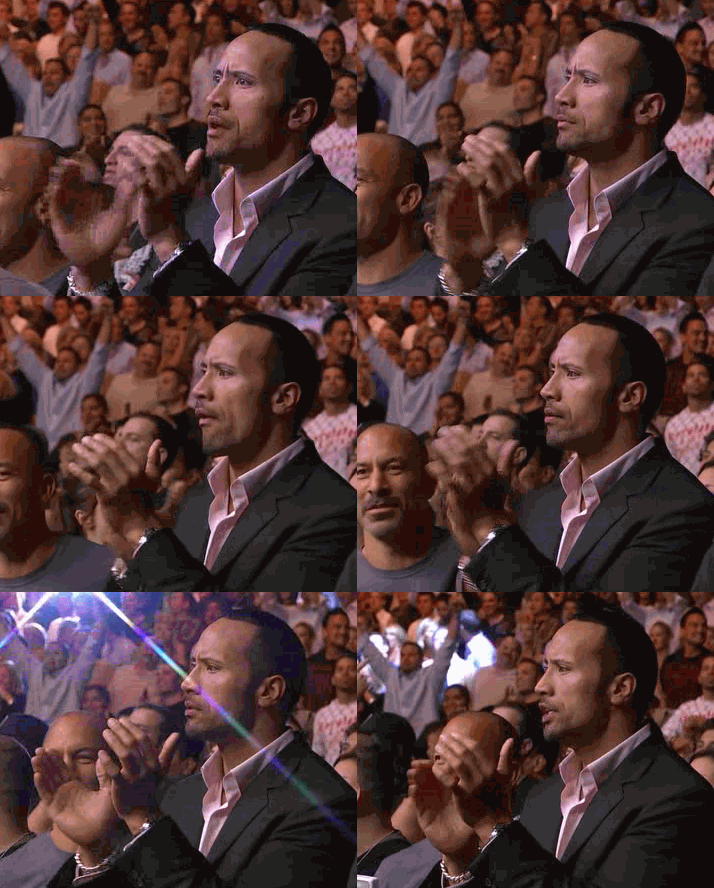
 

Be nice. Stay classy. 


Now I want to hear from you. What do you consider most valuable when you’re attending a panel? Pet peeves or top tips from your conference experiences?  

Successful query breakdown via an author and her agent

kristi-belcamino-author-writer

I was recently asked by my talented client Kristi Belcamino to join her in a guest post for Writer’s Digest in Chuck Sambuchino’s “Successful Queries” series to share her query letter and my response. I shared why I was drawn to it and ultimately went on to represent and sell the book. I love this kind of thing because it feels so simple and yet I know for prospective authors looking for advice this kind of feedback, which includes a real life example, can be really useful.

Book publishing is obviously an inherently subjective business so what appeals to me is not necessarily what appeals to others. However, when I look at a successful query letter, I find there are certain things that are generally done well.

In Kristi’s case, she introduces herself and her background in a way that is intriguing. An actual female crime reporter? Bring it on!
Then we see a first line that sucks you right in: Gabriella Giovanni has never met a man more exciting than a murder. I’m beyond interested to know more about this character.

She goes on to CLEARLY and CONCISELY pitch the book in a way that makes you want to read more. My best advice for writers looking to pitch their books in a query letter is to try to write the jacket copy of the book. You can go into greater detail about the story and characters in a synopsis or follow-up email, but for me (and again, this is subjective), I want to see the elevator pitch because if you can describe your work in a clear, concise and compelling way, then I can too when I speak with editors on your behalf.

Finally, she offers additional information about her writing background which shows me that not only has she received good feedback from industry professionals for her work, but that she also has worked hard on her book and takes her writing seriously.

Take a look at our post and let us know what you think and if there’s anything else you see in Kristi’s query or my response that’s worth targeting. Happy querying!

blessed-are-those-who-mourn-book-cover

1

When it’s okay to use bad grammar

When shuffling through query letters, bad grammar is often a loud warning bell. Literary agents tend to be wary when reading material from the prospective, unpublished author. Nothing will make an agent drop a query into the reject pile faster than poor grammar.

However, incorrect grammar can often be utilized as a literary style. Nearly every accomplished author does so—to one degree or another. Sentence fragments. Abbreviated words. Missing punctuation. Misspelled words and incomplete sentences. Literature is abundant with poor grammar.

So, how then can you determine when to ignore all those rules drilled into you by your elementary school teachers?

What is your writing for? Writing is purposeful. You don’t pick up a pen and commit words to paper accidentally. Is this a blog? An academic piece? A query letter? A creative piece? Resume? Knowing your audience is a time-tested lesson in writing, so for formal prose, always go the safe route and edit your piece to perfection to ensure perfect, “proper” grammar.

On the other hand, for creative pieces, bad grammar can help the author illustrate his or her point. The form your writing takes should match its tone.

Cormac McCarthy is known for his stark, bare prose and his distaste for commas and other forms of punctuation, such as the quotation mark. His writing not only complements the often-bleak tone of his work, but also adheres to a simplistic style for the sake of clarity and rhythm. He believes that punctuation can often disrupt the flow of a sentence and is usually superfluous.

Hope this was enlightening. I encourage those interested to read more on the topic. Here are some semi-related links to check out on the topic of grammar:

http://opinionator.blogs.nytimes.com/2012/07/09/a-matter-of-fashion/?_php=true&_type=blogs&_r=0

http://grammar.about.com/od/rhetoricstyle/a/effectivefrag.htm

http://andthatswhyyouresingle.com/2013/03/12/does-bad-grammar-punctuation-turn-you-off/

Why are the books always better?

I watched Gatsby the other day. Excuse me, let me clarify. I tried to watch yet another disappointing movie adaptation, another beloved-book-turned-train-wreck-of-a-movie. And I’ve never once gushed over F. Scott Fitzgerald’s magnum opus like so many do. No, I went in with reasonable expectations. Expectations even Leonardo DiCaprio with all his talent and all his movie-star swag couldn’t help the movie live up to.

So cheers to good books that can’t be experienced any other way than through the written word. Gatsby was flawed from the start. People have tried to make the movie before…and all have failed. Some other good examples of poor movie adaptations:


The Road by Cormac McCarthy: The man’s a genius. Again, another flawed project from the start—it was near impossible for this movie to live up to the book. Nobody does McCarthy better than McCarthy.


Any one of the Harry Potter movies: I know a lot of people liked these movies, but as someone who read the books, I can tell you that they don’t compare. So much was missing. Great parts were inevitably left out, and I was inevitably let down.


Lemony Snicket’s A Series of Unfortunate Events: This was truly the worst adaptation of a book I’ve ever seen. The whole film was one unfortunate event after another. Someone during my show time screamed out, “My eyes!” and ran crying from theater only twenty minutes in.

My question to you is: why? Why are the books always better? What does the written word evoke that motion pictures can’t? Is it simply the element of surprise or something more? Can you think of a movie that defies this unwritten rule and surpasses its source material?

7

The sense of a beginning

As we’ve discussed many times on this blog, a truly great opening line to a novel is the holy grail for those who read and write for a living.  A beautiful, evocative, powerful first sentence can mean the difference between committing to a 600-page journey or picking up the remote.  The truth is, most novels, even the ones we decree to be masterpieces, don’t have particularly memorable opening lines.

For instance:  “The madness of an autumn prairie cold front coming through.”

Or, “When the lights went off, the accompanist kissed her.”

Or, “The play—for which Briony had designed the posters, programs and tickets, constructed the sales booth out of a folding screen tipped on its side, and lined the collection box in red crepe paper—was written by her in a two-day tempest of composition, causing her to miss a breakfast and a lunch.”

These are the first sentences of three of my favorite novels of the past decade or so.  Solid openers, certainly, but nothing of the caliber of “It was the best of times, it was the worst of times.”  I believe that these three books (The Corrections, Bel Canto, and Atonement in case you hadn’t guessed) will become classics (if they haven’t already) despite the fact that Franzen, Patchett, and McEwan didn’t knock it out of the park with their first swing.

I just started reading Gone Girl and because it has been hyped to the heavens by everyone I know who’s read it, I was looking for a brilliant start.  And…it’s fine.  It made me want to keep reading but it didn’t grab me in a vice grip and drag me into the book.  To be honest, it felt a bit forced and writerly.  So far, however, the novel’s terrific and living up to the reviews.

My point, and I do have one, is that the first line doesn’t have to be mind-blowing.  It just needs to be good, intriguing, well written.  It should pique your curiosity even if it doesn’t turn you into a quivering mass of anticipation.  Ah, but the next 90,000 words need to keep you interested.   And, then you can try again—with a stunning closer that stays with you long after you’ve finished the book.

Of course, if that’s all too much trouble, you can do what these folks did and write some truly gruesome first sentences.  They will definitely grab someone’s attention.

What are the first lines from novels you’ve loved that didn’t exactly knock your socks off?  And why did you keep reading anyway?

4

The positive power of rejection

The longer you live, the more rejection you are faced with. It’s as natural a part of life as breathing. As a writer, you put yourself in a position to face more rejection than the average person (actors probably have a leg up on writers, though, in the rejection department). How you handle that part of the process is key to your success. If you give up too quickly, you’ll never get where you want to go. If you take it personally, you’ll wind up angry and resentful. But if you use it to make your writing better, and take the feedback that rejections sometimes offer and revise your work to make it the best it can be, then you’re really getting somewhere that could wind up being great. Perhaps not necessarily what you originally envisioned, but even better than that.

I enjoyed reading this recent article from writersdigest.com about Aminta Arrington’s winding road to publication. She describes the various agents with whom she corresponded and how their feedback shaped and changed the book she wound up writing and selling to a publisher. While not all agents or editors can offer the type of constructive feedback it sounds like she received, there are certainly other places to go to get feedback on your book, whether it’s from teachers, beta readers, writers’ groups, or your most insightful friends and family. Taking the idea of rejection and spinning it into a chance for growth and introspection is a worthwhile concept.

And it got me to wondering about our own blog readers and their experiences with the positive power of rejection. I’d love to hear your stories of how a rejection shaped your work in a positive (or negative – sometimes enough rejection can get you thinking about a new project instead of staying stuck on an old one that isn’t working) way. And it doesn’t have to be agent or publisher rejection. Maybe it’s a friend who told you they didn’t like something you’d written, or a teacher who gave you a grade lower than you thought you deserved until you heard his or her explanation and realized maybe it really wasn’t your best work. Please share your  positive rejection stories and then we can all work on trying to remember to see the glass half full approach to rejection from now on.

18

What grabs you?

I just spent a great weekend in Gettysburg, PA, at an SCBWI conference—incredibly well organized, plus delightful, inspiring keynote addresses by Patricia MacLachlan and E.B. Lewis. My only regret is that I wish I could have sat in on the break-out workshops and speeches, but I was booked solid with one-on-one manuscript critiques all day Saturday and Sunday morning. For each critique, I was sent the first 10 pages of a YA or MG novel, plus a one-page synopsis, in advance of a 15-minute session with the author. Which leads me to the question at hand…

Whenever I have a lot of critiques in a row (fifteen, in this case), as the day goes on I usually end up identifying one or two key issues that come up in multiple manuscripts. This time out, it seemed like a lot of the openings were rushed—to me, it almost felt like authors were consciously trying to smush all the key ingredients of characterization, setting, conflict, symbolism, voice, etc., into those precious ten pages for my review. However, when I asked if any had tailored their samples specifically for the critique, the answer was a resounding “no.”

Hence, I’m wondering: What’s the main thing you look for in a story? Do you want to meet the main character? Find out the central issue of the book? Dive right into the plot? Or do you want it all? I will say, in several of these critiques I found myself advocating for the author to slow down and let us get to know the main character before diving headfirst into the plot. But maybe that’s just me—which element gets you turning the pages?

6

Conference consternation

I took to Twitter today for some blog suggestions, and Rina Heisel wanted to know what mistakes I see writers making at conferences. I see lots of thems, but here’s my top 10 do’s and don’ts of conference going:

10. Come prepared to talk about your book without reading something. When I sit down for a pitch, or even just begin a casual conversation, I want you to be able to tell me about your book briefly without reading a script. Other people seem to have a memorized pitch, word-for-word, and stare at me intently as they try to remember each one. Nothing is more unsettling. Instead of doing that, imagine you’re telling me about your job, family or hobbies. You don’t memorize a speech to discuss those, you know them intimately enough to simply talk about them. Be as familiar with your book.

9. If you’re meeting with an agent or editor, find out a little about them in advance. The person may not be the best match for your work, but they can still provide helpful feedback. Knowing what they do in advance can help you to get the most out of your meeting.

8. Don’t be shy! Take the opportunity to meet as many other writers and publishing professionals as you can. Be polite, of course, but don’t hesitate to talk to people. I go to conferences specifically to educate authors–take advantage of that.

7. Have realistic expectations. Know what you want out of the conference, and set achievable goals. Scoring an agent or getting a request from an editor is always great, but it rarely happens. If you’re just starting out, a good goal might be getting professional feedback on your query or novel opening.

6. Make sure to take advantage of all the conference has to offer, from speeches, to classes, to workshops, to critiques, to social occasions. It’s all part of the experience.

5. Don’t forget that it was your first conference at some point! Embrace new attendees as much as you do old friends.

4. Dress comfortably, in appropriate casual attire. You don’t want to wear a business suit, but you also shouldn’t be wearing sweats.

3. Don’t be nervous! Conferences are typically a very lively, supportive environment. We publishing professionals aren’t all that scary. Conferences are NOT a requirement of our jobs, and we choose to attend them. We’re going on our spare time, and we want to be there. And most of us don’t bite.

2. Be ready to accept criticism. It can be tough hearing about problems with your work in person, and if you’re not ready for it, don’t sign up for a critique. The worst thing is to be defensive or hostile, and believe me, it happens all the time. It does’t help you, and it makes the critiquer feel as though he’s wasted his time. It doesn’t reflect well on your ability to handle a business filled with rejection, either.

1. Behave professionally. Don’t wear costumes. Don’t slip manuscripts under the stall door in the bathroom. Don’t drink to excess at gatherings. Publishing is a very small community, and bad behavior is remembered. While conferences should be fun, remember that you’re in a business environment and behave accordingly.

I think conference attendees may have even more tips, so please share them in the comments!

6

What’s the story

I’ve noticed something recently in many of the queries I receive: the writer wants to tell me all about the emotional journey of the story, but they aren’t telling me the actual story. Quite often, it feels like I’m given a general premise and a resolution but I don’t actually know what happens between the first and last pages.

Let’s think about this a bit. What is a story? It’s action, plot, and characters that are going places and doing things. Ideally for the writer, the problem is with the pitch (easy to fix) rather than with the entire book (not as easy to fix). Remember: the emotional journey of a character is reflected in the action of the story. But the story itself is just that—action, characters making moves that are always working towards a goal.

Here’s an example of what I’m talking about. (Note: this is not a real query):

(Protagonist)’s life has not been easy, but she’s made it through. Surviving a decidedly rough upbringing, she must cope with the pain of her mother’s violent drug abuse from a very early age.

Okay, we’re getting somewhere…

Vowing to never fall into the same traps as her mother, she relocates to a new city to start her entire life over. She must battle each day to find happiness and contentment, and not let her demons rule her life.

Keep going…

However, she feels that the memories of her past are never far behind. Throughout the story, she has to learn that we’re all human and that her mother needs her help. Ultimately, she forgives her mother and gets her into treatment.

Wait, hang on. What actually happens in the novel?

When it comes to distilling your entire novel into one paragraph for your query—a task I do not envy—you must zero in on the main characters and plot points. The emotional journey of a book is important, but when it comes to the pitch, be sure to convey the actual story first, and bring in the broader themes after.

4

Not So Easy Reading

I am still working my way through the New Yorker’s September 12th issue, which like most everything published this last month, is largely about 9/11, and no easy read. Given the state of the American economy, the possible implosion of the EuroZone, the poisonous political discourse, two terrible wars still ongoing, assorted natural disasters here and abroad, it’s hard not to feel a little, well, down.

Here’s a representative sampling. In his article “Coming Apart,” http://www.newyorker.com/reporting/2011/09/12/110912fa_fact_packer, George Packer writes: “In previous decades, sneak attacks, stock market crashes, and other great crises became hinges on which American history swung in dramatically new directions. But events on the same scale…no longer have the power: moneyed interests may have become too entrenched, elites too self seeking, institutions too feeble, and the public too polarized and passive for the country to be shocked into fundamental change.”

Ouch.

For me, like most folks who love the written word, one of the joys of reading is escapism. None of that here, but even such dismal fare is not without its rewards. Indeed, just as a good piece of writing can keep the real world at bay, so too can it bring it into provocative, all-too-proximate focus. (Escapism and engagement, are I guess, two sides of the same literary coin.) Packer’s article sent my head to my hands and my heart to my feet, but it was still thoughtful, effective, well-argued, and a pleasure to read. Regardless of whether you agree with Packer’s particular arguments about the past decade, Cassandras of every ideological stripe abound, and the best of them deliver their bad news breathtakingly well. As I’m sure many of you would agree, writing about bleak subjects is hard. Even setting aside the human inclination to shoot the messenger, leading readers over unpleasant terrain is risky. It’s easy to sound shrill, sentimental, paranoid, preachy or hysterical. I’m curious to see how Tom Friedman and Michael Mandelbaum handle this in THAT USED TO BE US, a book about America’s decline, which I will read from under my bed. Just in case the sky is falling. Apropos of the Chicken Little school of publishing, Adam Gopnik has a very entertaining review of a spate of “declinist” books titled “Decline, Fall, Rinse, Repeat” including the Friedman, which cheered me up. A little.

How about you? Would you (broadly) categorize your recent reading as escapism or engagement?