Category Archives: advice

1

Scratch

Facebook friends pointed me to this new interview with Jonathan Franzen, which is as entertaining as you might expect. But before it gets into the usual topics of Oprah and the internet, I was surprised at how much the interview focused on money—both Franzen’s pursuit of payment (or lack thereof) and how he eked out a living prior to The Corrections. It turns out the source of the interview, Scratch Magazine, is a new e-zine dedicated to the business side of publishing, and I urge any and all writers—unpublished, debut, mid-career, indie, freelancers—to check it out.

There’s a lot of useful information for writers of all stripes, and it’s refreshing how candidly the articles focus on money. In contrast, I was at a book conference this weekend where I did a roundtable talk with a bunch of writers and editors, and while we did talk some about the financial and contractual side of things, it was very much in the abstract. So it’s nice to see the Scratch team breaking down the dollars and cents—including the subscription they hope to charge—though I do hope that in future issues they’ll offer a few more examples for writers than a life of poverty in Tijuana. Or Somerville…
5

An author and editor chat

Like any relationship, the one between an author and his or her editor is nuanced and complex. We work in an industry that has a great deal of turnover on the editorial side and there are times when a multi-published author might have several editors within a house during their tenure. I actually have a client on my list that has done three books, and has had five editors!

So when I saw this interview on Slate with author Sarah Dessen and her longtime editor Regina Hayes (eleven books and counting), I thought it was pretty cool and worth sharing. I like Hayes’s thought on her role in the editing process: “To provide a fresh eye on the overarching story and to ask a lot of questions.” Since writing is a solo sport, it can become challenging to keep perspective on your work, and having another reader can be a really important part of the process. It doesn’t have to be a professional editor, although certainly if there is that opportunity it can be advantageous, but any number of beta readers who are good at reading and responding with constructive criticism can be helpful.

I also appreciated Dessen’s simple but important advice about writing: “Cutting is easy. Stretching is really hard. And just a bit of backstory can change everything.” In particular I’m in agreement on the part about backstory. You never want to be stuck asking why a character is motivated to act a certain way because something from their past has been left out of the story.

I’ve had the same intern the last few summers, and learned early  on in our working together that although she’s young, she has a good critical eye for material. Finding someone whose taste you can trust is a priceless commodity, and a good productive author/editor relationship is one to cherish. We’d like to hear your own stories of working with an editor and what that experience was like for you. Please share!

9

Virtual assistant to the rescue!

I was reading PW online and came across this piece about writers hiring virtual assistants to help them with various admin tasks related to their writing. I was intrigued, and it seems there’s a crop of these online helpers out there in business to lighten the load on writers so that they can spend more time on what they do best – writing!

It’s a simple concept, and yet novel and very 21st Century. I’m sure there are a variety of ways in which these relationships can be developed and managed in terms of pay, hours, and the “virtual” piece suggests the person works remotely. It’s key to find someone who knows the skills required (or can learn them), can do the job from wherever they are, and can be flexible to meet your needs as a writer which can change depending on where you are in your career.

This might not be the right solution for everyone, but I do think there are some ideas in here worth exploring. For example, the list that Kati comes up with describes various activities that a virtual assistant can help with. It includes everything from answering e-mails, updating your website, handling mailings for promotions, and exploring/managing all forms of social media.

In this market, writing is only one part (thankfully it still is the most important part) of the job. Marketing and promoting yourself and your work is critical to an author’s long-term success and that’s why a virtual assistant (or any other kind of assistant for that matter) is an interesting concept to contemplate.

If you were fortunate enough to be able to hire a virtual assistant, what would you have him or her do for you?

4

Give and take

My seven-year-old often (inadvertently, mostly) gives me insight into work dilemmas.  He’s at an age, for instance in which he’d rather not listen to advice from his parental units.  He’s a big boy now and wants to do things by himself, his way.  He does not need his dad and me telling him how he might save himself time and trouble on a task and outright doubts that our combined centuries of wisdom are a match for his lithe young brain.   (I gather this will only get worse once the teen years set in.)  Most of the time, though, all that hard-won experience does count for something and my son, being an honest, upstanding lad, gracefully agrees that perhaps we might know a bit more about a particular subject than he thought and that maybe our advice is at least worth considering.

Such is the way with authors sometimes.  They come to us because they want to benefit from our expertise and experience yet often butt heads with us when we try to offer advice that runs counter to their goals, preconceptions, instincts, whatever, about their books.  As a rule, the more talented the author the most able s/he is to take advice with good grace and at least explore whether it makes sense for his/her work and career.   And, much like parents everywhere feel, we hate to be right at the expense of someone’s bad choices.

Advice, though, is a double-edged sword.  Whose do you take?  Whose do you walk away from?  Everyone has an opinion and there are usually kernels of good sense in even bad counsel.  Unfortunately, the internet makes things harder by providing an ocean of often unsolicited input from everyone and their kid brother.

My feeling is, take advice from people you respect, who have solid experience under their belt, and who have had some success in the area you are looking for help in.  Then, try to tune out the rest of the noise and keep in mind that advice is just that and that ultimately you have to take responsibility for and ownership of your decisions.

With that in mind, here’s William Faulkner giving some pretty good tips to aspiring and practicing writers.

4

Successful queries to learn from, and a prize!

As you all know by now, I’m a huge fan of writersdigest.com. I think they offer such great resources to writers. And now I think I’ve found the most useful series yet, and not just because it’s edited by the very entertaining Chuck Sambuchino, with whom I broke bread at the recent Writers’ League of Texas conference.

Successful Queries, of which there are already 63 installments, offers readers an actual query letter followed by a critique from the agent who agreed to represent it. These are all books that have gone on to be published by major publishers so there is a ton of great information here to take away.  The letters themselves would be reason enough to spend some time checking it out, but the agent critiques are also extremely valuable to learn what agents are looking for and what stood out in a particular query.

What I’ve noted as a general rule is that the queries that work best are sometimes the simplest and most concise. Good writers with strong stories can pitch their books in just a few sentences, as flap copy does for published books. It doesn’t have to be long to be good.

Take a look and see if you agree with my assessment that this is a useful exercise, not to mention it’s free and you can do it from the comfort of your own home. And if you’re so inclined, tell us which query is your favorite and why, and I will pick at random a winner to receive a DGLM umbrella!

1

Writing shorter is better

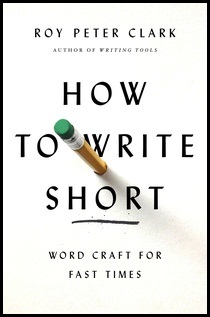
As many of my colleagues and clients know, as much as I enjoy reading, I absolutely hate writing. When I am required to write something, however, I have learned to be as brief and concise as possible–for me this works better, enabling me to get my point across without committing dozens of literary mistakes.

Now, my client Roy Peter Clark has published a book that tells us just how to do this effectively:

Ever since he came up with this idea, I have been excited – finally a book that I can use to improve whatever writing skills I have.

Writing short is what is happening these days, what with Twitter and all of the other social media messaging. But doing so effectively is definitely a different skill—especially for those who haven’t done it before. I think this piece by Roy which the New York Times published last week really says it all.

Certainly, following Roy’s advice has made me more confident in my writing skills. I am curious how other writers feel about the phenomenon of “short writing” given the growing importance of social media.

0

It’s just 15 minutes

I’ve always been a big fan of Laurie Halse Anderson’s books (cover image below for her upcoming new novel, which looks amazing).

I was speaking with my client Debby Lytton recently who was telling me about  a great post she wrote for her blog about the seven things she wish she’d known, and in it she links to Laurie’s 6th annual Write 15 Minutes A Day Challenge. Always up for a challenge and one that can help our blog readers, I wanted to share the details of this exercise (which is a few days in so get started asap!) and see how many of you can keep up with the challenge.

I know we’re all so busy but anyone can find 15 quiet minutes a day, right? I think the harder part is focusing and making it a truly productive 15 minutes. So, give it a try, give us some tips that worked for you, and see how long you can keep it up! Before too long, you’ll have an entire novel written, or at least a short story or article to pitch.

1

Behind the numbers

Looking at a royalty statement for the first time can be a little confusing. While the math is never hard, certain terms like “reserve against returns” and “subsidiary rights” can cause headaches where there needn’t be. The layout of a royalty statement is important too—an unorganized format can make reading a royalty statement ten times harder. Since there is no standard format though, I’ll just touch upon some basics.

Reserve against returns. Yes, most publishers don’t pay authors all the royalties they earn in the one period covered by a statement. The reserve against returns shows the amount withheld by the publisher for a limited period of time against the expectation of returns. This reserve is then released on later statements (assuming the book continues to sell).

Subsidiary rights. This is the section of the royalty statement that lists the revenue accumulated from rights that the publisher has sold to third parties. For example, this could include any earnings accrued by foreign editions of a book.

Unearned balance. An advance is simply that ladies and gentlemen. An advance. In order for a book to start earning royalties, it must first earn out the advance payment. Only then will an author see a positive balance. Negative balances are usually portrayed in parentheses.

Royalties earned. This amount depends on both the net units sold, as well as the terms stipulated in the author’s contract. Royalty rates range, but earnings are generally calculated based on the net or retail price of the book.

So those are some basics. Have more questions about royalty statements? Bring ’em!

3

Query letters that worked

As anyone who’s even been to a writers’ conference can attest, query letters cause no end of consternation and angst. That’s totally understandable, by the way—as the first introduction of a writer to an agent, it gets assigned a huge amount of importance. Plus, for a lot of writers, it’s a completely unnatural way of writing.

Going further, I think some of the frustration with queries comes from the lack of practical models—the generic queries you find in writers manuals tend to be so flat that they don’t offer much inspiration. And because the recommended query format is so basic—it’s really just intro, summary, and credits–writers often fall into the trap of thinking they need to fancy it up, and without concrete examples for guidance, the results tend not to work. On the other hand, cautionary examples typically are so laughably bad that they’re not really useful either, except for getting a rise out of a writers’ workshop.

So I was very excited to find this post on GalleyCat of actual query letters that landed authors representation. It’s a fantastic resource, and there’s a lot here that writers can learn, borrow or just plain steal. Better yet, the queries span a comprehensive range of categories—no matter what you’re writing, there should be a model here for you. At the same time, it’s worth looking at all of them, because reading them en masse reveals just how closely these successful authors hew to the basic query format, regardless of genre.  Finally, if you really want to get technical about them, several are even broken down and annotated.

And in terms of querying me: I’ll side with my fellow agents from GalleyCat that short, straightforward, and on-format works best, and for author/illustrators, always include either art samples or a link to a portfolio.

Happy querying!

3

Writing lessons via Shakespeare

I thought it was so cool when I heard that my longtime client, A.J. Hartley, was doing a panel at this year’s ThrillerFest on Shakespeare and what lessons we can learn from the old master’s ways. In his day job when he’s not writing smart commercial fiction, he is a world-renowned Shakespeare scholar and Shakespeare professor at UNC Charlotte.

Apparently I wasn’t the only one intrigued because the response to the panel was very enthusiastic. Writer’s Digest recently offered its readers some highlights which I wanted to share here. Much of the advice is practical, real-world and accessible, a strength of A.J.’s in his writing as well as his teaching.

A few examples of the gems you’ll find in A.J.’s advice:

*Good writers borrow…Great writers steal. Most of Shakespeare’s stories originated in other source material

*All scenes must have both internal and external conflict. “It’s not enough for the door to be locked. The character has to have a reason to not want to open it.”

*The dialogue says it all. Hartley pointed out that we tend to think of Shakespeare as a great philosopher, spouting off wisdoms—but that’s not the case. “Every word in Shakespeare is dialogue. It comes from character. … We do not know what Shakespeare thought about anything, and that’s what makes him good.”

It looks like there are a lot of things writers can take away from one of the oldest and greatest out there. And there’s so much more great stuff in this piece. Check it out and book your ticket to next year’s ThrillerFest where I’m guessing A.J. will be presenting another panel on this topic.

Hope you find someone useful that will translate to your own writing. Let us know.