Category Archives: backstory

0

Hello Instagram!

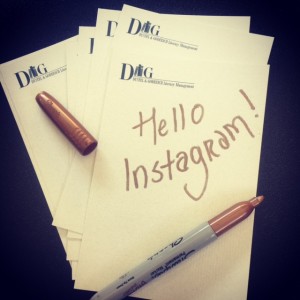
IMG_5811Introducing our brand new Instagram account: DGLMstagram!

You’re already following us on Twitter and Facebook, right? Now you can get an inside glimpse at all the excitement of the day-to-day life at a literary agency in pictures, as well as words. Expect to see book covers, author events, artfully arranged office supplies, holiday cupcakes, and more.

As you can see…we’ve already posted our first picture. What else do you want to see on our Instagram account? What are your favorite kinds of posts that other publishers, authors, or agencies share on Instagram? Let us know in the comments!

4

Behind the scenes of a bestseller

We are all looking for great books that will hit the bestseller lists. That’s the reality of being a book agent. There is nothing more exciting or rewarding than having a project you absolutely love be well supported by the publisher who acquires it and then subsequently embraced by the public who come out to buy it. In our dreams, this happens with every book we sign up. In our reality, it happens very, very rarely.

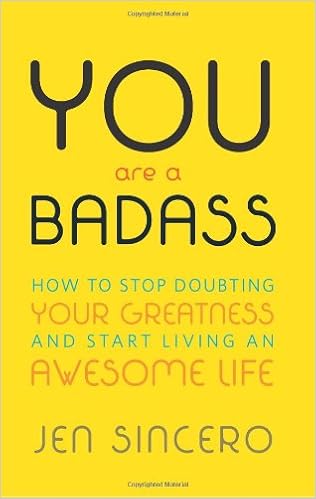
So, I like hearing about and sharing stories like this one about a nonfiction self-help book (a category I still do a lot of business in despite a very tight market for it) published in 2013 called YOU ARE A BADASS by life coach Jen Sincero that started off slow and has since become a surprise bestseller. It does illustrate that working hard throughout the publication process and beyond is critical for authors, as well as their publishers, if they want their books to be successful. Too often we see books come out of the gate slowly and never able to hit their stride due to a combination of the publisher withdrawing their support and the author slowing down their brand building and marketing efforts. I think that edgier books can really work in the current market, and I’m thinking about this one as well as the recent cookbook bestseller THUG KITCHEN: EAT LIKE YOU GIVE A F*CK, which also has profanity in its (sub)title!

I also think this approach translates to those who are seeking to be published in the first place. Often these roads are long and winding, and you need to be resilient and fierce in your efforts to both produce high quality work as well as your attempts to sell, market and promote it. Remember, you are a badass, like Ms. Sincero says, and clearly her message is resonating in a big way.


1

Stories Behind Stories

Every project has a tale–a story behind the story–and when I talk with potential clients, I always ask what brought them to the book they wish to write. The answers are often remarkable: I can only give a handful of examples (though this is a post that could go on and on) but learning the provenance of a given project is part of what I love about my job.

When his grandmother gave him a vintage typewriter that had once belonged to a distant, long-dead cousin, journalist Bill Lascher had no idea that it was a gift that would change his life. As it happened, the cousin had been Mel Jacoby, a dashing young war correspondent for Time Magazine who covered the opening days of WWII in the Pacific Theatre. Along with his new bride–a pioneering female correspondent named Annalee Whitmore—the newlyweds dodged Japanese bombs in the Chinese capital of Chongqing, narrowly escaped the fall of Manila, hunkered down in Corregidor with General MacArthur, and reported on the soldiers fighting desperately in Bataan. As Bill researched the history of this long-lost cousin, he became convinced that he had to write the story Mel Jacoby did not live to complete. A DANGER SHARED will be published by William Morrow in 2016.

In a similar vein, another of my clients, writer and scholar Diane Simmons, inherited a trove of yellowed, perfumed letters from a close family friend. When–a bit reluctantly–she dug into them, she found a story that beggared belief, an epistolary chronicle of a charming serial bigamist and his nine wives. She used that remarkable tale as the centerpiece of an examination of the changing roles of women before and after WWII. THE COURTSHIP OF EVA ELDRIDGE is narrative history and a detective story rolled into one.

When first I talked with her, psychologist and corporate coach Michelle Brody described the illustrated relationship book she wanted to write; she’d developed an effective technique in her practice in which she literally drew a picture of each of the dozen fights that all couples have. (Turns out Tolstoy was wrong, that even unhappy families are pretty similar). Her concept struck me as brilliant–12 stick figure fights!– but tricky to execute. Michelle was not an artist herself, nor had she created a proposal, but she did have a vision for the book. After expressing my enthusiasm for STOP THE FIGHT, as well as options for how we might proceed, Michelle vanished. But when she returned, more than a year later, it was with a complete manuscript. She’d hired an artist and created precisely the book she envisioned, and that’s the book I sold. Take a look at her smart, funny, spot-on website www.Stopthefightbook.com.  I challenge you NOT to recognize yourself in one of these fights.

I’ll close with the story behind the story of one of my memoirist clients, Qais Akbar Omar, author of A Fort of Nine Towers, who started recording his recollections of growing up in war-torn Afghanistan as a way of shaking off the nightmares that plagued him. Although English was not his mother tongue (far from it; he’d taught himself English from appliance manuals in the wake of the American invasion) he found that writing in English offered him a degree of distance from the traumatic events he recounted. For weeks, he locked himself in his room in Kabul and wrote. When he emerged, he handed off the hundreds of pages he’d produced to a friend, Steve Landrigan, an American aid worker and former journalist. Landrigan quickly realized that the book Qais produced was something far more polished and profound than the typical writing-as-therapy. The men found their way to me because I’d worked with Naguib Mahfouz, one of Qais’s all-time-favorite authors. They sent me the full manuscript and I was thunderstruck.The book has now been published to great critical acclaim, in more than a dozen languages around the world.

I’d love to hear your stories behind your stories—what brought YOU to the tale you wish to tell?

3

Stranger than life, larger than fiction

So, having spent close to a month as a sitting juror on a federal trial, I’m slowly recovering from the Stockholm Syndrome my fellow jurors and I experienced while cooped up in a courtroom every day, listening to lawyers drone on interminably, seemingly engaged in a contest to see who could make the most repetitive and tedious presentation of their case.

Sitting there day after day, trying to actively listen, even as my eyelids often felt like tiny weights were dangling from my lashes, gave me a new appreciation for legal dramas from To Kill a Mockingbird to The Firm to The Good Wife.  The fact that book and screen writers have been making trial proceedings as compelling and engrossing as they are (or can be in the right hands) is a testament to imagination and the ability to transform dull reality into if not art then entertainment.

A couple of days after the trial ended (with an acquittal in case you’re interested), Jane and I had dinner with David Morrell, who was shooting ideas for his new novel by us.  What struck me anew that night was that it is an alchemical process that transforms a snippet of a real story—whether historical or present-day—into the basis for a full-blooded work of fiction.  The mind of a gifted author takes that reality and spins a fantastic yarn out of it by picking and choosing elements  that are, in actuality, dramatic and entertaining, goosing action and motivation in the process.  The conclusion I draw is that real-life legal proceedings would benefit greatly from talented writers and skillful editors.  (I’m thinking that my trial would have been done in a week, tops, if it had been properly scripted.)

And, perhaps because I feel my lack of imagination would make for a sad fiction writing career, I always wonder how writers choose elements of real life and translate them into successful fiction.  Look at the current headlines in your local paper and tell me what novel you would write if you could rip one off for your fiction debut.   What are the nuggets that you would mine for a book that is more scintillating than my trial?


4

The backstory

Backstory is important, you’ll agree.  It’s what gives depth and weight to a narrative, allowing us to understand motivations and giving us context.  A common error authors make is letting the backstory overwhelm the narrative.  Then, it’s pages and pages of genealogy or irrelevant details about, for instance, the hero’s years spent kayaking in the Pacific Northwest, even if the novel is a legal thriller set in DC and having nothing to do with water craft.  Well thought out and incorporated backstory, however, is a joy.

Always having been intrigued by the part of the iceberg that hides beneath the water (to mangle part of a Hemingway quote), I also like to know the interesting arcana about the books themselves.  I like to know what the author was thinking, why s/he made the choices s/he did, what weird circumstances were taking place in the author’s life during the writing of the book, etc.   Being on our side of the publishing biz, we know a lot of books’ backstories—some funny, some sad, some sexy, some…surprising—and I always feel that they add a dimension to the reading experience.

If you’re like me in this respect, check out this clever and informative Buzzfeed compilation of weird book factoids, creation tales, and trivia.  My favorite?  Nabokov, notecards and butterfly nets in hand while creating Lolita.

What’s the weirdest thing you’ve learned about a book you love?

3

Making it last.

I was sitting in my favorite local coffee shop this past weekend when one of my favorite local coffee shop neighborhood friends stopped by as well. She sat down next to me as I was doing the crossword and pulled out the latest book she’d started reading. I don’t remember what it was, she wasn’t too sure about it either—she’d bought it on recommendation from one of the bookstore staff members and was none too keen on placing full faith in the reliability of said recommendation.

In any case, it was as she opened it up to the title page that I stopped her. There was an adorable stamp of one of those Victorian silhouette portraits and underneath, in simple block letters, it said “FROM THE LIBRARY OF [name redacted to protect the privacy of local coffee shop neighborhood friends].” I thought it was a great idea—not only to make sure that any person who may borrow or pick up the novel in the future would know to just whom to return it, but also as a mark of character.

One of my favorite things about used books—aside from the stories themselves—are the ownership markings, inscriptions, postcards that fall out, shopping lists and notes tucked away for safe keeping or bookmarking and promptly forgotten about. I have used books that I’ve bought solely for the inscription on the title page or for the personal notes scribbled therein. I don’t mean notes on the text—though if not too intrusive to my reading, those can be very fun, too—I mean the way you can just tell this book was owned, read, used and loved by someone before you. That the sentimentality and personality of a previous owner as well as the merit of the book itself can last for generations, too.

After exclaiming at my friend’s stamp, I vowed to get one of my own. I haven’t, yet, but it’s definitely on the list. My friend noted that one of her favorite things is adding her stamp to a book’s title page that already has a previous owner’s name, a library stamp, anything like that what have you. She called it a little catalogue of all the places the book has been and the people whose lives it has touched in any way—insignificant or otherwise. I thought it was a wonderful sentiment and agree wholeheartedly.

Old, used books are great for so many things, their “book smell,” the way they’re worn in, for possibly an outdated cover, but above all, it’s the reminder that many lives, not just yours as the current book’s keeper, can be touched by such a simple thing. What say you? Are you in the same camp or do you just hate any kind of mussing or marring on your literature? Go ahead, rant or wax poetic, Romantic, I’m all ears.

5

An author and editor chat

Like any relationship, the one between an author and his or her editor is nuanced and complex. We work in an industry that has a great deal of turnover on the editorial side and there are times when a multi-published author might have several editors within a house during their tenure. I actually have a client on my list that has done three books, and has had five editors!

So when I saw this interview on Slate with author Sarah Dessen and her longtime editor Regina Hayes (eleven books and counting), I thought it was pretty cool and worth sharing. I like Hayes’s thought on her role in the editing process: “To provide a fresh eye on the overarching story and to ask a lot of questions.” Since writing is a solo sport, it can become challenging to keep perspective on your work, and having another reader can be a really important part of the process. It doesn’t have to be a professional editor, although certainly if there is that opportunity it can be advantageous, but any number of beta readers who are good at reading and responding with constructive criticism can be helpful.

I also appreciated Dessen’s simple but important advice about writing: “Cutting is easy. Stretching is really hard. And just a bit of backstory can change everything.” In particular I’m in agreement on the part about backstory. You never want to be stuck asking why a character is motivated to act a certain way because something from their past has been left out of the story.

I’ve had the same intern the last few summers, and learned early  on in our working together that although she’s young, she has a good critical eye for material. Finding someone whose taste you can trust is a priceless commodity, and a good productive author/editor relationship is one to cherish. We’d like to hear your own stories of working with an editor and what that experience was like for you. Please share!