Category Archives: debate

2

Reaching A Younger Generation of Readers

This past spring, a few English majors from my college (including me) got the opportunity to have lunch with M. NourbeSe Philip, a Canadian poet and writer of all genres, and she asked the small group around her, “Do children still read books?” By books, she meant hard copy books, not digital versions. As some diehard English majors are wont to do, the table exploded in reassurances that yes, hard copy books were still very much present and who reads off Kindles/Nooks/iPads anyway? From there, we embarked on a cultural and social discussion about the importance of children holding a book in their hands, why hard copy books will probably always exist., etc.

Four months later, I started babysitting for a charming family who moved to NYC from Hong Kong with two gems of boys. (I’ve honestly never seen better behaved children in my life and they do homework when asked to without much griping. A dream!) My main reason for being there—other than giving their mom a break—is to get them to try and read more. Their mom mentioned with a wry grin that they prefer using the iPad or computer to picking up a book, and do you think you could install a love of reading in them, please?

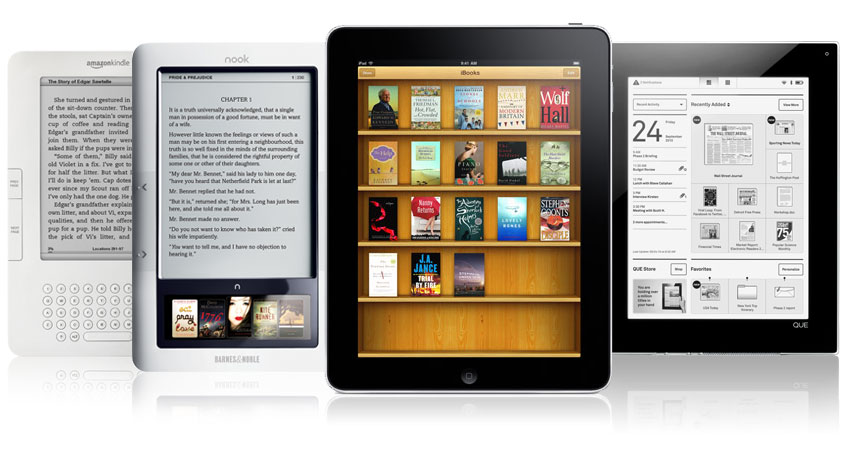
ipad-ereaders

As a kid who didn’t have access to digital reading, I’m a hard copy book reader myself. But I’ve found myself reading manuscripts on my iPad because those are digital and it’s a matter of convenience. The majority of people I know who are big readers have some kind of digital reading device. And last summer, I had a conversation with an agent at another literary agency about audiobooks and how to reach a wider, more digitally driven audience. “Certain demographics,” he said, “aren’t going to pick up a book. They’re going to be plugged in. How do we reach them?”

I think I’m going to bring my small charges to the Strand and turn them loose. I’m hoping that being surrounded by books will get them excited to choose a book to bring home. (So yeah, it’s a little bit of bribery, but you know. Babysitting is half bribery, to be honest.) Fingers crossed that somehow in my time with them, they start being enchanted by books they can hold and smell and turn pages in.

So that being said: any suggestions for books for active boys around ages 5 and 7 who love soccer, Legos, and have lived in two countries already?

Any predictions on how kids will be reading in ten, fifteen, twenty years?

23

The R Word.

On Friday night, I went to see a screening of the movie Dear White People, a wonderfully funny and warm but still very biting comedy about race relations on an Ivy league campus. (“Dear White People, the amount of black friends required not to seem racist has just been raised to two. Sorry, your weed man, Tyrone, doesn’t count.” ) The filmmaker, Justin Simien, said that he wants the movie to start a conversation—nothing gets better without a dialogue. He also cited as his inspiration great black cinema of the ‘80s and ‘90s and movies like Do the Right Thing that had things to say and left you feeling not just entertained but moved, sometimes uncomfortably so.

So race was at the front of my mind the next day when I went to the NYC Teen Author Book Festival to see some of my authors present on different panels. The audience was probably 90% white women in their 30s and 40s. This is an observation, not a judgment. But it’s something I kept thinking about because in the middle of New York City, that’s an awfully homogenous crowd.

I was not alone thinking about race that day. One of panels was called “Summer Reading” and the four authors discussed their novels, each set during the summer. At the end, an audience member stood up to say that she had been at the festival for two days and only seen one author of color. She also mentioned that she works with underprivileged teens in Hartford whose summers wouldn’t at all resemble those in the books being read from. She wanted to know what the panelists had to say about that.

It was an uncomfortable moment not just because a big issue was being raised but because my first thought was, “These four authors have nothing to do with planning this event and shouldn’t be asked to speak to such a large issue when they were just there to talk for five minutes about their particular novels.”

That’s a lie. My first thought was, “Please don’t let my client say anything stupid.” Listen, I’m an agent. It’s just in the bones.

Happily for me, my client on the panel, Gae Polisner, actually had a very thoughtful response, explaining that she writes fiction that comes from a very internal place and that her leads resemble her because she can only write from a place she knows and understands and just hopes that she touches on truths universal enough that they’ll resonate across the broadest spectrum of people possible. That is a great answer for an author. It does, however, leave some great big questions for an industry. Take a look at these articles by Walter Dean Myers  and his son Christopher Myers.

Those articles were spurred on by a study by the Cooperative Children’s Book Center at the University of Wisconsin showing that of 3,200 children’s books released in 2013, 223 were by authors of color, and 253 were about people of color. That’s less than 7%. To give some perspective, nationally, approximately 27% of the population is people of color.

Happily, I have easy answers to this diversity gap.

Ha! Just kidding. I don’t have easy answers. I actually don’t have any answers—just more questions. Like where is the root of the problem? Is it in the largely white make-up of the publishing industry? Are we weeding out material by and about experiences we simply don’t understand? Is there an institutional racism that hasn’t been broached yet? Is the problem that people of color aren’t encouraged to pursue careers in writing? Is it possible that there aren’t enough of these books being published because there aren’t enough being written? And, perhaps my own biggest question: are we too overwhelmed or scared to ask these questions because we don’t know what we’ll uncover about ourselves?

I won’t lie—I almost scrapped this blog post several times. It makes me nervous to bring up such a big subject because I don’t want to get it wrong. I don’t want to offend, and I don’t want anyone to cringe while they read it. But in the spirit of Dear White People, let’s do it. Let’s have the conversation.

4

Literary letdowns

I’ve recently heard from some friends who have been disappointed with critically-acclaimed, wildly popular books. In some cases, I’ve recommended the book on the wrong end of a vicious verbal barrage. Imagine this:


Toss in a few more obscenities for good measure and now you get what I’ve been dealing with recently. First it’s THE CORRECTIONS by Jonathan Franzen. Next, it’s INFINITE JEST. Even a couple of my most memorable childhood books have been slandered during this, the merriest time of year. If one more person puts down ENDER’S GAME or HATCHET

At first I thought my friends were being a little too harsh. They couldn’t see any of the, ahem, silver linings, in the aforementioned books. Then I thought back to those times I too had experienced that hollow feeling that follows the breaking of high expectations. We’ve all been there. Every one of us has cracked open a book hoping to turn that last page, clap the back cover closed, and look up to a new world with a fresh perspective.

It rarely happens. And we’re let down. Now’s the time to share. Let’s get all of the whining out the way right now and enjoy the rest of the holiday season. What books didn’t live up to your expectations?

2

Memorable characters

One of the greatest television shows of all time ended Sunday night. Breaking Bad wasn’t incredible because of its cinematography, its acting, or its storyline—though all contributed to the brilliance of the show. It was its characters, one in particular.

Walter White. Heisenberg.

It’s not a new story. Well, not completely. Breaking Bad is, at its core, the story of a man who, little by little, loses himself to the darkness within. The progression is always gradual, and the trick is making it seem natural, but some of the greatest (and by greatest, I mean my favorite) characters in literature wage this type of internal struggle. As readers, we love emotional turmoil. We can relate to it. It’s what defines us as human beings.

Some of my favorites:

Rand al’Thor from Robert Jordan’s THE WHEEL OF TIME series is driven insane as the series progresses.

Sir Arthur Conan Doyle’s Sherlock Holmes is literature’s greatest detective, yet Holmes is a struggling drug addict and habitual tobacco user, habits that threaten his trademark deductive capabilities.

LORD OF THE FLIES by William Golding. Pick a character, any character.

There’s a few. Let’s hear others. Who are your favorite characters?

6

Survey says

There is nothing I like better than a survey. I mean it. When I was younger, we would get these big consumer packet surveys mailed to our house once or twice a year and I couldn’t wait for my dad to get home so we could fill it out together. Answering really cool and interesting questions about things like what brand of paper towels we preferred and how often the family went grocery shopping. I’m not kidding, I lived for those.

So, when Publishers Weekly posted their Great Big Reading Poll yesterday, you can bet that contributing my answers was the highlight of my day. (Okay, now that might be a bit of an exaggeration). In any case, surveys are super fun and no matter the subject, the results are always interesting on some level. When you combine surveys with things about books, though, then, well, you’ve got me hooked.

While the questions PW poses aren’t revolutionary, they are indicative of the types of things that set readers apart from one another. One thing about surveys that’s a bit frustrating (and the reason I always hated multiple choice tests in school) is that you don’t get the chance to explain yourself. So, below are some of the questions I wished I could have explained to PW when I was answering!

Do you write in your books?
Generally, I do NOT—though I always wished I was the person who did. There’s something romantic about the image of the intellectual, dreamy reader who is so inspired by their books that they can’t help but get physically involved. There are a few books I have with half-hearted underlines, hearts, stars and exclamation points, but they are far and few between. The only book I have that is thoroughly marked up (and helpfully so) is my copy of Ulysses—it’s the notations that let me read and re-read it to my heart’s content without any confusion.

How do you save your place?
I was a dog-eared girl growing up, occasionally a face-down-on-the-table kind of lady, but now it’s strictly bookmarks. I have no idea what prompted the change in ideology, but now, though I harbor no ill-will or disdain towards anyone who is a page-folding, spine-breaking reader, I can’t bring myself to do it.

My bookshelf is…
Hah! I would say arranged by a method only known to me (and my roommate), but that only happens when we get in a crazy “let’s organize all these darn books!” mode and then, active readers that we are, constant taking out and putting back of books kind of messes up every single system we’ve ever come up with.

How many books do you read at once?
Counting only books read for pleasure, I’m definitely a one book and only one book kind of reader. I’ve tried reading more and sometimes it works, but I just start to feel bad for whatever book I’m not reading at the moment. Like I’ve hurt its feelings. Okay, let’s stop talking about this now.

Do you read used books?
A no-brainer. This isn’t to say that I don’t love a good brand new book all crisp and just mine, but guys, books go out of print all the time. Sometimes the only option is a used book, sometimes they’re just cheaper, and used bookstores are treasure troves of exciting things you never would have looked for on your own. There’s nothing better than buying a good book with a personal inscription in it, either, in my opinion.

I’d love to know what questions you liked best as well as those that could have really done with an “explain here” box below them. Tell me in the comments!

The best of all possible worlds

Last night I walked a couple of blocks down Fifth Avenue to the brownstone home of the Salmagundi Art Club for a panel discussion of “Publishing in the Digital Age” hosted by the Deadline Club.  It was a miserable evening, weather-wise (as soon as I walked out the door of 1 Union Square West, the heavens opened, cabs splashed water as I waited for the lights to change, and my hair took on the proportions of Diana Ross’ favorite wig), but the panel discussion was lively and informative.

The question on everyone’s mind seemed to be “Should we panic about the state of the book business in the wake of the digital revolution or do we dare be optimistic.”  Our job on the panel was to illuminate the big issues preoccupying publishers and authors while attempting not to freak anyone out.  Overall, my fellow panelists and I were quite optimistic about the opportunities digital publishing affords while still admitting to twinges of regret over the passing of the traditional, wood paneled, musty smelling industry we all came of age in.

The optimism on our end came down to “choice.”  Authors have more choices now than they ever did.  They can self-publish easily and relatively economically if they choose or they can go through the traditional channels and, if that doesn’t pan out, go back to the idea of self-publishing.  Before e-books, if an author was rejected by enough agents and publishers, the idea of printing and distributing his or her own work was a daunting one.  Now, it’s a relatively painless process.

So, how is this good news to us inside the industry?  Well, what empowers authors usually empowers agents and, perhaps to a lesser degree, publishers.  Publishers and agents still provide an invaluable service in terms of curating literary material.  We still bring experience, love of craft, and critical acumen to bear on the process of book making and we’re pretty good at it.  And, authors and readers know this.  While self-publishing is now a thriving business, traditional publishing continues to publish more (digital and print) books every year.   And readers continue to buy these curated products.   Despite the perception of the business as the Titanic wildly trying to skirt the iceberg, publishers are making real efforts to keep up with the changing times so that they can bring their traditional talents to bear on the work authors are producing today.

Not to get all Panglossian about it, but isn’t this the best of all possible worlds?

Why some authors hate publishers

A long-time client, who is very dear to our agency, pointed us in the direction of a piece by Michael Levin in the HuffPost that I’d missed when it ran last week.  Our client was distressed by Mr. Levin’s assertions about the nefarious tactics mustache twirling publishers use to victimize authors.  Understandably, since Mr. Levin writes with such passion and seeming authority, she was concerned that the picture he paints is an accurate depiction of the culture of book publishing as 2012 draws to a close and we count down to the  Mayan apocalypse (which, of course, if it comes to pass will make this discussion irrelevant).

After reading the piece Jane and I had basically the same reaction which boiled down to “Why do the people talking trash about our business always seem to be the ones who understand it the least or who have a bag full of sour grapes they’re carrying around with them?”  And, then I got all happy because I didn’t have to scrounge around looking for a blog topic this week.

We promised our client that we’d go through Mr. Levin’s arguments and respond to them from our point of view and this, more or less (with my usual digressions and irritating asides), is what I hope to do here.

Mr. Levin’s argument boils down to four salient points:  (1) Publishers hate authors even though authors and the work they produce are their lifeblood. (2) Publishers are reducing advances and royalties across the board with the added perk of also reducing marketing and promotion for their titles. (3) Publishers’ dependence on BookScan (the tracking system for sales) guarantees that unless an author has a boffo success, their career is over faster than you can say “reserve for returns.”  And (4) by lowering the quality of the product because they refuse to pay what good authors are worth, publishers are ensuring that the public stops buying books and turns to other sources (the Internet) for their information and entertainment kicks.

Alrighty, then!  This should be quick(ish).

(1)   Publishers are the partners and adversaries of agents.  We work with and against them for the good of our authors, who have our first allegiance.  That said, most publishers (and the term includes all the people who make books happen at a publishing house from the CEO to the intern who opens the mail) we deal with daily, sometimes hourly, are incredibly hard working, thoughtful, engaged, and compassionate.  I’ve said this before and it bears repeating, very few people go into our business to achieve their dreams of Trump-like wealth.  Salaries are low in publishing compared to those in other media, and the work is painstaking and, often thankless (Exhibit A: Mr. Levin).  Publishing types do their jobs—which entail long hours after they’ve left the office sitting with a manuscript that needs to be shaped on a granular level—because they LOVE books.  Period.  With all the challenges publishers are faced with in this increasingly digital world, the level of care they bring to the curating of great (and even not so great) books is impressive.

(2)  Not sure which publishers Mr. Levin is talking about but our agency has had its best year ever.  We’ve sold over 100 books this year and have been paid advances, ranging from five to seven figures, on every one of them.  Perhaps there are some tiny houses that are embracing the “no advance” model but we work with the Big Six as well as many, many smaller independent publishers and have not seen this no-advance/lower-royalty model Mr. Levin describes.

(3)  We depend on BookScan too when we are considering signing up an author.  It’s a tremendous tool that lets you know what you’re up against when trying to find a new home for a previously published author whose book didn’t do well.  Has BookScan ever been a deciding factor in not signing up a book?  Probably, but only if we were very much on the fence about it anyway.  I’d venture to say that this is the same process publishers go through because we’ve had numerous authors whose BookScan sales, how to put it delicately?, were in the toilet and we still sold their next book and the book after that.  Bottom line, if your next idea is great or your genius undeniable, or your platform has reached critical mass, BookScan will not destroy your career.

(4)  Really?  Take a look at the best books of the year lists that are cropping up all over the place right now and tell me if you think important, brilliant, exciting fiction and non-fiction isn’t being published any more.  And, given the fact that book sales have risen in the digital age, it seems that a new generation of readers is turning to…books…for their information and their entertainment kicks!

Seems to me that publishers don’t hate authors any more than authors hate publishers.  In this complicated new world we live in, we all (on both sides of the business) need to take responsibility for our own failures and flaws as well as advocate for our strengths and successes rather than succumbing to paranoid fantasies about how much “they” hate us.

4

Television and Novels: A Love Story

I came across this fascinating article in The Chronicle of Higher Education and simply had to share it. It  accounts for the evolution of arc television (ex. Breaking Bad, Mad Men, Boardwalk Empire, Game of Thrones) and highlights the similarities between these types of shows and other creative media. I have to admit, the title, “Storied TV: Cable Is the New Novel,” threw me for a loop at first. I thought this piece was going to propose that these wildly popular and critically acclaimed series are on the road to replacing novels, but after reading it, I don’t think this is what the author intends to suggest (even if some of the people who commented disagree). In fact, it seems that the author is comparing the television vs. motion picture dispute (until now, films have undoubtedly beat television in terms of status, merit, and praise) to that of the new journalism vs. novel debate from the 70s.

In fact, the author of the piece, Thomas Doherty (a writer, among other things) points out what makes these television shows as enthralling as a great novel: “Like the bulky tomes of Dickens and Dreiser, Trollope and Wharton, the series are thick on character and dense in plot line, spanning generations and tribal networks and crisscrossing the currents of personal life and professional duty.” In the comments, someone even points out that several of these shows were actually based on novels. This brings me to my question for you, the readers: Think about your favorite novel. Would you rather see it as a television show following the format described above or as a big screen debut?

3

Books as Art

The outrage surrounding MTV reality starlet and YA author Lauren Conrad’s destroying some of Lemony Snicket’s books on her DIY craft show to make them into storage containers has reignited the debate over books being used as non-reading materials. Rebecca Joines Schinsky of Book Riot posted about this and makes some really great points worth considering if you find yourself appalled by Conrad’s actions. For one, Schinsky notes that people love books for the stories, not the medium in which they’re delivered—most evident nowadays in the success of digital publishing. On top of that, she quotes Rachel Fershleiser—author, former bookseller and publicist, who has the publishing experience and no-nonsense attitude required to set the record straight—that books that don’t sell are often recycled. So, why shouldn’t creative people use them as they see fit?

Now, there are a couple of things that certainly don’t help Conrad’s case. The books she destroyed were Lemony Snicket’s. Lemony Snicket, people. The girl writes YA and doesn’t appreciate a modern classic children’s author? And storage containers? Really? Not the most original or useful endeavor. If, however, you don’t see the problem with that, check out The Repurposed Library by Lisa Occhipinti or Playing with Books by Jason Thompson for some truly great ideas.

And if you’re as fascinated by a celebrity feud as I am, take a look at Lemony Snicket’s amusing response here.

eBook Piracy

In a digital publishing world, how do we deal with piracy? Authors and readers alike have strong opinions about piracy, DRM (a special kind of coding that is added to some eBooks so you can’t do things like copy and paste or print out an entire eBook), and how to stop eBooks from being stolen. And some have more creative solutions than others. The Guardian recently shared this piece about author Terry Goodkind and his own special brand of revenge. After finding a pirated copy of his self-published title THE FIRST CONFESSOR: THE LEGEND OF MAGDA available online, Terry took to his Facebook to out his pirate to fans and publicly shame him for stealing the eBook (including posting a photo of the alleged pirate).

And it worked.

The pirate removed all of his links to Goodkind’s book and Goodkind considers this a victory.

The question is: should we be castigating people who make pirated eBooks available? Or, as Paul Coelho believes, does piracy stir readers’ interest and sales? Goodkind believes it removes any incentive to legitimately purchase an author’s work. What do you think? Should authors put a lot of effort into combating piracy?