Category Archives: titles

0

What’s in a name?

As it turns out, a lot.  Because titles can’t be copyrighted, same or similar ones pop up with surprising regularity despite best efforts by authors, agents, publishers, filmmakers, and playwrights to come up with something original.  That, of course, is not always a bad thing, as evidenced by this report from Galleycat.  A. J. Waines’ Girl on a Train is benefiting from the confusion of readers who were looking to buy Paula Hawkins’ bestseller The Girl on the Train.  The sales of Waines’ book have spiked and some readers don’t seem to mind the mix-up as they enjoyed their reading experience.

We spend a lot of time giving feedback to our authors on titles and it’s never not tough.  A good title resonates with a book buyer.  It makes you either “get” the category/subject matter immediately or it puzzles you enough that it makes you want to find out more.  It’s either straightforward and catchy or confusingly oblique but still memorable.  Depending on the category you are working in, a strong title can go a long way in helping to market the book.  And really, anything goes—Cryptonomicon, anyone?—as long as it’s intriguing in the right way to the right group of readers.

But while everyone tries to be unique, duplicates and triplicates abound.  Even after searching Amazon for similar titles in your category, there’s no guarantee that the same one won’t pop up in another genre.  Case in point (one is a novel from DGLM client Libby Cudmore due out in 2016; one is a memoir from 2010):
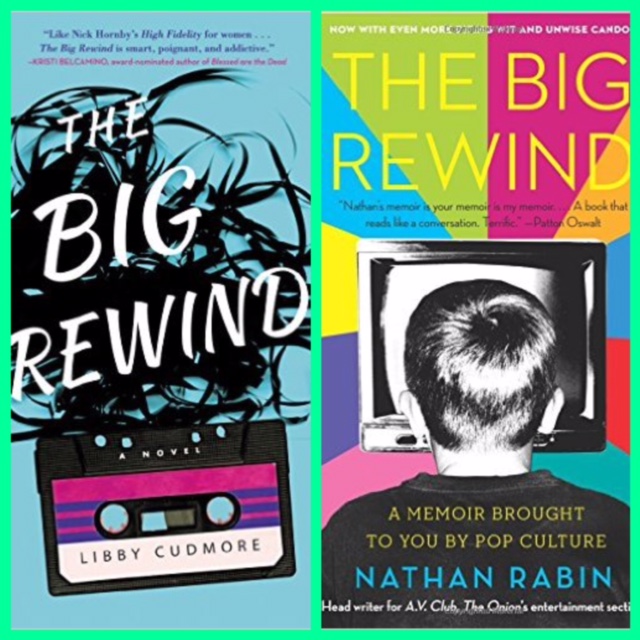
Big Rewind

Hey, a good title is a good title is a good title.  As long as you’re not intentionally trying to draw readers away from another author’s work by using their title, no harm no foul (at least as far as copyright law is concerned).

What books can you think of that share same/similar titles?

1

A Good Title is Hard To Find

It may be that a rose by any other name would smell as sweet. But outside the world of doomed adolescent lovers, the names of things matter, and finding the right title is crucial. A well-chosen title reflects and subtly positions the book, but finding les mots justes–that’s always tricky. My client, debut novelist Beth Hahn, blogged about the experience of letting go of her original title—THE SINGING BONE—in favor of DARK EYES.

“I got to keep THE SINGING BONE through editing and even saw the manuscript’s final version with title intact, but then, at some point–I think it happened during tip sheet review–there was a pause, and someone questioned my title, wondering if it were too literary, too mysterious, too–oh, but those were the very things I liked about it. Anyway, the publisher worried that readers wouldn’t know the how to interpret THE SINGING BONE, and truthfully, I had noticed this when I told people. “The Singing what?” was not an uncommon response.

I guess I could have fought for my title, but then, honestly, I sort-of knew why the title was being changed, so I began to think of the title change as a further relinquishing of my book. Yes, THE SINGING BONE was my novel’s title, but when a book is sold, it belongs to everyone–to editors and art directors and readers, too, to libraries, and to strangers who would not get to ask me, “The Singing what?”

Finally, I got an email from my editor: “What about DARK EYES?” he wrote. It was clean, relevant. It screams “Mystery/Thriller.” I’d thought of DARK EYES, but I’d been too literal with it. The darkest character in the book, Mr. Wyck, has blue eyes–light blue eyes. But the song “Dark Eyes” cuts a strange path through the novel, turning up in different scenes and carrying plenty of psychological and emotional weight.”

I’m in the midst of helping another client and his editor come up with a new title for WWII-era narrative nonfiction. Our marching orders are to find: “Something with zing. Something that sounds dangerous and romantic. Something that’s catchy and rolls off the tongue. Especially something that is not generic.” Whew! Settling on a title that both the author and the publisher love can take a while, but the effort is certainly in the book’s best interest.  Sometimes a title emerges from the text itself, a particularly resonant line or quotation.

Where and how do you find your titles? How often in the writing do you switch gears?

3

My Fall/Winter Reading List

I’m really excited for pretty much every upcoming fall/winter book, but I know I won’t have a chance to read everything I want to. I don’t have enough time. So I have narrowed my blog today down to the following selections that will take precedence on what looks to be a very ambitious reading list these next few months.

A debut novel from a talented writer about a young woman growing up in a poor Irish family with a stream of consciousness narrative. Definitely worth a look.

Howley’s year-long immersion following two MMA fighters sounds fascinating. A captivating narrative that analyzes the philosophy behind MMA fighting is sure to raise some eyebrows.

I love NPH. He’s extremely talented, not to mention the clever structure of this book. I expect great things, but then again, I never expect anything less from NPH.

Yes please, I’ll have a copy. She’s funnier than Tina Fey–don’t let anyone tell you otherwise. Parks and Recreation is hilarious.

Because how could I not read Louis Zamperini’s autobiography after Hillenbrand’s Unbroken?

A unique World War II story about the brutal murder of a Japanese family and those investigating it. Ellroy’s latest is receiving a lot of buzz. Color me intrigued.

Honorable mentions:

LACY EYE by Jessica Treadway

I’ve already read this book, but wanted to include it hear because I strongly recommend it. A suspenseful, haunting read.

TO RISE AGAIN AT A DECENT HOUR by Joshua Ferris

Published this summer so not technically a fall/winter book, but Ferris’s novel has been on my list for a long time and was recently shortlisted for the Man Booker Prize in 2014.

What are you most excited for this fall?

1

The name game

There’s nothing quite like starting off a new season with a book sale, particularly in Autumn, when the summer’s lethargy fades and it feels like everyone in publishing is back on the hunt for new work. And happily enough, I was able to place a middle grade novel that I absolutely loved, made even more gratifying by the fact that, full disclosure, it took quite a while to find its home. But back-patting aside, I wanted to share this story because it speaks to the importance of a really good title.

So, the first time I sent the novel around, it had what I thought was a snappy title—two words that rhymed, which seemed quirky and fun, plus it came from a line in the book, which is always a good thing. Yet, on the first round, despite some enthusiastic reports and near misses, we didn’t end up with a sale. And after enough passes, for which a lot of editors said the same thing, the author and I decided to table the novel for now and work on something new.

But then, a few months after we put it aside, the author came back to me and asked if we could try again with a new title. He just had a feeling that the original title wasn’t quite representing the substance and tenor of the book. Instead, he suggested a three-word phrase that was much more literary and ambiguous, though still taken from a line in the book. So, we gave it another shot, and lo and behold, the offer came in about a month later!

Now, there could certainly be many other variables here at play—the timing of the submission, not finding the right editor until late in the game, the holes in the editor’s list, etc. But I do think that the new title reframed readers’ expectations about what was inside and put them in a different mindset when reading it. Yes, titles can be a struggle, and since publishers almost always contractually control the title, the struggle can seem counterproductive at times. But I hope this story shows how important it is to find a title that truly reflects the book—and at the same time, if the title isn’t quite working but the content’s there, a title change just might be what the doctor ordered…

3

Bad Titles and Binge Reading

Nominees for the little-known but totally inspired Diagram Prize (an award dreamed up by some publishing professionals to forestall boredom at a Frankfurt Book Fair) have just been announced.   The Diagram honors the “oddest book titles of the year.”

“The first winner of the prize was Proceedings of the Second International Workshop on Nude Mice. Other winners throughout the years have included How to Avoid Huge Ships, Cooking with Poo, and last year’s Goblinproofing One’s Chicken Coop.”

You can find the 2014 nominees here. I’m partial to Pie-ography: Where Pie Meets Biography, which combines two of my favorite things.

I looked around on my own bookshelves in search of overlooked competitors, and aside from some academic books (which seem unfair to single out, since awfulness in titles is a skill that scholars are required cultivate) the oddest I came up with Neil McFarquhar’s book, The Media Relations Department of Hizbollah Wishes You a Happy Birthday. 

I’m sure you can do me one better.

Another article I spotted—this piece by Julie Bosman— prompted some debate on whether binge watching TV has changed the way we engage with books.  I grant that publishers are keen to publish commercial fiction more quickly, but otherwise, I’m not yet convinced.  On the contrary, it seems to me that TV has finally caught up with books in allowing its viewers to do what any self-respecting bibliophile has long done—stay up impossibly late, shirk all other responsibilities and go on a bleary-eyed bender till the final bittersweet page. And beyond.  The truly intemperate can move on to an author’s entire oeuvre. Well before I was downing Downton Abbey in greedy gulps (I came to the show very late) I’d gone on an Evelyn Waugh tear.  Just reading his books can damage your liver.

In any case, what do you think? Is binge reading books a byproduct of Netflix-ation  and Amazon’s single click culture, or does it have a longer and more storied history?

7

The not so subtle subtitle


Yesterday I sat down with two clients and their editor for a pleasant meet-and-greet and to discuss their recently acquired work of nonfiction.  We talked about the editorial process, the production schedule, cover,  interior design and title.   The only hiccup arrived when we got to the subtitle. The suggested copy was, in the estimation of the authors, just a little over-the-top.  In particular, the subtitle seemed to intimate that the book’s contents would Change Its Readers Lives. Forever.

The authors wanted the offending lines replaced with something a little more modest, less hyperbolic—some phrase rendered in a tone more wry and recognizable. They offered to come up with some alternatives. The editor was amenable, and we all agreed to reconvene our discussion over e-mail, where we could bounce ideas off of one another. I don’t know about you, but I cannot properly consider a title or a subtitle until I see it written down, and I think best alone and in front of a keyboard.

I’ve been mulling over possibilities and I’ve yet to come up with the precisely-right phrase. Subtitles are tricky because they must 1) capture the content of the book and 2) convince a person to buy it.  I also I feel a bit conflicted.  The reader/consumer/book buyer in me knows better than to believe the overheated rhetoric of subtitles, but 15 years in the publishing business makes me wonder if we are quite ready to dispense with overstatement. More humble assertions like “this book will leave you largely unchanged, albeit with slightly less free time” well, there’s not much appeal in that. What do you say? Would you be as drawn to a book that promised to be only “mildly interesting” or “easy enough to read?”  Do you find subtitles off-putting or inviting?

Perhaps it’s just me, but I suspect that these breathless, over-earnest subtitle pledges, calculated as they are, also speak to the secret wish of every reader.  The desire to find that magic book—the one that does blow our minds, change our lives, the story, true or imagined, that affects us in some powerful, primal way.

4

Sock Patterns and Office Chairs

Although I’m a bit late for April Fools, a little silliness seems in order on this sunny spring day: Moby Lives, the blog connected to indie publisher Melville House, features the winners of the Oddest Book Title of the Year. http://mhpbooks.com/oddest-book-title-of-the-year-award-winner-named/ Although the winner was a Thai Cookbook from Australia titled Cooking with Poo (prompting me to wonder whether my six-year-old son was among the judges) I was more partial to four.


2. Mr Andoh’s Pennine Diary: Memoirs of a Japanese Chicken Sexer in 1935 Hebden Bridge by Stephen Curry and Takayoshi Andoh (Royd Press)
3) The Great Singapore Penis Panic and the Future of American Mass Hysteria by Scott D Mendelson (Createspace)
4) Estonian Sock Patterns All Around the World by Aino Praakli (Elmatar)
5) The Mushroom in Christian Art by John A Rush (North Atlantic Books)
6) A Taxonomy of Office Chairs by Jonathan Olivares (Phaidon)
7) A Century of Sand Dredging in the Bristol Channel: Volume Two by Peter Gosson (Amberley)


As this list perhaps does not reflect, but as we all know, coming up with titles is apallingly difficult.  Or rather, coming up with effective titles is difficult, though I cannot help but think A Taxonomy of Office Chairs is awful by design. A Century of Sand Dredging in the Bristol Channel: Volume Two is so bad it’s brilliant.  A good title is crucial, both for the purposes of selling a book to a publishing house and thereafter for attracting a book-buyer/reader.  Regardless of the degree to which my client and I believe we have come up with the precisely right word or phrase, there’s a good chance our title may change. Not only the acquiring editor, but the publisher, the publicity department, and the sales and marketing teams generally weigh in, and with so many cooks in the kitchen, it’s sometimes hard to create a wining recipe.  One editor for whom I worked swore by the racing forms: from scanning the names of the colorfully named thoroughbreds she could arrive at a title.

How do you proceed? I know some writers begin with their title, which–in the wake of yet another title brainstorming session–I am beginning to think is the right approach.  How about you? How and when do you come up with a title?


6

A Rose by Any Other Name

It’s a well-known phenomenon that writers, artists and other creative types alike are, at the very least, incredibly close to their work. The tiniest change in detail, a spot of color there, a preposition change here means a great deal to the creator. It should only rightly follow, then, that the title of a book goes under a great deal of change and scrutiny and causes much consternation. Visual artists can get away with calling everything “Untitled #__,” but writers have this dilemma of having to use words. And we all know how hard it is to get words exactly, 100% beautifully right!

Despite all of this, it’s hard to imagine old favorites or tried and true classics ever being called anything else. I came across this article in Publishers Weekly yesterday (okay, Lauren showed it to me) revealing what the working titles for many old standbys were. Of course James Joyce would be super secretive about Finnegan’s Wake, and though I’ve never read more than 3 pages of the book before throwing it across the room, I can see where Work in Progress would have been applicable. The book does start in the middle of a sentence…

I love that Who’s Afraid of Virginia Woolf? had to be changed to Who’s Afraid of Franz Kafka? in Prague for contextual and political reasons and I really, really, really wish that The Great Gatsby was called The High Bouncing Lover. Alas.

Could any of the “great books,” or even just famous books do with a better title? How many titles do you end up going through before settling on the perfect one? Can someone please write a book and call it The Terror of the Monster?

Title Help

Since I am short on time and in need of assistance, I thought I’d kill two birds with one stone, blog about what I’m working on, and enlist any help you might offer.
Right now, I am scouring the works of the Russian poets Pushkin and Lermontov in hopes of finding a phrase that might serve as a title for novel that I sold, an epic tale set in the Imperial Court of Russia. As I try out various phrases, it’s once again clear that finding a suitable title is tricky business. The book was originally published in French, but like so many direct translations, its title (All the Honor of Men), which is taken from a quote, does not quite work in English. It also sounds a bit too masculine for a work of historical fiction that has at its heart as star-crossed set of lovers as ever existed.

I’d like something that sings, zings, and otherwise announces itself as a humdinger of a title. Since I can’t ask that you read the book (well, not at this point anyway) I’d love to hear your nominations for recent terrific titles. Maybe your suggestion will inspire a breakthrough!

6

Better titles!

by Jim

Jessica Regel tweeted this wonderfully entertaining blog today that gives some books slightly more accurate titles. Can anyone argue that Franny and Zooey could be retitled Wealthy and Mopey?

And wouldn’t it be easier to choose books if their titles were pithier and more to the point? British Battle Royale…that’s not just a title—that’s a book pitch!

Of course, there’s the immortal My Teacher Ruined This, which here stands in for Wuthering Heights. But don’t we all have a book that a well-meaning English teacher somehow overanalyzed to the point where the reading of it became a deep, dark slog? I still need to try reading The Great Gatsby again outside of the tortured process of high school English class. How about you? Any books that were tortured beyond recognition in your past?