Category Archives: reading

4

Stop buying books? Never.

by Lauren


The ever entertaining Laura at Combreviations was inspired by a Guardian blog entry to recount her year of not buying books: a year in which money woes meant reading all the books she already had.  The horror!

I’m a pack rat perpetually lured by the siren song of materialism to own an awful lot of things that I don’t, perhaps, need to permanently possess.  I rarely get rid of books I’ve read and dislike.  I get a bit twitchy when items loaned out don’t get returned, even if I don’t have any need for them back.  And if I love it, I simply must give it pride of place. 

I certainly don’t want people to stop buying books simply because they don’t need to (if they did, how on earth would I make money to buy all the books I want to buy?), but I am sometimes alarmed by the sheer percentage of books in the teetering piles that I have not and, let’s face it, will not ever read.

When this happens, though, I just resolve to read twice as much, to continue to justify my spending.  And with a weekend of rain and a day’s wait for the cable guy looming on the horizon, it’s nice to have the reminder to aggressively get through at least something the next few days to make room on the to-be-read pile for the six recent purchases threatening to fall off my desk here before I get them home.

7

Capturing the present

by Lauren

Since reading this Guardian article from earlier this month featuring Julian Gough’s criticism of fellow Irish novelists, I’ve been feeling torn. On the one hand, I do get his point that contemporary Irish novelists tend to be backward-looking, that “reading award-winning Irish literary fiction, you wouldn’t know television had been invented.” Yet, as a book lover with a Masters in Irish Studies and an on-the-record Colum McCann fanatic, I want to have a strong argument against Gough’s claim. While I don’t have an exhaustive knowledge of Irish lit by any means, I have studied it and have even worked in an Irish bookstore, where Irish content is generally separate from similar sections, so that Irish fiction gets a separate set of bookcases from fiction, and so on. I feel I should be able to call to mind some great literature that feels present rather than past. Gough doesn’t necessarily assert that they aren’t writing good novels, merely that they aren’t reflecting contemporary culture. Now, no doubt novels set in the past still often reflect the ethos of the time in which they’re written, but it does seem unusual for a culture not to directly document the contemporary world in novel form.

So help me out, folks! I’d love to be able to leap to the defense of the subjects of my academic study, even if only in my own head where Gough’s objections are lingering.

3

Entering the Fray

by Jessica

I didn’t actually make it to the O’Reilly Tools of Change Conference, which took place here in New York earlier this week, but between assorted bloggers, tweets and handy You Tube posts, plus the actual eyewitness reports of colleagues and friends, I was something of a virtual attendee. No doubt actual conference-goers will say that I missed the frisson of excitement coursing through the event (so many smart people assembled to discuss the publishing’s digital future must mean that there is money to be made!), but I feel I’ve gained reasonable insight into the discussion, and if you are so inclined, said insight can be yours as well. For a handy overview have a look at this PW article.

You might then check out social media guru Chris Brogan discussing on-line audience building for authors, or Ariana Huffington, delivering a keynote address entitled “Publishing is Dead, Long Live Publishing.” She makes a good, albeit not entirely new, point that the digital space allows readers a heretofore-unimaginable degree of engagement with the written word. Thanks to the magic of the Internet, readers are now able to join the conversation, to participate in the greater cultural discourse in a direct, visible and sometimes influential way. All to the good, I say, though I must admit that for all the reading I do online, I rarely comment on articles, even those that move me to paroxysms of delight or fits of fury. (Theoretically, these fits should no longer happen, as my on-line reading choices should, as studies indicate, lead me into an echo chamber of like-minded thinkers. I must be following the wrong links, because I still find plenty to infuriate.)

And while I know this question is necessarily self-selecting for its respondents, I wonder how often you weigh in on your favorite sites? Where? I’ve no shortage of opinions, but somehow, aside from this blog, I’ve not developed the habit of expressing them in any google-able format. I suppose I’m a reader/lurker, but in keeping with the exhortations of the Tools of Change cheerleaders, I plan to make a more concerted effort to enter the fray.

2

Historical fiction

by Stacey

I came across this list of favorite historical novels compiled by Seattle Times readers , and thought I’d share it for those of you who enjoy a good piece of historical fiction, or for those of you who write in this category. I tend to do better with contemporary novels, but this is a varied and eclectic list that looks like a lot of fun, and I’m reading The Help now for our next DGLM book club, so I’m looking forward to weighing in on that book’s amazing commercial success and positive reader response. If you have any favorites (this batch focuses only on those set in the U.S.) that are note on the list, please share.

9

Publishing with dinosaurs and stick figures

by Lauren

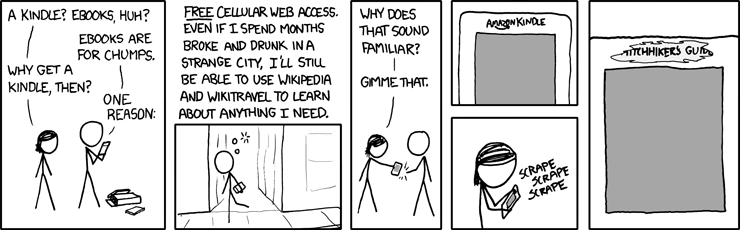
Short weeks always feel so busy, so rather than try to grapple with the news of the day, how about some comic strips?
Dinosaur Comics and xkcd are, for my money, two of the best web comics out there–and conveniently, both sometimes talk about books/publishing, so I can offer you relevant joy right here on our blog!  (If you enjoy what you see here, head over to their websites or buy their books!!)
Ha!
I’m always on the lookout for something new, so if there are any web comics you’re enjoying, let us know in the comments!
10

Literary ghosts

by Miriam

The subject of ghostwriting seems to be in the air right now. The recent New York Times profile of James Patterson pulled back the curtains on something that was a fairly open secret within the industry: Of the 620 books (give or take) that Mr. Patterson publishes every year, most are collaborations in the loosest term of the word. As Andrew Crofts points out in his rather passionate defense of the practice, if it’s not the oldest profession, ghostwriting has certainly been around since writing utensils began to be used to make literature instead of just grocery lists.

Two new films, Roman Polanski’s The Ghost and L’Autre Dumas, starring the great Gerard Depardieu, deal with the notion of authorship and literary collaborations and I’m intrigued by what they have to say. For agents, a good ghostwriter is a huge asset to one’s client list. Generally excellent writers themselves, they are able to put their egos aside and use their skills as literary entrepreneurs. They are usually able to multitask, are very organized and meet deadlines without the sturm und drang that can drive editors (and sometimes agents) to the nearest bar. And their services can command very nice money.

So, why do we still feel a little disappointed when we find out that a favorite author had more than just transcribing help? Do you?

1

Beast Books

by Lauren

Galleycat reports on the launch of Beast Books from Tina Brown’s Daily Beast, with books that will be longer than articles but shorter than most nonfiction books. One of the common publishing rejections (from us to authors and from editors to us) is: “It’s fascinating, but it’s more of a magazine article.” Often, though, the truth is more that the idea falls in between: it requires greater explication than magazine space allows, but there’s not enough to it to support a book. This model could make for a good home for such ideas. It’s an interesting concept, and I’ll be paying attention to how well it works–particularly since my level of personal commitment to well crafted nonfiction on subjects I don’t find naturally interesting is often longer than an article, but shorter than a book.

2

Influential YA authors

by Stacey

Although I represent a wide range of adult authors and books, my research and posts lately have steered more toward the children’s markets because of my personal experiences, and also because a number of my adult authors are working on projects for the young adult and middle grade markets. I appreciate that this category has grown exponentially in recent years, and that there seems to be room for a real mix of creative elements. I came across this list on Omnivoracious, a blog run by Amazon book editors, and it breaks down the ten most influential YA authors of the last decade, the ones who it’s suggested most current authors are trying to emulate in some way. There are also a bunch of other authors listed at the end who might have made the list under different circumstances. If you are interested in this genre, either reading or writing, it’s a good introduction to what’s out there (although the list is in no way comprehensive), and what’s worked in the market over the last decade. It’s worth noting that even though this audience skews to a female readership, half the authors are men, and many of the books appeal to both sexes. I’ve liked a lot of these books, some of which have really broken new ground, and look forward to seeing what this growing market has in store for the next decade, when my own kids will be old enough to enjoy these books. Happy reading, and let us know if there are authors you feel would be a worthy addition to their list.

16

Authors as rock stars

by Miriam

The publishing business is weird. That’s a given for those of us who toil within its ranks. It’s also unpredictable, quixotic, and often baffling. One of the things that never ceases to amaze me is the phenomenon of serious author turned “rock star.” Joshua Ferris, according to Jason Pinter, is the latest Jay McInerney, J.D. Salinger, F. Scott Fitzgerald, Lord Byron, etc., and no disrespect to Mr. Ferris, whose first book I thoroughly enjoyed and strongly recommended, but what is it about him that people find so, well, sexy? And, should that be a reason to rush out and buy his sophomore novel?

Over the years, I’ve come across many very attractive authors, many not so attractive but highly charismatic authors, and some who, attractive or not, were so shy or self-conscious or socially inept that it made perfect sense to me that they’d chosen to become writers – traditionally a solitary and vaguely misanthropic pursuit. Except, of course, nowadays even the most retiring of authors has to glam it up for the cameras, both physically and personality-wise in order to get attention for his or her work. We at DGLM have always been aware that this is a reality of the media-driven age we live in but still cringe at the thought of having to advise authors to “maximize their assets” by working with a p.r. coach on finding ways to become more telegenic, for instance. Personally, I prefer my writers to be reclusive, eccentric and odd-looking and more interested in crafting beautiful sentences than looking beautiful on Oprah, but in the tabloid era that type seems to be a dying breed.

Does an author’s looks or celebrity status influence your decision to buy his/her books?

5

The need to write

by Rachel

While reading the many articles dedicated to the late (need I mention great and extremely talented) J.D. Salinger, I came across a story published in the Australian, which touched upon Salinger and his need to write. In today’s celebrity-obsessed culture, writes Erica Wagner, Salinger did not write because publication awaited him, but “because a real writer writes because he must.”

This sentiment is echoed in a Telegraph article, where it mentions the rumors–persisting for 45 years–that although Salinger shied away from publishing, he was still very much writing and that there could be as many as 10 novels tucked away in his safe.

But perhaps most interesting, in a New York Times article, Verlyn Klinkenborg explains that “to send a work out into the world, was, to Mr. Salinger, an intrusion”–which posed the question: is it really possible to be a writer without publishing?

It’s interesting to read about the many sides of J.D. Salinger’s life, but what really struck me was the fact that for many decades, this incredible author wrote purely for the sake of writing, because he had a need to write–he was not putting pen to paper for literary awards or outside praise. This kind of passion is what will make me enjoy reading his books for years to come.