
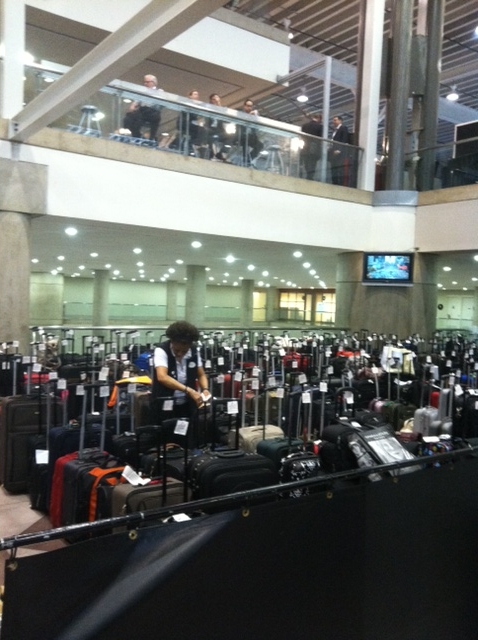
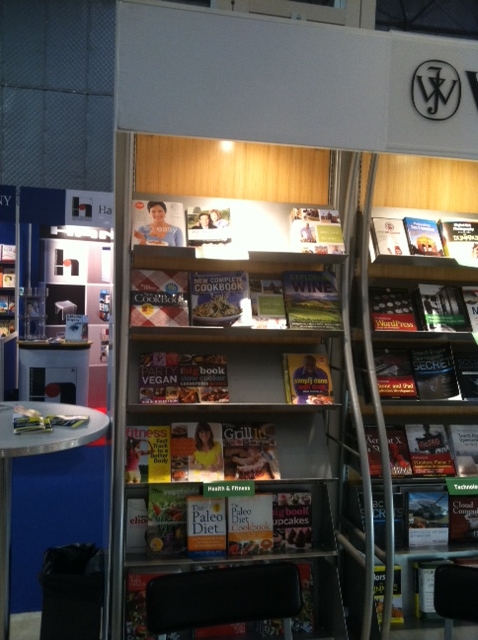
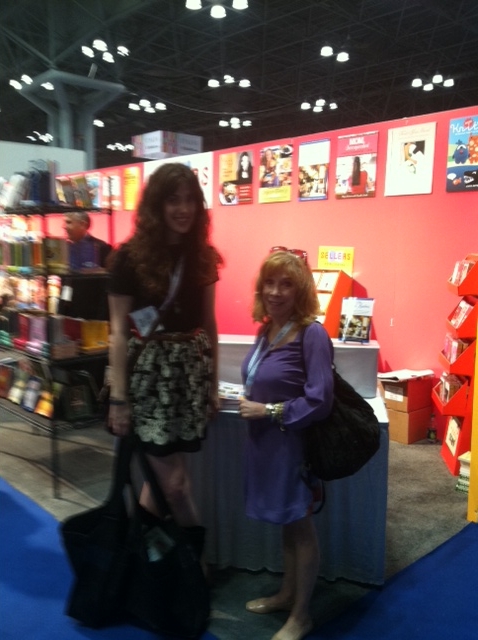
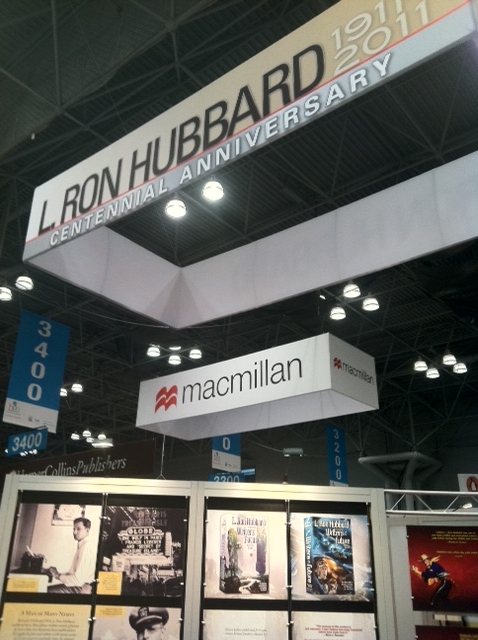
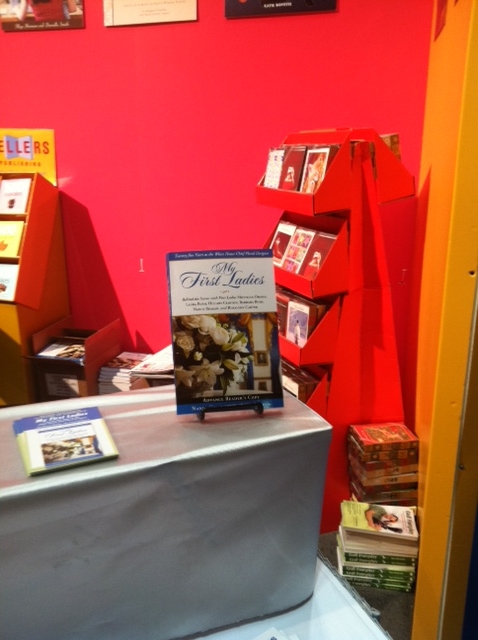
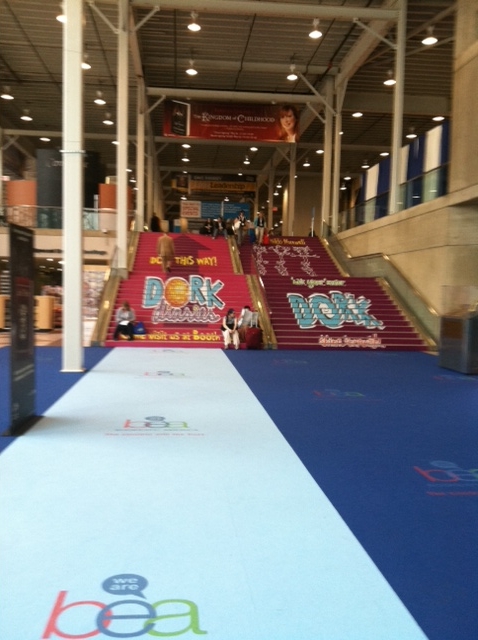
Some scenes from BEA. Jane, Rachel (their picture below cracks me up–Rachel’s statuesque, while Jane is, er, twee) and I trekked over to the Javits center last week on Thursday, which was the last day of the Expo. It was comforting to see that L. Ron Hubbard still has the biggest booth. Lovely to see our authors’ books on display. Heard a rumor that the “Dork” stairs cost the publisher $25,000. Then, we ran into Michael (is he squinting?) with his clients Lisa McMann and James Dashner and we chatted with Liesa Abrams of Aladdin (who edits some of Lisa and James’ books) about her Batman-themed wedding. As we were heading out, we saw the sea of suitcases and hoped that they all found their way to their rightful destinations.
Category Archives: Miriam

 May 25, 2011
  Miriam
  authors, bestsellers, buzz, digital publishing, e-books, fun, Miriam, self-publishing, technology
 If you get it for free…
Conventional wisdom (and mothers concerned about their daughters’ virtue) holds that if you give something away for free, you’ll never find someone to actually pay you for it. That is so clearly not the case in the e-publishing world that it seems almost suicidally pigheaded to hew to that line of reasoning.
This morning, Jane and I sat with longtime client, author Joe Konrath, at Coffee Shop on Union Square for a very early breakfast. As usual, the waitresses were rude and inattentive and the coffee only okay. But, I digress. Some of you might know Joe as one of the founding fathers of the electronic self-publishing movement. He is also a very smart man who made it a point to educate himself about traditional publishing prior to heading out into the then uncharted e-book waters. He is an evangelist who knows whereof he speaks, whatever your opinion on what he has to say.
Anyhow, we were talking about file sharing and free content and the subject of Go the F**k to Sleep came up. The book is, of course, a publishing phenomenon. Currently #4 on Amazon on the basis of pre-orders alone, film rights are already sold and an article about it in New York magazine this week attempts to analyze what particular nerve it’s struck for harried parents. The book is putting Akashic Books, a small Brooklyn independent publisher on the map.
The interesting thing about this story is that this 34-page book has already been read by, well, everyone. The .pdf was leaked weeks ago and went viral so fast it was back in your in-box before you’d sent it out to all your friends. It’s funny that the e-version is just now being announced. Did I mention that everyone has already read this on their computers?
To me, this only supports the theory that offering free content and file sharing is a good idea in order to get people to buy books. Yes? No? Maybe in certain cases but not others? What do you all say?
Scandals/Scandales
The thing about taking turns blogging once a week as we do here at DGLM is that you sometimes have the perfect subject to write about but it’s not on your designated day. Then, Wednesday rolls around, you had a miserable commute into the rain-soaked city, your lower back aches and you’re walking around like an 80-year-old who’s nine months pregnant (you know how pregnant women waddle when they’re in their sixth trimester…or was that just me?), the piles on your desk are mocking you, and all you want to do is read everything you can find online about the Schwarzenegger and Strauss-Kahn scandals. So, in lieu of something pithy and informative about publishing (e-books, the business as we know it is dying, yadda, yadda), I’m just going to ramble on about these two current headliners.
The Schwarzenegger story is tawdry and lurid in a way that we’re so used to (John Edwards is cackling madly somewhere) that it’s really just a fill-in-the-blank kind of scandal. Doesn’t mean I’m not going to pick up my copy of Star as soon as it hits the newsstands. The Strauss-Kahn case, however, is much more interesting because it is so multi-layered and speaks to so many different kinds of abuses and contradictions. Arnold Schwarzenegger’s infidelity is hurtful to his family and fans in the way that these kinds of betrayals generally are. Strauss-Kahn’s alleged actions will have an effect on the global marketplace and the fate of several countries currently facing huge financial crises. Criminal behavior is an apt description and not just because of the appalling nature of the offense.
So, being that it’s the way my brain is wired after 150 years in the business, I see potential for books in both stories: Schwarzenegger’s would be a novel—Jackie Collins meets Dominick Dunne perhaps? Strauss-Kahn’s a serious, non-fiction exploration of why powerful men, whose careers are devoted to helping humanity in macro ways, often turn out to be such sleazeballs and our complicity as a culture in letting them get away with it—this is more of a Michael Lewis meets Philip Gourevitch for a long discussion over coffee kind of book.
Which, if either, would you buy and read? And why?
Writing well is important
You might look at the title of this post and then higher up at the masthead of this blog and think, “Duh!” Well, yes, a literary agency blog post that states something as obvious as “writing well is important,” would seem to indicate that its author is either (a) simple minded or (b) really, really struggling to find a subject for her weekly rant.
In fact, while idly catching up on my online news, I came across this post by Kim Brooks, who teaches college composition courses. As I read about Ms. Brooks’ frustration with the papers her students turn in, which show a complete lack of understanding of or even appreciation for correctly written English, I started musing about the countless queries my colleagues and I receive which are peppered with awkward at best, ungrammatical and nonsensical prose at worst. Then, there are the proposals and manuscripts turned in by journalists and other professionals whose livelihood depends on their writing skills and which make us pound our heads on our desks in desperation. One can ascribe these sloppy, sometimes undecipherable texts to laziness or haste, but perhaps, as Ms. Brooks suggests, we should be looking at how English is taught in this country and why it is that so many kids are graduating high school without knowing what to do with a comma, much less a semi-colon.
Call me old-fashioned, a geek, or a more colorful epithet, but I think it’s shameful that we are not more invested in knowing how to write well—not imaginatively, creatively, or poetically, mind you, just technically well. Can you enjoy a piece of writing when the punctuation is off and there are misspellings or malapropisms throughout, even if the subject matter is compelling?
May 04, 2011 Miriam agents, controversy, digital publishing, e-books, future of publishing, Miriam, optimism, publishers, self-publishing If an agent or publisher came calling
With electronic self-publishing becoming the latest tulip mania, one of the questions hashed and rehashed in publishing circles is whether authors who are finding success in this venue would be willing to give it all up in order to be published by a “traditional” publisher. E-publishing evangelists deny that there is any point or desire to go back to the shackles of mainstream publishing. Why would you sell your art for pennies and let agents and publishers take the bulk of your earnings, they query. Take your work back, do it yourselves, and make 70% of the income, they encourage the masses.
We publishing types have been losing sleep lately over our own future. Gatekeeping has gone out of vogue in this new democracy. Also, we worry that our services may become obsolete now that anyone with an internet connection can upload their work and start getting their check from Amazon or Kobo within days. Even enterprising houses are getting into the self-publishing business and calling it community building.
So, over our coffee and bagels on a recent morning, the staff of DGLM wondered whether all of the above is incontrovertibly true. Anecdotal evidence leads us to believe that many people who self-publish (including some of those who are making nice money doing so) are actually interested in traditional publishing as an outlet for their work and value the services that an agent, editor, production team, and sales and marketing force provide. Many are excited when we offer representation and seem to feel that the most important thing we agents bring to the table is allowing them to focus on their writing instead of the “business” side of the business. (This, by the way, is something I think all authors appreciate, as finding the time to be creative can be difficult even in the best of situations.)
Clearly, the future of publishing is electronic media and we love a literary success story, whether it’s generated by Random House or by a self-published author. But amidst all the greatly exaggerated reports of traditional publishing’s demise, here’s an informal survey. Would you still go the traditional route even if you were making the big buckaroos doing it yourself?
Art imitates art
Herman Melville’s pompous dictum, “It is better to fail in originality than to succeed in imitation,” notwithstanding, I love retellings of great stories. From Marion Zimmer Bradley’s wonderful The Mists of Avalon to Michael Cunningham’s The Hours to Wide Sargasso Sea by Jean Rhys (some of my favorites) it’s hard for me not to see the possibilities for retelling in a book or play or television series or film that I especially enjoyed. Of course, the closer a work is to classic status, the easier it is to imagine a modern spin—in part because the author is probably long dead and unable to complain that zombies and werewolves have been inserted into their 19th century storyline.
This Flavorwire post got me thinking about what books would benefit from a new retelling. Madame Bovary as a Real Housewife of New Jersey, anyone? Moby Dick with spaceships and a lot less talk about whale fat rendering? A Tale of Two Cities set in the present-day Middle East?
What are your favorite retellings and which stories would you like to see retold?
“The sceptre and the isle”
This fun survey of royally bad relationships had me pondering the fate of Kate and Will once the wedding hoopla is over and done with and the reality of marriage in full public view sets in. Having always been fascinated with British royal history (what a lot of nutters and knaves!) I’ve read a lot of fiction and some non-fiction devoted to the goings on of the English kings and queens. From the Plantagenets to the Windsors, every generation of royals seems to bring with it its share of tragedy, scandal, and…interesting fashion choices. As the latest royal wedding (with its attendant media frenzy) draws near, I wonder what narratives of intrigue and glory this pretty couple will inspire for future authors. Let’s hope their marriage is more stable and happy than Henry II and Eleanor of Aquitaine’s or Henry VIII and Anne Boleyn’s, say. But if it isn’t, I’m sure there will be many bestsellers chronicling what went wrong.
What are your favorite books about British royalty?
The readiness is all
We’ve all heard that old cliché about the timing of a relationship just not being right. On paper it all looked good. He was smart and funny. So was she. They were both crazy about dogs and children. They both loved country music and British humor. You get the picture. They were perfect for each other. But the relationship fizzled after a passionate start and when they looked back on that interlude, they told themselves that the timing just hadn’t been right. And, occasionally you hear the story of a couple who find each other after many years apart and discover that the spark that initially drew them together is still there. Only now they are in a place in their lives where they can finally make it work. Sure, it’s a Lifetime movie or a Nicholas Sparks book, but it also happens more often than one would imagine.
I’ve been working on a lot of fiction lately and have been blown away by some of the new novels I’ve come across and underwhelmed by others. Generally speaking, the difference in my reactions is not due to a great disparity in the authors’ talents. We’re privileged to represent some very gifted writers around here and when something doesn’t “work” it is, like those star-crossed relationships, often due to timing.
When I say timing, I don’t mean that a novel has to hit some kind of zeitgeist nerve in order to be publishable. Sometimes, it’s about letting a subject, an idea, a character…whatever…percolate, get seasoned, and simmer until it’s fully cooked. All writers know what a difference a few days or weeks can make in terms of their perception of their own work. The manuscript you thought represented the second coming of Proust the day you typed the final period seems like an incoherent mess a month later and that day is when the real work of editing and polishing should begin. This kind of bad timing stems from falling in love with a premise/idea, no matter how flawed, and wanting to unleash it on the world before all the kinks have been worked out. The good new is that as long as an author is able to be somewhat objective and, more important, willing to dig deep and revise until the novel is ready, this is the best bad timing problem to have.
The worst kind of bad timing is when the book is good, maybe even great, but for external reasons—the market is suddenly glutted with chick lit, vampire books, memoirs, etc., or a news event makes the subject seem in poor taste or offensive, for instance—it will be impossible to sell. Then, there is nothing for it but to take that lovingly crafted manuscript, put it on a shelf and let it percolate for a few months, maybe even years, until the time is right to unleash it on the world.
One of our authors just published a novel she’d been working on for years. A new title, a new publisher (not the one who originally bought it) and a lot of seasoning and it’s finally on the shelves. The readiness is all….
Do you all have stories of projects that worked or didn’t because of bad timing? We certainly do.
…in bed.
I’m a little embarrassed to admit it, but I have some seriously slothful tendencies. If I thought I’d get anything done, I’d install a hammock in my office. My point is I like lounging around. A stack of books on my night table, a lap desk and a laptop nearby, and some Mad Men episodes on the DVR and I could stay in bed for days. There’s something about the relaxed state you find yourself in when propped up against a bunch of pillows that allows for a certain type of creativity—assuming, of course, that you can stay awake.
This fun piece by Meg Wolitzer reminded me that the bed can be as creative a hub as the dining table or the library. It also got me thinking about literary goings-on in beds (usually sex and death, but not always). What are your favorite bedroom scenes in literature?
Why read?
Picking up the thread that Jim began unspooling on Monday and that Steph commented on yesterday, my question today is why read at all?
We all know that reading and writing go together like peanut butter and bananas (in case you hadn’t picked up on it from earlier posts, I’m an Elvis fan) and that the two activities are inextricably linked. Reading comes first, though, doesn’t it? You have to know how to read before you can write with meaning. We write because we read, in other words.
Given all the competition for our attention these days (endless cable channels and Wiis and iTunes), it feels like reading is becoming more of a choice than an absolute necessity. Which, of course, is part of the problem the publishing business is facing. Why read when you can waste time playing Angry Birds on your iPhone? Why read when you can go to a movie? Or make small talk on Facebook? Why read when you can spend hours downloading useless apps for your iPad?
Reading is solitary. It can be intellectually taxing. It makes you flex numerous muscles including your imagination. It is a singularly subjective experience (all of us have faced the disappointment of sharing a book we love with someone only to hear them opine that it’s just okay or, worse, pan it outright). It entails a time commitment of hours, days, sometimes weeks. And in some circles, it can even get you labeled a nerd. So, why do we do it?
Personally, I’m a huge fan of film and tv (I have strong couch potato tendencies) and I thoroughly embrace each new technology that delivers information and entertainment more quickly and easily to me. But, none of it compares to the thrill I get when flipping open a book to the first page. There is something so intimate and special about entering an author’s mind and the universe she or he has created especially for me, knowing that for the duration of my stay in that universe, I will enjoy a deliciously private experience. I won’t have to compete against the highest score on a video game. I won’t have to laugh at the same punchlines my neighbor with the supersized popcorn bin finds hysterical. I won’t have to do anything, in short, but allow the story and my imagination to carry me where they will.
I read for knowledge, for comfort, to relieve boredom, to make sense of the world and to be entertained, surprised, sometimes awed. Why do you read when you have so many other pastimes to choose from?