Category Archives: Lauren

7

Get organized

by Lauren

As the rights director, part of my job is trying to synthesize information on an author’s entire career to pitch front and backlist titles—and to know what is available to be sold or resold now. Foreign rights don’t have as short a shelf life as many others, and we still make foreign deals on books years down the line, sometimes after they’re out of print in the U.S.  Recently, I asked one of our clients to send me a copy of an old contract from before we represented him, and he quickly pulled it from his files and got it in my hands. He remarked that he had heard from other authors that they didn’t really keep accurate files, and he couldn’t understand how they functioned. The truth is, sometimes, they don’t do it very well.

So if I can offer you one piece of advice today, it’s this: get organized. Even if organization doesn’t come naturally to you. Even if you find it inherently loathsome. Do not assume that other people will keep records of things you’re getting copies of and don’t assume that you’ll still be in touch with them when you need those things later. Don’t assume that people who you’ve stopped doing business with will prioritize giving you information you want at the speed with which you need it. Keep every single contract, license, and royalty statement you receive. Any time you sign a legal document or are given a financial statement, be sure you can get your hands on it in the future and within a few hours of it being asked of you. Think about saving things digitally to make them easier to find and save space (though you should still keep hard copies with original signatures of any legal agreement as well). 

And start early. Plenty of well meaning authors tell me–as they sigh with dismay that they think they maybe did a deal with some country that begins with T for their 3rd or 4th book–that they’re going to organize their paperwork this time.  But 20 years in, that’s a much more difficult task than if you start organizing yourself from Day 1. And who wouldn’t want a career with that kind of longevity and potential?

6

Using what’s out there

by Lauren

Have you ever discovered that the exact information you were looking for was readily available online, but not found it until months after you first decided it would be of use? It just happened to me this morning, and it’s a reminder that no matter how hard you search, there’s still a lot out there that you might be missing. While Googling can get you far in life (and I firmly believe everyone should cultivate reasonably good search skills for their personal and professional benefit), sometimes the greatest sites are ones you’d never know to look for. It can be really helpful to know what sites others with similar interests and needs find handy.

Certainly, all authors should be sure to check out the website of the Authors Guild. Some of their resources are only for members (authors with publishing contracts should think about joining), but others, like the information on the Google settlement, are freely available. For anyone interested in the possibilities that the world of social media has to offer (and frankly, you should all be, because it’s not only personally fun and useful, it’s critical to a successful career in publishing these days!), Mashable is one of the best sites out there, including how-to guides both basic and advanced to get you started and then help you take it to the next level. If, like me, you’re a grammar nerd (or simply need the help), check out the Chicago Manual of Style’s free monthly Q&A. There’s also the option to subscribe to the manual itself online, though I’m personally partial to the hard copy on my desk with post-its flagging the issues for which I’m most likely to need reminders.

Which sites do all of you find useful? We find the blogs in our blogroll (take a look to the right!) to be pretty informative, but I think the best resources for authors, both published and aspiring, are probably those their fellow authors are already using. So share below your favorite resources for authors and publishing professionals! I’ll definitely be looking to add to my list.

2

Entering the publishing world

by Lauren

Are you new to the whole publishing thing? Maybe you’ve just finished your first ever masterpiece (and by finished, I mean edited, polished, had readers give you feedback, etc.) and are ready to look for an agent. Maybe this is even the first place you wound up after googling—in which case, welcome to publishing, my friend! You’re going to love it here (also sometimes hate it, but mostly, we hope, love it). There’s a lot of great advice here, if we do say so ourselves. But much of it is detailed and narrowly focused, and maybe you need a quick overview. If so, Eric over at Pimp My Novel has a very brief tutorial that’ll help you figure out where to begin—and give you a sense of what questions you need to be asking. My only caveat is that the year he mentions between acquisition and publication is more likely to be two years for non-fiction—or fiction that is sold on a partial or needs a lot of editorial work before acceptance.

20

Checking in

by Lauren

So how’s it going DGLM blog readers? We wanted to take the opportunity now that we’ve had time to settle in to find out how you feel about the changes we made here.

We’ve all been thrilled with the feedback we’re getting and how active you guys are. Finding time to work on this without taking time away from our clients has been a challenge–I’m writing this on the subway en route to the office, for example–but we’re having fun being part of the discussion with you.

So how do you feel about the redesign? We’re blogging much more than we used to, but are there areas we’re still not covering (or covering enough) that you’d like us to consider? What are you liking most? Least? The title contest and Slush Week were both a lot of fun for us, and we’d love to do more contests and series–what do you think? Is there a helpful button or widget you wish you could find in our sidebar? We’ve gotten great suggestions from you guys, like Slush Week and the I Wish I Saw More… sidebar, so please keep ’em coming. (In the comments below, but also in the comments at any time! We’re always interested to hear what you think.)

You can see the blogs that we’re reading to the right–we’d love more suggestions! In particular, I’d love to read a blog by someone who works in sub rights. Anyone know of one?

Speaking of which, who are you? Unpublished authors, published authors, editors, agents, publishing professionals, tax attorneys who simply love our sparkling wit? Let us know below, anonymously or otherwise.

Some housekeeping as well. We stopped doing questions corner because we weren’t really getting many questions emailed, but we’re reading the questions you ask in the comments and try to cover the bigger ones in separate blog posts. If you’re missing that feature, try clicking the advice tag in the cloud at bottom.

Speaking of the tag cloud, I may have gotten a little overambitious early on with the tagging and created a ton of tags that aren’t very useful, so I’ll be cleaning that up a bit.

And for our fellow Blogger bloggers, are there any handy widgets or tricks we should know about? You guys were very helpful in resolving our color issues some time back. If anyone has any tips on embedding video in particular, that’d be great. We’ve had sizing issues, fought with the HTML forever, and then given up when it was still not quite right.

Most of all, thanks to everyone reading! Thanks to the linkers and retweeters and Facebook sharers who’ve helped us find others. Thanks for actively participating in the discussions, letting us know what you think, and helping us improve. Thanks also to those of you who read but don’t comment–we hope to hear from you, too! It’s a genuine pleasure talking with all of you.

And now the train’s pulling into 14th Street, so it’s time for me to go!

3

In control

by Lauren

Yesterday, Michael offered some really sound advice on how to deal with potentially difficult situations that arise in the publishing process, and I wanted to follow that up with a link to something of a companion piece over at Pimp My Novel. Eric outlines what you can’t control as the sales force tries to make magic happen for your book and then finishes with a sobering but important fact: “Everything from having your partial MS passed on to the agent by his/her assistant to the final sales call to winning all kinds of fancy literary awards will inherently contain an element of randomness or luck, and it’s up to you to make the best of it, regardless of the circumstance.” That last part is key to a satisfying publishing experience. Some things will be affected by chance, but that doesn’t mean you should just passively leave your entire career in the hands of fate! For everything that lines up perfectly, capitalize on opportunity and don’t bank on chance. Lucky enough to have some author signings in an era where that’s less and less the case, don’t forget to tweet about it, make a Facebook invite, and email your address book. When things seem to be going wrong—and inevitably something will—do what you can to fix them and do everything you can in other areas to minimize their impact. Pretend you’re in AA and memorize the serenity prayer—and talk to your agent when you need help with the “wisdom to know the difference” part.

And if you’re still wondering how to make the best of it, run don’t walk to the previous post Eric links to in his entry: What You Can Do: Twelve Easy Steps. His hypothetical timeline may well be much shorter than what you’ll experience—except in the parts where the work is on your desk and you’ll be praying to every god anyone has ever believed in for more hours in the day—but it outlines clearly just how proactive you can and should be. You can’t force luck to go your way, so make sure you don’t forget to do all the things within your power.

4

Stop buying books? Never.

by Lauren


The ever entertaining Laura at Combreviations was inspired by a Guardian blog entry to recount her year of not buying books: a year in which money woes meant reading all the books she already had.  The horror!

I’m a pack rat perpetually lured by the siren song of materialism to own an awful lot of things that I don’t, perhaps, need to permanently possess.  I rarely get rid of books I’ve read and dislike.  I get a bit twitchy when items loaned out don’t get returned, even if I don’t have any need for them back.  And if I love it, I simply must give it pride of place. 

I certainly don’t want people to stop buying books simply because they don’t need to (if they did, how on earth would I make money to buy all the books I want to buy?), but I am sometimes alarmed by the sheer percentage of books in the teetering piles that I have not and, let’s face it, will not ever read.

When this happens, though, I just resolve to read twice as much, to continue to justify my spending.  And with a weekend of rain and a day’s wait for the cable guy looming on the horizon, it’s nice to have the reminder to aggressively get through at least something the next few days to make room on the to-be-read pile for the six recent purchases threatening to fall off my desk here before I get them home.

7

Lauren’s Slush Week entry

by Lauren

(For details on Slush Week, see Chasya’s introduction.)

Dear (Agent’s name),

Cleopatra Giancarlo is different from your average twenty-something career girl. For one thing, she knows when people lie because she can see the truth in their shadows. For another, she doesn’t use her power for good. Or evil. After repeated failures to help others, she mostly just uses it to get deals at Bloomingdale’s. She fears what the government would do if they discovered her ability, yet she longs to find out if there are people like her out there. If there’s anything more she could be.

She gets her wish when two strangers whisk her away from her old life and introduce her to the world of suprasensors. John Arlin and Samantha Grooms represent an organization called YuriCorp, one of many privately-owned firms that employ supras like Cleo to increase their profit margin. Any of these firms would be thrilled to have Cleo on staff, and their methods of recruitment aren’t always friendly.

But even in the world of supras, Cleo doesn’t get to be normal. Her new boss wants her to go undercover and seek traitors in the company ranks. Her new friends know what she can do and how to work around it. And her new assignment might end up with her in a coma–or worse.

The Whole Truth is a 100,000 word paranormal women’s fiction with a mouthy heroine who finds out people are people even when they can bend spoons with their brains. I’ve got an MFA in creative writing and am published in (titles/publishers/genres redacted for Slush Week purposes).

Thanks for your time, and I look forward to your response.

(Author’s name)


Dear (Agent’s name),

Cleopatra Giancarlo is different from your average twenty-something career girl. For one thing, she knows when people lie because she can see the truth in their shadows. For another, she doesn’t use her power for good. Or evil. (This kind of rhetorical set up is a bit too common and doesn’t feel fresh to me.) After repeated failures to help others, she mostly just uses it to get deals at Bloomingdale’s. (This, on the other hand, works for me. I found it funny without being too cute. It’s where the author first gets my attention.) She fears what the government would do if they discovered her ability, yet she longs to find out if there are people like her out there. If there’s anything more she could be.

She gets her wish when two strangers whisk her away from her old life and introduce her to the world of suprasensors. John Arlin and Samantha Grooms represent an organization called YuriCorp, one of many privately-owned firms that employ supras like Cleo to increase their profit margin. Any of these firms would be thrilled to have Cleo on staff, and their methods of recruitment aren’t always friendly.

Interesting premise. It’s hard to write paranormal that doesn’t sound like a million other books, but this manages to stand out.

But even in the world of supras, Cleo doesn’t get to be normal. Her new boss wants her to go undercover and seek traitors in the company ranks. Her new friends know what she can do and how to work around it. And her new assignment might end up with her in a coma–or worse.

The Whole Truth is a 100,000 word paranormal women’s fiction (This makes me wonder why the author doesn’t call it paranormal romance, since paranormal women’s fiction isn’t really a category people usually refer to. Is the author trying to separate herself from romance or not doing her research or what? From a shelving standpoint, most paranormal is going in one of three places: romance, fantasy, or children’s. Women’s fiction typically goes in general fiction. Categories may be somewhat artificial, but it pays to know where you fit.) with a mouthy heroine who finds out people are people even when they can bend spoons with their brains. I’ve got an MFA in creative writing and am published in (titles/publishers/genres redacted for Slush Week purposes). (Without the actual info here, it’s tough to say how relevant the credentials are, but if they’re not especially impressive, keeping it brief would be good. For instance, Pushcart Prize nominations must be quite nice for the author, but the sheer volume of them and low bar to entry mean they don’t really help us discern potential in a query. It sounds like in this case, the author planned to keep it brief and just state the facts, which is good.)

Thanks for your time, and I look forward to your response.

(Author’s name)

I’m not desperate to get my hands on it, but I’d have requested it for the Bloomingdale’s line combined with this being a category I’m looking for and a premise that doesn’t remind me of every other query I’ve read today. Truth be told, I’d probably only have skimmed the rest once I saw that line and just asked for material–probably 50 pages since I’m not blown away, but I’m intrigued enough to find out more.

Thank you to everyone who participated in Slush Week by (bravely) sending in their queries and commenting on the posts! It’s been fun and we hope informative!!

7

Capturing the present

by Lauren

Since reading this Guardian article from earlier this month featuring Julian Gough’s criticism of fellow Irish novelists, I’ve been feeling torn. On the one hand, I do get his point that contemporary Irish novelists tend to be backward-looking, that “reading award-winning Irish literary fiction, you wouldn’t know television had been invented.” Yet, as a book lover with a Masters in Irish Studies and an on-the-record Colum McCann fanatic, I want to have a strong argument against Gough’s claim. While I don’t have an exhaustive knowledge of Irish lit by any means, I have studied it and have even worked in an Irish bookstore, where Irish content is generally separate from similar sections, so that Irish fiction gets a separate set of bookcases from fiction, and so on. I feel I should be able to call to mind some great literature that feels present rather than past. Gough doesn’t necessarily assert that they aren’t writing good novels, merely that they aren’t reflecting contemporary culture. Now, no doubt novels set in the past still often reflect the ethos of the time in which they’re written, but it does seem unusual for a culture not to directly document the contemporary world in novel form.

So help me out, folks! I’d love to be able to leap to the defense of the subjects of my academic study, even if only in my own head where Gough’s objections are lingering.

9

Publishing with dinosaurs and stick figures

by Lauren

Short weeks always feel so busy, so rather than try to grapple with the news of the day, how about some comic strips?
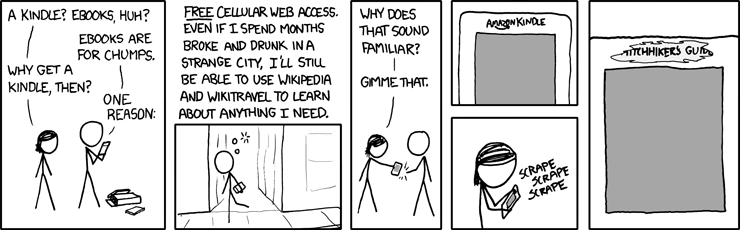
Dinosaur Comics and xkcd are, for my money, two of the best web comics out there–and conveniently, both sometimes talk about books/publishing, so I can offer you relevant joy right here on our blog!  (If you enjoy what you see here, head over to their websites or buy their books!!)
Ha!
I’m always on the lookout for something new, so if there are any web comics you’re enjoying, let us know in the comments!
6

Browsing the aisles

by Lauren

Some recent posts on the future of bookstores made me consider my attachment to strolling the aisles, even though I do plenty of book buying online these days. I try to wholeheartedly embrace the digital future and am not inherently afraid of large corporations (I hope Blogger-owner Google will flag that statement for future proof they should give me one of the plum jobs after they take over the world). But if Amazon puts Barnes & Noble out of business–that one will hit right where it hurts.

I’m a Barnes & Noble girl, having worked there for 3 1/2 years in college. Every day I witnessed firsthand that people at large corporate bookstores do care about, know about, and enjoy books. It’s been years since I worked at the store on 8th St and 6th Ave, but my coworkers were nearly all readers who cared about what they did. There was a reason they worked there instead of the GAP and most that I’m in touch with 7 years later still work in book retail and are passionate about what they do.

I’ve also had the pleasure of working for an independent, Dubray Books on Shop Street in Galway, Ireland. Dubray is a small chain (though even a large chain in Ireland is only so big), owned by a family from Bray all the way over on the opposite coast from Galway. As a consequence, the Galway store is the only one not on the Dublin side of the country, a whole 3 hours away. My boss was the store manager, who ran the place with the dedication and pride of an owner. And he was as passionate about books as my managers at B&N had been. An American who’d learned the trade at Borders, he certainly significantly preferred essentially running his own shop, but there was no way he’d only learned to love storytelling once he had no corporate oversight.

It’s true that you’ll always have some duds–I did work with a woman at B&N who was totally unfazed when I showed her the three shelves of Hemingway books she’d told a customer we didn’t have because she couldn’t spell it and didn’t know who he was–but I also worked with people who could find you any book in the children’s section without a database or could recommend you a romance novel for your mother based on sketchily remembered details of the cover of the last one she read. I firmly believe that if you can’t find a book lover in a bookstore, you must not be looking very hard.

Wherever the smart money might be in the debate on the future, I can’t help but be optimistic that bookstores are here to stay and desperately hope that if they do fall by the wayside, it won’t be in my lifetime. However, I’ve met people who work for Amazon and BN.com, and I can say with confidence that if we do end up solely in their hands, we’ll still be dealing with people who care about, know about, and enjoy books. My problem with Amazon and its online brethren displacing bookstores is not that they’re not passionate about books but that we don’t meet them so they can share that with us. Some of the joy of sharing great books with strangers would disappear if brick and mortar stores disappear, and that does feel like a genuine loss to me. I can’t guess at the future, but I do hope that the e-book and the bookstore can happily co-exist for a long time to come.