Category Archives: Lauren

5

The book stays in the picture

by Lauren

There was some great debate in the comments when I tackled foreign rights, so let’s move on to another sub right.  It seems like this is the perfect week to talk about film, since Variety just did a piece on the current state of book-to-film, complete with quotes from Jane!  (I always enjoy the Variety lingo–only in LA would we be referred to as a “Gotham-based” agency.  Clearly Batman was rights director before me. )

So we’ve already talked about foreign, which takes up the most time and generates the most deals, but film and television is the big one on a per deal basis in terms of money. On the one hand, a big film means big money for the author (though as Jane points out, not as big as it used to be).  That said, the percentage of books that ever reach the screen is tiny. Of those that don’t, a slightly larger percentage will have the rights bought but will never be made. Another slightly larger bunch will be optioned–meaning a studio or production company has the right to try to get the funding to outright buy the rights to the material. Options, however, usually lapse before any significant progress is made.

I’ve heard it said that the ideal situation for the author is for the option producer to get enough traction to keep optioning and eventually buy the rights, but never make the movie.  Though I don’t know how many authors would really want to lose the upside—significantly inflated booksales—to get rid of the downside—a corrupted version of the story they wrote making it into the world.

8

Technical difficulties

by Lauren

Hello there, blog readers!  I’ve recently been alerted to a couple technological snafus related to our blog.   Fortunately, you guys have been super helpful in the past, so I’m coming back for more.  In the eternal tech conundrum, it’s near impossible to troubleshoot a problem you can’t replicate, so naturally both these things don’t appear to be an issue on our end (and we haven’t changed any settings recently, related or otherwise).

First DGLM client Joelle Anthony let us know that sometime in April or so, she stopped being able to comment on our blog.  Here’s what she says:

“Just so you know, what happens is I click comment, the window opens, I type my comment, I choose my name and URL (I’ve also tried anonymous) and then when I hit post, instead of word verification coming up like it used to, everything just disappears and I’m back reading the comments that are already there.”

She can comment on blogs where comments are formatted like this: http://anthonysundaysoup.blogspot.com/ but not on blogs where comments are formatted like ours: http://ramblingsofadevotedbookworm.blogspot.com/.

And second we heard via Facebook from reader Mark Janousek that lately our blog entries don’t show up in his Facebook news feed.  I suspect Facebook’s the culprit here, with their constant setting switches and such, but I don’t see a way to change those settings. 

I still get the blog feed on my Facebook and have no problem commenting on our blog.

So for both questions: a) does anyone know why that happens?, b) does it happen to anyone else?, c) has anyone narrowed down the circumstances under which it happens to a narrower set?, and/or d) does anyone know what settings I need to tweak?

If you can’t comment, please feel free to email me at labramo@dystel.com with any answers to the above!

Thanks in advance, guys, and thanks especially to Joelle and Mark for giving us the heads up!

27

Kicking ass and taking names

by Lauren

This weekend I went away for Memorial Day to a beautiful riverside cabin in the woods upstate. At one point, sitting by the riverbank in the sunshine, I looked up from my book to take note that all five of us were reading when we could’ve been doing anything we wanted. (We’d all packed more than one book even though we were limited to one duffel bag each—just in case.) It warmed my heart, I tell you. There was also much discussion of what we were reading—particularly of the third book in Stieg Larsson’s trilogy, which one person had brought along and another had already read.

People who’ve read these particular books tend to invoke the heroine’s enviable toughness. I’m often struck by conversations about a heroine so badass that it makes the book worth reading, because it’s not something I can really recall experiencing. I like to think I’m pro-woman (at the very least because I am one, and I’m pretty pro-me) and have a good handle on which ladies supposedly kick ass, but I don’t have that gut reaction of identification or aspiration or whatever it is that so many women (and men) I know do to a tough heroine and the book in which she lives. Of those incredible female characters I can identify off the top of my head, they’re really supplied by my childhood reading: Laura Ingalls; Pippi Longstocking; Jo March, up until the regrettable point that she ditches Laurie for the old German at which point I pretend the book is over so that I can still love it; etc. When I think of my favorite characters from non-children’s books, they’re really all men. As are a large percentage of my favorite authors.

I’m not 100% sure it matters—a great book is a great book, and a great character is a great character—but I still feel like I must be missing something. So this summer, I’m challenging myself to focus my personal reading on amazing women.

Here’s where you come in: since my natural reading proclivities have been steering me the wrong way, I’m going to need a list. I’ll stick Larsson on there, but I’m feeling the overwhelming buzz kick up my contrarian nature, and I’m just not ready to tackle the girl or her dragon tattoo quite yet. So below, let me know your favorite female characters, your favorite female authors, and why (without spoilers), and I’ll give as many as I can a shot. Then I’ll let you know how I fare when the summer is through!

7

Building enough bookshelves

by Lauren

“I would be most content if my children grew up to be the kind of people who think decorating consists mostly of building enough bookshelves.” Anna Quindlen

While I can’t speak for Anna Quindlen’s children, I think that those of us here seem to have gotten it right! Thanks to everyone who sent in their bookshelf photos. I’ll start here with mine, and then follow me after the jump for some from DGLM agents and blog readers!!

As I mentioned, I added a new bookcase to the family recently, so the first is haphazardly organized and covered in knickknacks, photos, and mementos. The second actually has some organization to it: Baby-sitters Club and Little House books on the bottom; galleys in the middle; and the top shelf is a combination of books I represent (which I really have to get better about bringing home, because there’s a lot missing), books I sell rights for, and books I’m eager to read that are ready to move up to the majors: the bedside table pile. I actually moved the bedside table pile on top of the bookcase for photo purposes—that’s the pile on the left that’s topped with my brand new Room by Emma Donoghue galley. Those are the books I’m in the middle of or desperate to read next. The pile beside it are the books that I don’t own (though some of those are intermingled elsewhere as well) and have to remember to read and give back. At a glance, it seems about half of those are Jim’s!

Miriam and Stacey kindly took photos for me of some of their books—and they’re delightful for totally different reasons.

Miriam’s I love for the display table, which is an idea I’ve already stolen for my dream library with the rolling ladders.

Stacey’s I love because they’re not bookshelves at all. Having moved in the not too distant past and with 4 young kids at home, Stacey’s books actually currently live in a closet. Something about the haphazard stacks makes me think of used bookstores, and I kind of want to stop by her house and flip through to see what’s there.

We also got some great photos from you guys, so I’m putting my favorites up here:

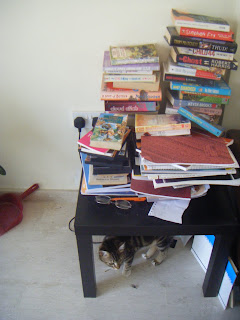
Mary Witzl sent her photo in part as a call to action. Bonus points for the adorable cat sneaking into the photo!

We’ve got plenty of bookshelves in our flat back in the U.K., but where we’re living, we’ve got only teetering piles stacked up on shelves. I’ll send a photo, though. Maybe that will shame my family into tidiness.

Alice Pope sent us one of eight (jealous!!).

Here is one of eight bookcases on my house, this one mostly dedicated to picture books. I have a 2 YA/MG bookcases, a nonfiction bookcase, a cookbook bookcase, an adult fiction bookcase, a classics bookcase, and the boy’s bookcase full of PBs, board books and Captain Underpants.

(He only reads things from my PB shelves under close supervision.) :)

And yet…there are still piles of books on the floor of every room and a 2 rather precarious piles on my nightstand. Think I should get a Kindle?

Lynn sent a jealousy inducing photo of one small part of her personal library—not only does the shelving shown far exceed my paltry bookcases, but the full library can’t be viewed because the books have to be shipped back from her “private beach” to Paris!

Aww!! I should have taken a wide view of my library before we dismantled it! No, we didn’t have rolling ladders that I, like everyone else here, dream of having, but I did have my stepping stool placed discreetly behind a door in case I needed to get something from the top two shelves.

Vicki sent us her two bookcases and dresser-top collection, firmly refusing to get on board with my bookshelf envy. I should learn to be so zen. My favorite part of these photos is how cozy the stuffed animals look nestled in among the books. It’s like a book forest.

Just two bookcases in my room, but I think I have enough room for what I need. As you can see, the shelving on the left is much more spread out, so it still has a lot of room to expand. Plus I still have the tops of both bookcases.

I also have a shelf of writing-related books and my HP collection on my dresser. I’ll be very worried if I run out of room completely.

Though Bill Peschel isn’t helping, because he sent this link to a blog feature about his personal library, which inspires “envy and despair,” as critic Heidi MacDonald so rightly put it.

Thanks to you all for sharing, and I’m mentally filing away some ideas for when I have endless space and money (that day will come, right?). As for the winner, it’s a very tough call, but I have to say that Lynn’s mere fragment of her library so dwarfs my collection and comes closest to my dream library—and she even has a step stool from which she might someday be able to upgrade to rolling ladders—so congratulations! Drop me a line at labramo@dystel.com to tell me what sort of books you enjoy, and I’ll send you something to add to your already impressive collection!

13

Happy BEA!

by Lauren

By the time this posts, I’ll already be at the DGLM table in the International Rights Center at the Jacob Javits Center, doing my duty at Book Expo America as the agency’s subsidiary rights director. Today is the beginning of American publishing’s largest trade show and, for me, a three-day extravaganza of back-to-back meetings with foreign publishers, sub-agents, scouts, audio editors, and film producers. I’ll leave it to one of my colleagues to give you the BEA scoop in another post, but in the meantime, I thought it might be a good time to talk subrights.

I offered a basic rundown of how subrights works a couple years ago, but maybe now would be a good time to talk in more depth. Since foreign rights take up the bulk of my time—and will account for most of my meetings this week—why don’t we start there? If you’d like to know more about audio, film, and serial, just let me know below, and I’ll tackle them in future posts.

Foreign is the biggest rights market. When a book sells to an American publisher, there are more or less three options: North American, world English, or world. Occasionally a book sells separately to Canada and the US, but that’s not the norm unless the author is Canadian, and even then, it really depends on the type of book.

In a North American rights deal, the American publisher will distribute their edition in English in the US, Canada, the US territories, and the open market. The open market is the term for those territories where English-language rights are fair game. American and British publishers have essentially carved up the world into three sections: US exclusive territories; UK & Commonwealth exclusive territories; and everywhere else. Occasionally, there’s a land grab from one side or the other insisting that they must have exclusive rights to a particular place (BEA 2006 featured a panel on the whole kerfuffle). I’ve seen British publishers insist that they should get Europe exclusively because they’re…nearby? And I’ve seen US publishers insist that India’s not in the British Commonwealth. The part of it that always perplexes me is that the major players on both sides are generally owned by the same parent companies. The open market is the territories in which both the US and the UK publishers are allowed to sell. In the end, all that matters from the authors’ and agents’ perspectives is that the publishers’ dispute doesn’t prevent a sale to both territories and that the book is widely available. The notion that an island nation that no one involved could pick out on a map is a deal breaker is really quite silly. Fortunately, it usually works out.

In a world English deal, this is blessedly not our problem, though unfortunately we also lose the chance to do a separate deal in the UK. This typically means that the US publisher has a UK arm that they feel will publish or distribute the book well. All non-English rights, though, are controlled by the author, which means that we’re trying to place those where possible.

In a world rights deal, it’s all—English and every other language—in the publisher’s hands.
The way that foreign rights deals are typically done is through a network of subagents in the major territories throughout the world. In countries like the UK, Germany, Japan, etc., there are agencies that represent American publishers and agents, and those are the people I work most closely with on foreign rights deals. Our subagents represent the full list of rights that we represent on behalf of our authors in their territories, though of course not all books will sell in all countries.

Sometimes, books don’t sell internationally at all—it’s often said that such books “don’t travel.” Books that depend largely on pre-existing interest in the author or subject, for example, are less likely to sell internationally if that pre-existing interest isn’t also international. A novel by a small publisher in the US is more likely to sell than a bestselling American cookbook by a celebrity chef who is not on TV outside the US market. This is one of the things I love most about foreign rights: the rules are totally different and sometimes the little guy in the US market gets to be a bigshot elsewhere. As part of that, there’s a lot of information to manage: true crime sometimes sells in Australia, Germany and Japan, but rarely elsewhere unless the case has international reach; memoirs are tough in Spain; and you can’t typically sell to a foreign country those things that they feel they do better than the US. For example, literary fiction is tough to sell in France, but commercial novels are easier. (The French don’t exactly clamor for American attempts at high culture.) Horror’s tough to sell in Asia, because their standards for what’s frightening are quite different than the American one: think of The Ring as compared to an American slasher flick.

I really love these little glimpses into foreign cultures, and it’s always really satisfying when I choose a book to highlight for a particular subagent or publisher and get a sale. And it’s a huge pleasure to work directly with clients of the agency who aren’t my own, some of whom I’ll be lucky enough to see for a bit at the fair!

Any questions?

12

At home on the shelves

by Lauren

One of my deepest home decor desires is to line my walls with bookcases.  I grew up in a house where bookshelves were everywhere you looked, but New York City apartment living isn’t necessarily ideal for the literary pack rat in me.  I’m probably not going to fulfill my dreams of Beauty and the Beast-style rolling ladders any time soon. 

That said, I’ve happily just added a new bookcase to my collection, so for right now, my shelves just barely hold all the books in my apartment, so long as I don’t bring home the stacks of books obscuring the window by my desk here or the ones boxed up at my mom’s.  The box of Babysitter’s Club books I just bought from a stoop sale (Books #1-44 plus various specials for $20!  A total bargain!) really ate up all the space I had left after moving the floor stacks onto the bookcase.

So when I read the comments on Rachel’s post last week, I was envious of the enormous size of your to-be-read piles.  Those numbers don’t count all the already-read books you probably possess!  Do any of you have a real personal library?  Or walls upon walls lined with shelves?  Just massive stacks threatening to topple?  Books strewn about here and there, to be picked up on a whim?

I’m a big fan of the New Yorker‘s Book Bench blog’s 1,000 Words feature, where people send photos of books out in the wild, so I’m asking you, dear readers, to send photos of your lovingly curated or totally ramshackle collections.   Email your photo as an attachment to news@dystel.com with the subject line “Book Shelves”, and then comment below to tell us about your personal library!  We’ll feature some of our favorite photos here on the blog—and I’ll see if I can’t convince some of my colleagues to share their own images.  The person who sends in my favorite photo (or the first person to demonstrate their ownership of the enviable rolling bookshelves) will get a copy of something from my bookshelves–making room for me to bring home the copy of Sebastian Junger’s War I just got.

3

Do the Write Thing

by Lauren

Have you heard about the flooding in Tennessee? At least 30 dead, more than a billion dollars in damage, and a potentially crippling blow to a local economy dependent on tourism. I haven’t seen much coverage of it—except blogs lamenting that the lack of media attention hinders disaster relief fundraising efforts—and some people here weren’t aware of it at all when I mentioned it.

It’s actually due to Facebook that I really know the extent of the damage and need for relief. One of my closest friends grew up in Murfreesboro, a city in Nashville’s orbit, and I took a trip down there to stay with her family and help her move back to college just before our sophomore year. Her family, who I know well, still lives there. One of my clearest memories of my visit to Nashville is the lovely Cumberland River—now wreaking havoc—and how much a part of the downtown landscape it is. (The other is that Rachel ordered a veggie burger when we had lunch at the NASCAR Café, which was frankly delightful.)

With so much need, I was happy to stumble across the Do the Write Thing for Nashville auction being run by authors Victoria Schwab, Amanda Morgan, and Myra McEntire. They’re auctioning off some amazing items that anyone reading this blog should appreciate—galleys, critiques, etc—so head on over and check out their wares! And if you want to offer them something to auction, take a look here.

Keep an eye out for the DGLM auction item on day 5: a batch of galleys by our clients!

Now I’m off to figure out what I want to bid on!

2

Tabloid lit

by Lauren

While I’ve not been much of a trashy magazine reader since I was a teenager (except for when I lived in Ireland where British tabloids abound, because they really are the masters of the genre!), I loved this Flavorpill post on which tabloid staples our great literary figures most closely resemble.  It’s hard to decide in some cases whom the comparison is crueler to: the fictional trainwreck or the real-life one. 

But I quibble with some of their choices.  Gatsby and Diddy seem similar on the surface, which I suppose is somewhat fitting the themes of the book, but Diddy just doesn’t seem as emotionally damaged as poor pathetic Jay.  For me, Gatsby’s all about the pathos and how poorly the surface covers it up if you really look.  I’d probably have gone for some unloved and unloveable poseur who hangs with the heiress set but is still never totally of them.  Admittedly, I can’t think of someone who fits.  Nicole Richie?  Clearly seems to have her issues, and she wasn’t born into wealth–though unlike Gatsby, she didn’t work her way in either.  Lindsay Lohan, perhaps?  (I clearly love Gatsby, but have never been a fan of Mr. Combs, so perhaps that’s my issue.  Poor little LiLo, though, I’m still giving credit for the sheer watchability of her Parent Trap remake, which I’ve seen roughly 80 million times on television.)

And perhaps it’s just me, but George Clooney oozes charisma, whereas Darcy seems more reserved and steadfast.  Frankly, I don’t see a Darcy type ending up in the tabloids unless he…I don’t know…saves a small child or cute puppy during a slow news week?

But it’s got me thinking, and now I’m trying to figure out who would stand in for some other classics.  Clarissa Dalloway?  Jo March?  And who is John Mayer in the canon?

13

A literary mystery

by Lauren

Recently I experienced a moment of great joy when a friend spontaneously remembered the name of the girl band we liked in elementary school that no one else seemed to remember. I couldn’t remember any helpful details like the band’s name or song titles or song lyrics or even melodies I could hum. But it turns out they were called BoyKrazy, and they were even worse than I might have guessed.

This is not book-related in itself, but it has come up as a topic of conversation over the last couple years on occasion with my friend Nell, who has her own life mystery to solve. On realizing the joy of solving mine, it occurred to me that I could try to pay it forward by asking for the help of you, our well read audience, to solve hers. Nell loved a children’s book when she was in elementary school that must have been first published no later than 1986, but she suspects it was probably from the mid-to-late 70s or early 80s. Here’s what she remembers:

The main character is a young girl who always paints mustaches on herself. Her teacher tells her that mustaches are for boys and that she can’t paint any more on herself. She has black hair that I think is in a bowl cut with bangs.

At some point in the story, she makes a new friend who has an electric train set in her attic, closet, spare room, or someplace like that. I believe the story takes place in New York City or some other metropolitan area with apartment buildings (I vaguely remember the new friend living in her building), but I may have projected that on my memories from my earliest childhood memories.

The story ends with the girl painting mustaches on everyone in art class, including the girly girl and the art teacher–who ends up laughing about it.

So, please, if this is at all familiar to you, help a girl out in the comments! If you understand the agony of kind of sort of remembering something that no one else seems to know exists, you’ll want to lend her a hand. Thanks!

UPDATE: Mystery solved!!  Nell reports that it was in fact Elizabeth Levy’s Nice Little Girls.   Thank you very much, Rebecca!  Now tell me, do you own the book, or are you the best Google detective of all time?

4

Ke$ha: A poet for our times

by Lauren

Poetry doesn’t often find itself a subject of our blog entries around here, since it’s not within the purview of this agency or most others professionally speaking. And unless we’re talking the poetry of pop music, it’s not necessarily of interest to the majority of us personally. I’m something of an exception to the rule: I’ve only recently learned to identify Lady Gaga and Taylor Swift by voice, much to the dismay of Jim and our interns, but do happen to know a bit about poetry.  I’ve studied it and even used to memorize it for fun, because that’s just the kind of nerd I am.

So I was delighted to finally learn who this Ke$ha girl is through the Princeton Tiger‘s video interview with Pulitzer Prize winning poet Paul Muldoon, the subject of my grad school dissertation.  If you love pop songs, allusive poets, or college students in very brightly colored ties, check it out.