Category Archives: poetry

Bestselling poetry in motion

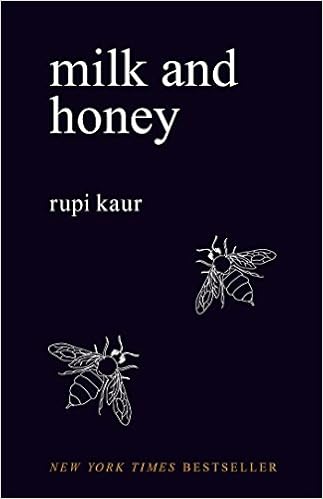
It’s not often that you hear about a poetry collection becoming a commercial bestseller, but in the case of Rupi Kaur’s MILK AND HONEY, that’s exactly what’s happened.

To me, as much as it’s categorized as poetry, I see it more as a lifestyle book, skewing  inspirational self-help, definitely has spirituality and mind/body/spirt overtones. It’s like a collection of poetic mantras for a healthy, positive way of living coming from a place of women overcoming adversity and female empowerment. She addresses dark issues like sexual abuse and survival. Here’s a Buzzfeed piece which lists a sampling of her work like:

“we all move forward when

we recognize how resilient

and striking the women

around us are”

As evidenced in this article from Publisher’s Weekly, she self-published her first book and Andrews McMeel, an independent publisher based in Kansas City primarily known for humor and gift books, took notice and signed up the author to give the book a wider distribution through its networks.

I think it illustrates that if you are able to tap into a receptive audience, no matter what category you are writing in, you can be successful. Social media really helped Rupi Kaur build a name for herself and her work, as well as visiting college campuses to share her spoken-word poetry. Her work was resonating, and the book is an extension of a platform she has worked hard to build and develop. May many others follow in her brave footsteps!

1

Happy birthday, Byron!

graffiti2

Lord Byron’s graffiti on the Temple of Poseidon at Cape Sounion, near Athens, Greece


Ah, Lord Byron.  You were only 36 when you died, but you still managed: to write one of the best Romantic poems, become a hero in Greece for fighting in their revolutionary war, father Ava Lovelace (who was a computer programming badass in the 1840s, and no that isn’t a typo), have a lifetime’s worth of scandalous affairs, and literally leave your mark on some of the most beautiful places I’ve ever been.  That is a lot of life for only 36 years. Happy birthday, you mad, bad, dangerous bastard!


1

Poetry becoming popular?

A while ago I mentioned the different ways in which authors have been using social media to tell stories. And apparently the same goes for poetry. Check out this extremely interesting piece from the NYT.

I love the description of a best-selling celebrity poet as the literary equivalent of a unicorn. Instagram and Tumblr are pretty perfect for poetry if you think about it. Perfect length. Perfect example of form-function-storytelling harmony. I have the emotional maturity of a six-year-old, and as such, don’t really understand poetry, but I’d love to hear from our readers.

What do you think of poetry in this medium? Do you follow any Instapoets? Any ideas why it’s so popular?

4

The murderous beats

This past Sunday afternoon, several parents from my son’s preschool organized an Easter Egg Hunt for the kids in Riverside Park near Columbia University. With the park in full bloom and the children remarkably well behaved for so late in the day, we must have presented just about as wholesome and innocent a portrait as you can get here in the Big City.

Yet who would have guessed our kiddies were scrounging for eggs on the site of a legendary literary murder?

Not me, until I read this piece in the Times about the Beat writers and how Lucian Carr, mentor to Ginsberg and Kerouac at Columbia, murdered the childhood stalker who had followed Carr to New York from St. Louis. Afterwards, Carr dumped the body in the Hudson—and must have dragged it right through the spot where we were picnicking 68 years later!

Well, morbid connections aside, I love this story for a few reasons. One, I’ve been a big fan of the Beats since high school when my lit-mag friends and I would traipse down to Café Reggio on MacDougal Street and pretend we were hipsters over cappucinos—though, full disclosure, I didn’t actually read any of their work until post-college. But when I did, I was hooked, and even now I’ve probably re-read HOWL and ON THE ROAD more than any other books on my shelf.

Two, it’s always fun to hear a new story about literary heroes, especially a nicely lurid one like this. But I especially love how it places the rowdy, anti-establishment Beats firmly in the Columbia literary culture—somehow, it makes them more relatable without deflating their impact, sort of like Thoreau heading home from Walden for dinner.

And three, it reaffirms my book-love for NYC. I mean, you could walk down virtually any street in any borough and there’s some kind of literary connection—a scene from a favorite book, the residence of a famous writer, the site (or former site) of a bookstore or writers’ bar or some other hangout. And in a few instances, like Riverside Park, something much more sinister…

9

The Poem in Your Pocket

April is national poetry month, and since the folks who sponsor it make it ridiculously easy to read more poetry, I’ve signed up for their poem-a-day e-mail. I will also participate in the Poem in Your Pocket Day on April 14th (just prior to Tax Return in the Mail day) in which people are encouraged to carry their favorite poem with them.

I’m still deciding what mine will be. Mathew Arnold’s “Dover Beach” holds a special place in my heart, but I’ve also always been partial to Dylan Thomas’ gorgeous “Fern Hill.” Sadly, with the exception of those poems placed before me in the New Yorker or Harper’s, I’m embarrassed to admit that I rarely read poetry, at least of the grown-up variety. My preschooler loves Shel Silverstein, Dr. Seuss, A.A. Milne, and Lewis Caroll, the sillier and more tongue twist-y the poem, the better. It’s clear that rhyming, meter, assonance, consonance and sheer pleasure in wordplay in general come pretty naturally to kids. But at some point or another, even for the very bookish, the habit of poetry seems to fall by the wayside. Despite being surrounded by literary types, I know few people who read poetry for pleasure, fewer still who read contemporary poets, and fewer still who actually buy books of poetry. It’s no secret that the novel has eclipsed the poem as a literary form, and I have my own theories about why this is, but why do you suppose poetry has suffered such loss of “market share?” I’d also be pleased if you’d share the name (or a link to) your favorite poem.

4

Train of thought echoes in the memory….

by John

Saw this notice in the Times today. To quote: “Train of Thought, the program that placed literary quotations from the likes of Kafka and Schopenhauer in the unlikely locale of a packed New York City subway car, is being removed, two years after it assumed the mantle of subterranean high culture from Poetry in Motion.”

Like most New Yorkers, I spend the majority of my time on the subway with my headphones on and my face buried in a book or newspaper in a vain attempt to block out the rest of my fellow citizens. But whenever I come up for air, it’s always a small pleasure to see a quote from Shakespeare or Mark Twain sandwiched between ads for Dr. Zizmor’s skin treatments. Not that these literary snippets offer a ton of insight, but just the fact that the MTA would provide booksish distractions always makes me smile.

But I suppose all good things must come to end, and the kicker is that the MTA will be using the Train of Thought space for updates on maintenance and other customer service ads. Considering the glacial rate of improvement on the subway, I’d think some heady words from Proust would do more to keep people in a good mood than chipper service updates that don’t square with reality.

Hence, to all you writerly riders, a modest holiday plea: let the MTA know we want our poetry back! For, to mangle a quote (boy, I really DO need Train of Thought), what profit the subway to gain more ad space and forfeit its soul?

3

The allusive and elusive Jay-Z

by Lauren

As you may recall, I’m a bit of a poetry fan. Truth be told, though, I enjoy breaking apart its rhythms and allusions much more than I ever have any sentiment it’s meant to convey. I like the challenge of memorization and figuring out the appropriate intonation, as well as the more scientific analysis of form, which is both nerdy and perhaps a real violation of the spirit in which many poets endeavor. I myself am a fan of the just slightly too clever type of poet—Paul Muldoon and the like—instead of poetry in which form doesn’t play a strong role. I have a vague recollection of once reading a poem about poetry that was so clever, it actually demonstrated each term as it discussed it, and while I instantly fell in love I can’t for the life of me recall what it is.  Does anyone know what I’m thinking of? It’d certainly be some canonical thing from an English class.

I was reminded of this type of analysis while reading a Guardian article on Jay-Z’s “Empire State of Mind,” a song I quite like, not least because it sort of sounds like nonsense if don’t understand the allusions. I certainly don’t get much of it on my own, which is why I lost a bit of time down the rabbit hole of this blog entry and subsequent comments on The Awl a while back. The analyses of various parts of the song and the allusions that may or may not be contained therein—as well as this very detailed explanation of the entire song linked to in the comments—are really kind of mind blowing. If you like the song, are confused by it, or just love when people put words together in an interesting way, do check it out! And if the bad grammar of the chorus bothers you as much as it does me, you’re going to love this solution.

4

Ke$ha: A poet for our times

by Lauren

Poetry doesn’t often find itself a subject of our blog entries around here, since it’s not within the purview of this agency or most others professionally speaking. And unless we’re talking the poetry of pop music, it’s not necessarily of interest to the majority of us personally. I’m something of an exception to the rule: I’ve only recently learned to identify Lady Gaga and Taylor Swift by voice, much to the dismay of Jim and our interns, but do happen to know a bit about poetry.  I’ve studied it and even used to memorize it for fun, because that’s just the kind of nerd I am.

So I was delighted to finally learn who this Ke$ha girl is through the Princeton Tiger‘s video interview with Pulitzer Prize winning poet Paul Muldoon, the subject of my grad school dissertation.  If you love pop songs, allusive poets, or college students in very brightly colored ties, check it out.