Category Archives: Jim

4

The Children are Our Future

I spent much of last week at the Romantic Times Booklovers Convention in downtown LA. It was, as one would expect, delightful. I won’t bore you with all of the details of the conference. Suffice to say it’s thrilling to spend time surrounded by dozens of bestselling authors; the Mr. Romance pageant was cheesetastic fun; and Bottega Louie has amazing éclairs.

The most heartening aspect of the event for me was the massive Sunday book fair which then rolled into “Teen Day,” a separate event with the RT young adult authors being led through a day of activities from reading selected short pieces to rotating through groups of teen readers for chats. Authors seem so much more accessible than they ever did to me as a teen. While I’m sure there were author tours and events when I was a teenager, the reach of information via author sites and outreach and the scope of the events themselves seems ever greater. I don’t think I ever even thought about writing to an author. They seemed like distant, near mythical beings. Working in publishing divested me of that feeling pretty quickly! I kid, I kid. The point is, from the outside, it appears that teens are much more engaged in the reading process than they ever were before.

Maybe because I’m a ridiculous optimist about publishing in general, but given the growth of the young adult market and the fact that there is a generation raised on blockbusters like Harry Potter and Twilight, I have a completely unscientific hunch that reading is becoming a more popular pastime then it was when I had my nose buried in Fear Street and that there will thus be more adult readers in the next generation than my own produced.

What do we think? Are there going to be more readers buying books in the coming years? Is there job security in publishing after all? ARE the children our future?

8

Author Smackdowns

As a follow-up to my post last week, I was going to jump in with a response piece. Now I know why you write, so here’s why I read. But Miriam totally beat me to the punch. How dare she?!

So it’s an about face and on to talk again about commercial versus literary fiction. Or really, commercial versus literary authors. On Saturday, I was going to attend an event called An Afternoon of Failure which was a bunch of authors getting together to discuss whether we have failed literature or if it has failed us. I figured it would be pretty self-congratulatory and very anger-inducing, but what can I say? Sometimes you need a little dose of pretension to get the blood boiling. Of course, as is only fitting for an event called “An Afternoon of Failure,” I sat down on my couch shortly before I was to leave and found myself waking up two hours later having completely missed the whole thing. Oops! Regardless, this sounded like a bunch of marginal authors hanging out together mourning the state of current literature and making some absurd argument about how books stopped being good after…(fill in the blank).

As someone who just plain loves reading, I often feel caught between the hyper-literary and ultra-commercial. It doesn’t really make sense to feel trapped since the lines are so superfluous, but both groups tend to take themselves too seriously. Whether it’s literary authors griping about how “good literature” never sells or commercial authors whining about how dull literary fiction is, it’s still snobbery. Over at The Morning News’s Tournament of Books this morning, Jennifer Weiner who often bemoans the ways commercial fiction is belittled said that Jennifer Egan’s A VISIT FROM THE GOON SQUAD was “no fun.” I literally gasped in horror. She went on to say, “Egan’s book seemed more like an exercise in Let Me Show You How Clever I Am than anything as lowbrow as entertainment.” Which completely misses the point since the book is wildly entertaining AND fun AND funny. But more relevantly, it’s the kind of inter-author sniping that is so common and so mysterious.

I’m not going to lie: sometimes it’s super fun to see authors on the attack because people who write for a living tend to come up with THE best put-downs. I still don’t fully understand these sorts of literary rivalries, though. Is it the competitive nature of the industry putting people on edge? Is it petty jealousy? Is it a sincere belief in one’s superiority? Haters gonna hate. But I wonder why other people think that is.

To close, I’ll offer my favorite ever moment of inter-author bitchery. Mary McCarthy (sadly, no relation) went on Dick Cavett and suggested, regarding Lillian Hellman, that “every word she writes is a lie, including ‘and’ and ‘the’.” It’s too good. So maybe the better question is, how secure do you have to be in your own intelligence and wit to take an author on?

25

Why do you write?

Bear with me kids. I’m going to make you do the heavy lifting on my blog entry this week. I feel like I’m coming down with something. And since I’m a hypochondriac who watches too many old movies, I think it might be consumption.

Or a cold. Whichever.

Seriously, sometime I’ll share the story about the nurse I cornered at a writers’ conference when I convinced myself I was having a stroke.

Regardless, I was thinking about how many people ask agents whether or not they write or intend to write. While my answer is usually, “What? Do I look crazy?” I am prepared to make a confession: every once in awhile I read a book and think, “I could have done this.” The reality, of course, is that I probably couldn’t. I lack the creativity and (more importantly) sufficient desire to pound through 5,000 words, let alone 80,000.

So I have to ask: why do you do it? What gets you to sit down and commit to churning out a whole book? I imagine it’s different for everyone, but I’m curious if there’s any sort of consensus. Is it a love of language? Characters that won’t leave you alone until you can get them on the page? Desire for a quick buck? (Ha!) I can think of lots of reasons to give up on writing—it’s stressful, it’s competitive, it’s lonely. And I’m very, very thankful that writers DON’T give up. But tell me: where does the motivation and wherewithal come from?

14

Commenters Cry “Bull!”

A comment came in yesterday on last week’s post about not writing to trends. It wasn’t the first comment to doubt my veracity, but it had the most zing, so I wanted to jump back in and talk a bit more about it. Let’s dive in and see me get thrashed, shall we?

“So stop worrying about trends. Write the books you need to write. Authenticity and enthusiasm are priceless.”

This is absurd.

First, one agent’s trendy knockoff is another’s authentic innovation.  There is no consistency or objectivity in this area.

Meyer’s vampire books were (in my opinion) directly inspired by season two of Buffy… but that fact is quite lost on her audience, most of which never watched Buffy.

Second, literary agents aren’t literary and they aren’t agents. They are salesmen, and they want what all salesmen want: something that’s easy to sell.

This being the case, forget incest-filled Gothic novels.  Instead, give any “literary agent” a whiff of a memoir to be ghostwritten for Sarah Palin six months from now.

I predict it will get snapped up in a blue blur, never mind the fact that not a word of it exists yet and therefore its merit can’t possibly be judged.  What matters is the certain, easy, and lucrative sale.

Agents who encourage new writers to “be authentic” or “write the books you need to write” are just wasting everybody’s time.

Jason makes some completely fair points. Yes, literary agents are salespeople. And we work on commission so do we want things that are easy to sell? Absolutely. But what I find a bit dispiriting about this comment is the notion that we’re only in it to make a buck. Trust me, if I wanted to be rolling in piles of cash, I probably could have found a more direct route than going into book publishing. I’ve said it before, and I’ll say it again: we do this because we love it. While there are people out there who do sell things just as cash grabs, I sincerely believe that more often than not, agents mostly work on material they legitimately feel passionate about, and not just for its financial potential. Naïve? Stupidly optimistic? Perhaps. But it’s something I see borne out in the agents I know, and not just the ones here.

What has come up a few times is the feeling that I’m completely wrong about not writing to a market. And hey, I’m totally fine with people disagreeing with me. But since I very much agree with myself, I thought I’d talk a little more about this. Yes, we can look at people who saw things selling and jumped into the fray and made a buck. A thriller writer who tried their hand at young adult, a romance writer who made a quick buck back in the day with chick-lit—these examples are out there. “I tried so hard to sell what I wanted to write and couldn’t do it. Then I sold something else.” Well…okay. But how sustainable is that long-term? And how satisfying is a career writing books you don’t love? At some point, won’t the reader catch on? Won’t the books become rather lifeless if you’re writing them only to grab a buck?

Here’s the thing—maybe Stephenie Meyer’s book was derivative of the second season of Buffy. I don’t know—I never watched it. Even if that’s the case, there’s a giant difference between derivative and calculated. If there’s one thing I never doubt about Meyer, it’s her own enthusiasm for her books and her characters. I don’t want to suggest that one should never experiment in their writing. Maybe someone has been doing adult novels for a long time, sees the success of the current young adult market, and wants to give it a go. Wonderful! They have to do it because they’re excited about it, though. I maintain that readers are savvy enough to see through blatant attempts to cash in.

An awareness of the market is necessary, but the most successful books aren’t ones that follow trends. They’re the ones that create them. Go ahead, write to a trend. Get a nice deal. Or go out on a limb, write a great book, and aim for personal and creative satisfaction and the better chance that you’ll break out in a real way. Your call.

21

Pregnant cannibal teens from outer space

Nicole Peeler has a genius post up over on my client Richelle Mead’s blog. It’s about the question of how young might be too young for readers to be exposed to certain content. It’s a valid question, and it’s interesting for me to consider how my own feelings on it change.

I was reading wildly inappropriate things when I was a pre-teen—Valley of the Dolls, Lucky, Pet Sematary, Weaveworld. Death, destruction, sex, psychoses: all in my daily reading. My very conservative parents were pretty strict about what I watched on television, but they never seemed to think to monitor what I was reading. In return, I really went for it! The older the book’s intended audience (as far as I understood it), the better. I’d get books from the library just because they were banned. How did I even know they were “banned books?” I must have found a list somewhere. Which is how I led to be really bored by Wide Sargasso Sea years before I should have tackled it…and incredibly confused by The Stranger. It was years before I picked up Camus again. Big surprise: he’s way better than I gave him credit for when I was 12.

Since I’m pretty happy with how I turned out, my opinion always has been, “If you can understand it, you can read it.” I stick by that, but I won’t lie, it totally gave me the weirds when my niece started reading Gossip Girl. And those ARE teen books. I understand the protective instincts that make people want to monitor teen reading, but I don’t agree with it. Kids who are reading for pleasure are naturally inquisitive. They’re also plenty savvy enough to understand the difference between fiction and real life.  Beyond that, I really do believe that more knowledge is always a good thing. And a book is one piece of a larger body of information being consumed. If someone were somehow raised in a Gossip Girl bubble where the books were all they read and the TV show was all they watched then yeah, that might be kind of terrifying. But as one piece of a growing cultural and worldly understanding, no one book will turn someone into a sex-crazed, homicidal beast from hell.

So put everything out there. Pregnant cannibal teens from outer space. Just go for it. Who cares? It’s just a piece of the puzzle. While I’m sure that there are books that incited people to bad actions (Mein Kampf is always my go to as an example of bad books), I don’t believe that any book can in and of  itself create the person who carries those actions out.

What do you think? Am I too easygoing? Are there books that shouldn’t be available to certain age ranges? Are there things that shouldn’t be in teen books?

5

The Tournament of Books: a blog post (you knew it was coming)

I blog about The Morning News’s Tournament of Books every year.  There’s been little evidence that anyone cares very deeply, but I do. So I’ll keep doing it!

The tournament is a March Madness style head to head of books from the past year. It’s usually 15 literary novels and one outlier—one year it was a YA novel, another year they had something more commercial. This year they have Anne Carlson’s poetry collection/scrapbook/objet d’art Nox. Whatever you want to call it, it’s beautiful. And it doesn’t have a chance of winning.

The real question this year is whether Jonathan Franzen’s Freedom will go the distance or whether it will be trounced in a backlash. As someone who liked it considerably less than The Corrections but still admires Franzen’s phenomenal skill as a writer, I’m completely okay with it going either way. The books I’m rooting for are my two favorite novels of last year: Room by Emma Donoghue and A Visit from the Goon Squad by the incomparable Jennifer Egan.

Again this year, I conned the DGLM bookclub into reading titles from the tournament, randomly selected from a hat. Miriam is deeply bitter about getting Lord of Misrule. Prediction: she’ll hate it. I ended up choosing James Hynes’ Next. Halfway through, I’m falling very, very hard for it. I can only hope that it sustains itself at the level of grace, insight, and humor it has shown so far.

I’m also pleased that someone is doing a contest for folks to predict the outcome. You can enter here.  I’m personally not predicting many spoilers in the first half of the contest. I get much nervier with the right side of the bracket when I predict Super Sad True Love Story gets knocked out super-fast. Of course, that’s because I’ve read (or tried to read) each of Gary Shteyngart’s novels and deeply disliked each one in new and exciting ways.

So join me in following the tournament this year? It’s good fun, I promise. It doesn’t take itself seriously, and it’s ultimately a bunch of nerds talking about books and presenting an award in the process. These are a few of my favorite things…

29

I hate trends.

I was exchanging emails with my delightful client Saundra Mitchell the other day, and she brought up Flowers in the Attic, everyone’s favorite attic incest novel. Now, you can debate whether that book had any literary merit, but it was undeniably provocative and controversial and engaging. When I started to ponder it a bit, I thought, Why isn’t anyone out there trying to write the next Flowers in the Attic? Something dark and inappropriate. A gothic page-turner. How much fun would that be?

Because while I’m sure that there are some people writing that kind of thing, I feel like I’ve spent the past few months with a slush pile full of dystopian were-vampire steampunk young adult novels with adult crossover potential. Which I mentioned to Saundra (okay, I ranted), leading her to ask whether trend-chasing in the market is a new phenomenon or whether it’s been around for a long time.

It’s always like this. I think right now we’re stuck between a few. Certainly lots more people are writing young adult because they’ve heard that’s where the money is. That also explains the sudden presence of lots and lots more YA agents. Vampires/demons/werewolves and other creatures of the night still regularly show up quite a lot in my inbox; there’s also a lot of dystopian stuff trying to cash in on what’s happening RIGHT NOW; and there is a small but dedicated group who are still trying to make steampunk happen (ah, the trend that never was). But by and large, a solid half of everything is always by people writing to the market in the most concerted and obvious way possible. Whether it’s Jane Austen knock-offs, the era of chick-lit, The Michelangelo Doctrine, or as far back as the Y2K books when I started here in ’99, far too many people are too shortsighted to even aim for the next big thing because they’re aiming for the now big thing. No matter how often I tell people the biggest books don’t follow the trends but instead create them, there will always be someone who’s all “ZOMG, I wrote the next Twilight!”

None of this is to say that these are categories I don’t want to see. I still love vampire books and would happily take more on, but only if it’s something really fresh and different, and REALLY only if I believe the author is writing the book that they want and need to write, not trying to cash in on a moment. I just think there’s an authenticity about passion projects that can’t be faked. And while I certainly want to find things that hit trends at the exact right moment, I don’t trust projects written in an effort to be timely. So stop worrying about trends. Write the books you need to write. Authenticity and enthusiasm are priceless.

14

A Very Dystel Valentine

I feel like my blog posts have been coming at you straight from dullsville for the past few weeks, and I need to spice things up a bit! So: romance!

In honor of Valentine’s Day, the holiday invented by couples specifically to scorch the hearts of their single friends, I’ve decided to poll some fellow Dystel-ites on the most romantic books of all time.

Miriam picked Jane Eyre and The English Patient with a nod to Love in the Time of Cholera which should come as no surprise seeing as her most recent entry testified to her love of its first line: “It was inevitable: the scent of bitter almonds always reminded him of the fate of unrequited love.” While everyone else in the office complained that they couldn’t think of romantic books, she continued with her suggestions: The Mambo Kings Play Songs of Love; most of Turgenev; some Milan Kundera; A Tale of Two Cities.

Jane’s response was immediate and perfect: does romance get more epic that Gone with the Wind? I think not.

Lauren took a decidedly anti-romantic approach. While she does enjoy, say, the poetry of Keats, her favorite books tend to be bleaker and feature antiheroes and assholes. I pointed out that assholes need love too, and she settled on The Great Gatsby. Romantic AND bleak. It qualifies!

Everyone else scrambled for answers as though romance in books was a totally unfamiliar concept. But they came up with favorites eventually! John settled on Wuthering Heights. Michael got stuck coming up with a list of the most inappropriate choices of all time (Lolita, The Unbearable Lightness of Being, Revolutionary Road, Flowers in the Attic!), but eventually refocused on actual romance and selected the  much more appropriate Shopgirl. Stephanie chose A Walk to Remember, which I haven’t read, but I did see the Mandy Moore movie!

As for me, my choice doesn’t have a happy ending, but I still think it’s the most romantic book ever (and one of my all-time favorites). The Hunchback of Notre Dame. I mean, come on! SPOILER ALERT. Quasimodo loves Esmeralda so much that he clutches her dead body until HE DIES TOO! And the last line! “When they tried to detach the skeleton which he held in his embrace, he fell to dust.” I love that line like Quasi loved his gypsy girl.

What about all you folks? What do you think the most romantic novels of all time are?

1

When It Rains

I’ve never understood why, but I feel like I always exist in one of two work modes: uncertain why I can’t find any good new material or drowning in a deluge of promising projects. It’s a drowning moment right now. I’ve signed up more new clients since the beginning of January than I think I did in most of 2010. I actually got really worried at one point that my standards must have dropped, so I took a few days off and went back to some novels before offering representation just to make sure I wasn’t being wildly optimistic. Each project was every bit as great as I had initially thought. It really was just a fluke in timing!

Of course, nothing undercuts the joy of finding several great projects at the same time like realizing you have no idea how you’re going to get through all of the editing you now have to do (“I’m dancing as fast as I can!”).

So I’ve cleared most of my plans this week to edit like a madman, but I’ve already seen the first ray of hope that I’ll be able to catch up: my slush pile from this morning included no less than four writers who called me the wrong name (i.e. Mr. Miller, Ms. McCarthy), two people whose queries involved catastrophic grammar mistakes in the first SENTENCE (think, “I is writing”), and one person who decided to query me because of my outstanding representation of a particular client…who is not, in fact, a client of mine. Or the agency.

I hope it doesn’t sound cruel, but when you’re overwhelmed with material, it’s easier to pass for the smaller reasons.

7

Convention time with the kid lit crew

This weekend was the Winter Conference for the SCBWI. That’s the Society of Children’s Book Writers and Illustrators. I was super excited to be invited to participate and was asked to give three one hour sessions on the state of the marketplace, how to get published, and all that jazz.

At the cocktail party on Friday night, I started to try to suss out how other presenters were doing things. After the first person I asked told me that she hadn’t prepared much, “just two or three pages of notes,” I realized I probably needed to get planning. So that night I went home and wrote copious notes about potential speaking points. Notes that I ultimately referred to not a once!

I ran each of my sessions as a q&a and happily had lots of thoughtful questions that allowed me to ramble on which is pretty much my favorite thing to do. My favorite exchange went something like this: “You seem really optimistic about publishing.” “Yup.” “Is that the general feeling in the industry?” “Nope!”

As one of the attendees told me after my session, everyone knows how hard it is to get published. No one needs it crammed down their throats. The fact is, things are challenging for everyone, but great books still sell and still break out. I’ve never thought of myself as a terribly optimistic person, but even in this time of flux, we’ve had some great luck, so it seems crazy to be depressed all the time about changes in the way books are published and sold.

One of the best things about spending the weekend with children’s book authors is that they’re often quick-witted and entertaining. Someone in one of my panels brought up that I say I’m looking for “underrepresented voices,” a phrase that I know trips up a lot of people. To clarify, I said, “Look, I represent a lot of thirty-something white women. And that’s great. I love my clients. But there are other voices out there.” After the panel, someone hung out to talk with me and opened with, “Hi, Jim. I’m brown, and I’m old. Interested yet?” Super cute. Someone else stuck around and told me I was so funny that I should be a stand-up comedian. I told her that flattery will get her everywhere and handed her agency agreements on the spot.

It wasn’t ALL sunshine and happiness. The post-lunch crowd seemed a little less energetic than the first two sessions. As one attendee noted, “It must suck to follow R. L. Stine.” He did not get agency agreements.

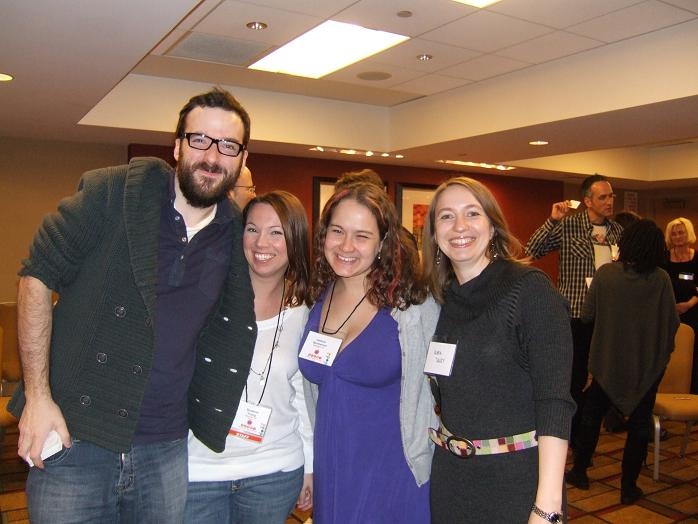
And most importantly, I got to hang out with some of my clients, one of whom I met for the first time this weekend! Look at us all—I’m a giant! That’s Suzanne Young being swallowed by my sweater, Jessica Spotswood in royal blue, and Robin Talley with the fancy belt.