Category Archives: literary

0

Get Out and Read

As a huge fan of maps and finding unique things to do in my city on the weekend, I found this article detailing artist Jason Polan’s map of the best places to read in Los Angeles a wonderful treat. Even if you don’t live in LA, you have to appreciate how amazing this map is. Reading can be a very insular experience, keeping you locked indoors with your favorite blanket, or it can give you a reason to go out and just sit somewhere while becoming a part of the setting—a park, the beach, or perhaps under a tree in the amazing bookstore, Book Soup, of Los Feliz. I tend to prefer the blanket and couch scenario, but every time I do get out of my house, I find I have a far greater appreciation for reading. It could be the vitamin D, or that weird association with happiness and sun, or perhaps just that I feel more a part of society or nature. Whatever it is, there’s undeniably something special about reading outdoors.
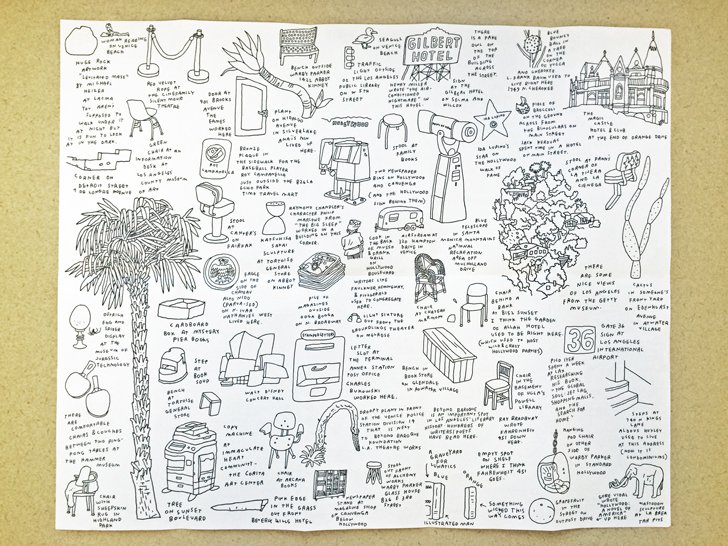
MapBack

(The back of Jason Polan’s map.)

I plan on picking up one of those maps, but what really interests me, is the thought of making my own map of the best places to read in LA. So far I have one place that is nearly unbeatable.

The café at Griffith Observatory.

I took my dog on a walk through Griffith Park late one Saturday afternoon, planning to sit under a tree and tuck into some summer reading. As I started walking, I realized I could walk all the way up to the Griffith Observatory, which seemed like a challenge me and my pup were up to. I was currently reading Wild by Cheryl Strayed, which was partly the reason I tortured myself walking the two mile, six hundred feet climb to the observatory. When we got there, the café was our first stop for some water, and I was so blown away with the beautiful scenery, I ended up staying for hours. My pup slept under my feet, and I got through nearly half of Wild. I took breaks from the book to look over the city, enamored that a place so beautiful existed, AND allowed dogs, AND allowed me to sit there for hours nursing some free water. When the sun went down, I was faced with a far more beautiful sight: stars as bright as the city lights below them. It truly is a magical spot, and it made the book I was reading—particularly because the book also deals with getting out in the world—even more special and memorable for me. Plus, it’s called the Café at the End of the Universe, how could it be better?
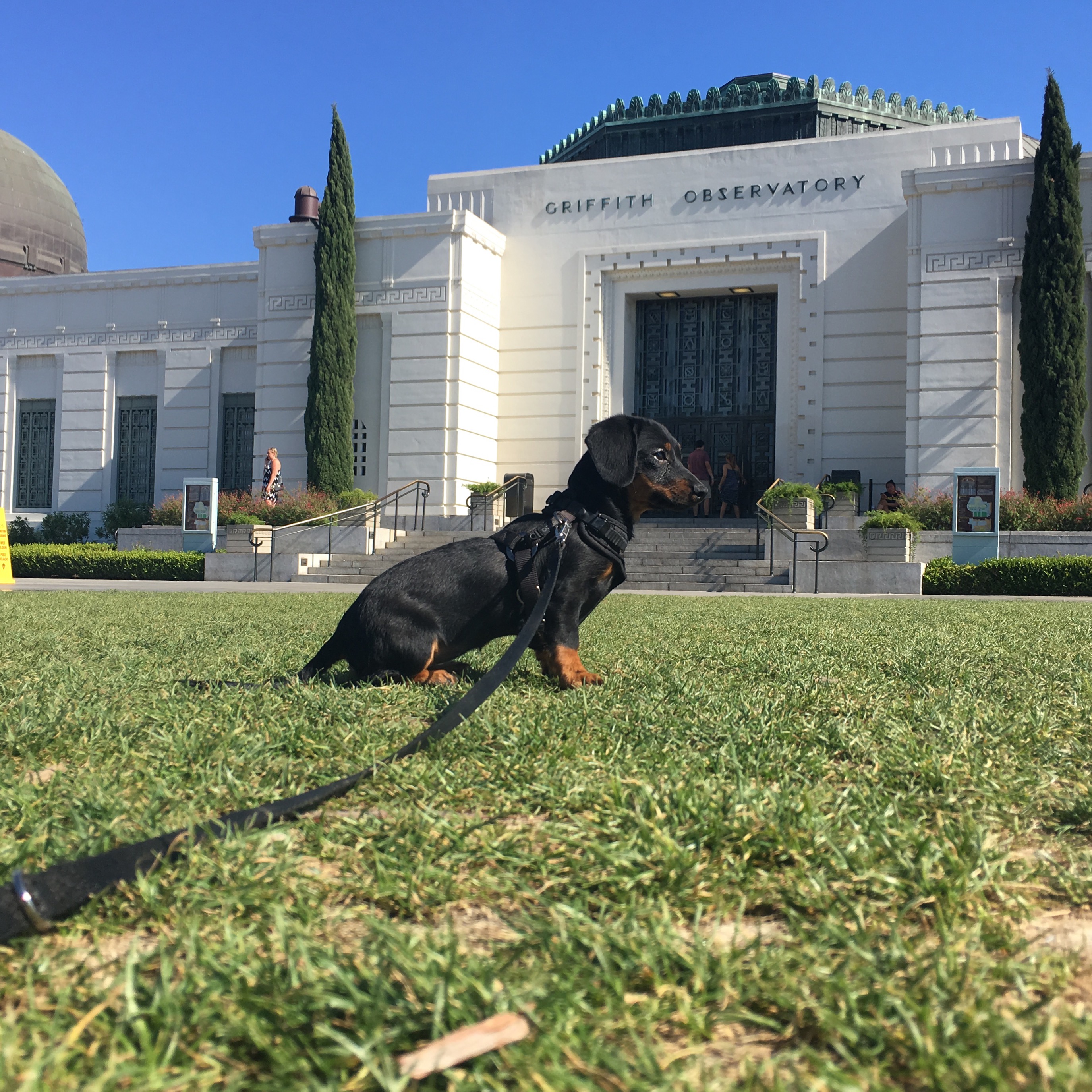
IMG_8785

(My dog, Nyx, looking very cultured.)

Cafe at the End of the Universe at Griffith Observatory, Los Angeles, CA

Cafe at the End of the Universe at Griffith Observatory, Los Angeles, CA

(The café at night.)

I’m looking forward to finding more spots in LA where I can cozy up to a nice book while also enjoying the great city I have the privilege to live in. Perhaps I’ll have a few updates in the future!

Where are the best places to read in your city?
0

Reading the past

Channeling the sixteen-year-old in me (the sixteen-year-old that I most certainly was), when I saw a Buzzfeed quiz* today that would reveal which affliction of La Belle Époque would lead to my untimely death, I really had no choice but to click and take it immediately.

I’ll be honest, I was a little disappointed with my result: broken heart. As a Moulin Rouge obsessed teenager, I thought it the height of elegance to die gracefully and beautifully of tuberculosis (or, as I like to call it, the galloping consumption) much like Satine, the main character. She coughed so daintily, looked so beautiful to the end and, of course, had Ewan MacGregor, the starving playwright, torn to bits at her demise.

Though I’ve since moved on from such childish fantasies (mostly), and I know that tuberculosis is neither a pleasant nor desirable thing to contract, it did get my mind reeling on all the reasons why I love that era and the literary movements that go along with it. Second only to the English Romantics (hello masterful Wordsworth, arrogant Byron and poor, poor sickly Keats), the French Belle Époque is an era of literature that I love dearly and tend to forget about until I’m reminded. I thank the one comparative literature course I took in college as well as any French teachers who tried to get me to read de Maupassant and Baudelaire in their original forms for introducing me to realism, naturalism and even the little bits of Modernism (I’ve read one half of one book of In Search of Lost Time and I consider that an accomplishment).

Such literature strikes a real chord—telling of a world on the precipice of something so different and alive than had ever before been described. Giving heed to experimentation that had theretofore been snubbed and extolling the beauty in the smallest and most quotidian of objects or actions. It’s been years, honestly, sadly, since I’ve given my books from this era a real look, but even reading the names of authors and poets—Zola, Rimbaud, those already mentioned—elicits a visceral reaction that whisks me back to visions of Parisian department stores and muddy alleys that are described with such clarity and honesty by these writers.

I’ve been trying to avoid using the word “romanticize” since I’ve also referenced the Romantics today, but I can’t any longer. Sure, I romanticize the era, seen through the rose colored tint of artwork and nostalgic whims of a reader in today’s fast paced, technology-obsessed world, but there is also an inherent liveliness to the work itself. Filled with urgency and excitement (and not without a heavy dose of nostalgia of its own), the literature of La Belle Époque is at once dreamy and intensely relatable.

My musings aside, do you have any favorite literary movements that still get your heart racing and brain whirring even if you don’t read them regularly?


*stop panicking, the quiz is here.

9

Book’s too long or life’s too short?

Jim McCarthy and I spend an inordinate amount of time instant messaging each other about everything from our lunch orders to what horrible fashion choices Lena Dunham has made lately.  This morning, our exchange went like this:

 jmccarthy@dystel.com 9:09 am
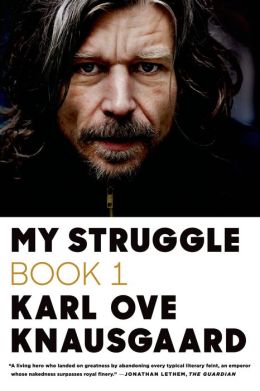
have you heard about this 3,000 page norwegian autobiographical novel My Struggle?

Mcgoderich 9:10 amMY STRUGGLE by Karl Ove Knausgaard
uh…no
sounds…deadly

 jmccarthy@dystel.com 9:11 am
it’s getting an absurd amount of press. i decided to give it a shot. i’m 50 pages  into volume 1 (of 6), so i can speak on it pretty authoritatively.
it’s…really good
so far

Mcgoderich 9:12 am
what’s it about?

 jmccarthy@dystel.com 9:14 am
it’s kind of just about his incredibly ordinary life. and it feels like it should be just a whole lot of navel-gazing except for the fact that he’s incredibly thoughtful and brutally honest.

Jim and I tend to have similar responses to fiction (with the glaring, appalling exception of Atonement, which I consider brilliant and he “meh”),  so I generally trust his judgment when it comes to recommendations for new reading material.   But, while we are both voracious readers, Jim still has the will and wherewithal to tackle massive literary novels with relish whereas I often look on them with fear and trepidation.  I feel like what he’s describing above can be handled by Nicholson Baker in under 300 pages.  Three thousand pages full of “the ordinariness of life, which is sometimes visionary, sometimes banal, and sometimes momentous, but all of it perforce ordinary because it happens in the course of a life, and happens, in different forms, to everyone…,” as the New Yorker puts it, makes me just want to take a nap.

Maybe it’s old age, mommy brain, or general crankiness, but I want my fiction to be more…extraordinary.  And shorter.  Yeah, definitely shorter.

What about you guys?  Do you gravitate towards this kind of minutely observed life narrative or do you shelve it in a corner of your mind under “some day I’ll read Finnegan’s Wake”?

1

What’s in a name?

Yesterday, I tweeted this piece about how reading literary fiction (vs. popular fiction) develops our ability to understand and decipher social cues that power our relationships with other people.   My initial reaction to the article was, “Hmmm, interesting.  Makes sense.”  I think all self-respecting bookworms would agree that books teach us much more than facts and big words, they teach us human behavior.   So, of course literary fiction would sharpen our abilities to identify emotional and intellectual motivations and apply them to ourselves and our real-world dilemmas.  After all, wasn’t that the point of all those tedious essays we wrote in high school and college about why Emma Bovary was so delusional or why Ahab couldn’t just leave that dumb whale alone?


But something about the piece troubled me, and my “Aha!” moment came when I read this slightly different take on the New School study.  In the first article the examples of popular fiction were Danielle Steel’s The Sins of the Mother and Gillian Flynn’s Gone Girl.  Literary fiction, on the other hand was represented by Tea Obreht’s The Tiger’s Wife, Don DeLillo and Anton Chekhov.  Okaaay, who decided that Gillian Flynn is more popular than literary or that she should be featured in the same sentence as Danielle Steel?  Before you Steel fans get all worked up, I am not casting aspersions on that author’s prodigious body of work.  I am merely saying that just because a book sells a lot of copies and hangs out on the bestseller lists for a while does not make it “popular fiction” as the literary snobs among us think of it any more than tiny print runs and fewer sales make something “literary.”  And so claiming that Flynn’s brilliantly crafted, psychological thriller is for the purposes of this study less literary than Obreht’s book* seems to point to a major fault in the findings if, in fact, that is the criteria for judgment.

All of this, of course, takes us to the old publishing pastime of arguing over whether something is literary or commercial.  If sales are the basis for categorization, then Cormac McCarthy, Phillip Roth, and, yes, Mr. Dickens would all be labeled popular fiction authors.  Of course, the study makes the point that a “literary” work is one that is more concerned with its characters’ internal processes and less with plot and action, thus forcing us to work harder at deciphering motivation.   But haven’t we all read many plot driven novels that have been raised to the literary canon?  Ahem, Mr. Dickens, again.

Personally, I think that most fiction flexes our mental muscles.  Even formula romance (or mystery, or science fiction) forces us to look for motivation and emotional cause and effect.  Maybe some books make us work harder and, therefore, give us the brain equivalent of a six-pack, but my sense is that I’ve learned a thing or two even from wildly popular fiction that I may not have by reading only highbrow stuff.

What do you think?  Is it possible that the bias in this study is “literary”?  Can you think of samples of popular fiction that forced you to bring out  your empathy/social decoding tools?


___________________________________

*In the interest of full disclosure, I hated that book.

18

You can’t have it all.

Everyone knows who Dan Brown is. Even people who aren’t active readers are familiar with his name, as they are with Nicholas Sparks, James Patterson and Jodi Picoult. Thesea re prolific authors, there’s no doubt about it, and you can find a whole shelf of them in nearly any bookstore. Authors like David Mitchell, Jhumpa Lahiri and Jonathan Lethem, however, don’t have nearly as much name recognition, despite garnering amazing critical reviews in places like the New York Times Book Review.

Surely both sets of authors love what they do. All experience the glorious rush of inspiration and, conversely, the frustrations of writer’s block or dead ends. But what sets them apart from one another? Does either group feel better about themselves because they are invariably commercial writers or literary ones? Surely there’s no real distinction between them as writers­—they all write, they all call themselves authors and rightly so.

There are clear merits specific to each set, however. There’s obviously more money involved in being a commercial author, yet more prestige comes from fitting into the latter category. While I can’t imagine one can make the choice in writing style—a novel written by an author who forced him or herself to think and write differently to what came naturally would just not be that author’s best work, no matter how technically perfect it was or how imaginative the idea.

That brings me to my question—no, I’m not here to start an argument pitting the two sides against one another. This is simply something that intrigues me. If you had to choose a particular author’s career to mimic, whose would it be? Would you prefer to be widely successful, raking in money and selling millions of copies of your book, but maybe suffering derision from high-minded literary snobs and going overlooked time and time again by reviewers? Or would you rather stunning, eloquent reviews and intelligent, deep discussion of your work amongst a small few, seeing only moderate success sales-wise? While there are some authors who have managed to bridge the gap and have both critical and commercial renown, it’s a very exclusive club. What say you?

2

Mentors and Monsters

In the spirit of Miriam’s post on literary influences, there’s a piece about literary mentors in The Millions, http://www.themillions.com/2011/06/lighting-the-way-on-mentoring-and-being-mentored.html and I‘m curious to learn more about your experience, either with (or as) a mentor. So often we think of writing as a solitary pursuit, but such literary relationships do exist.  My sense is that outside of MFA programs, they can be hard to establish and perhaps hard to navigate. A few years ago Free Press published Mentors, Muses and Monsters: 30 Writers on the People Who Changed Their Lives. You can read Joyce Carol Oates essay, “In the Absence of Mentors, Monsters” in the (always superb) Narrative Magazine. http://www.narrativemagazine.com/issues/fall-2009/absence-mentorsmonsters

6

Under the influence

Driving into the City on Monday, I heard a snippet of a segment on NPR where they asked their listeners to discuss books that have influenced them.  I made a mental note to look up the program online when I got to the office and had forgotten all about it by the time I’d crossed the GW bridge (now, of course, I can’t find the link).  But, the subject stayed with me.  As a result, I’ve been noodling about the influence of books for the last couple of days.  Obviously, all of us bookworms have been swayed by literature—both high and low—but how, specifically?  It’s rather obvious that books shape our intellectual growth but what about other areas of our lives?  How much of our beliefs, tastes and dislikes, career paths and other big-ticket choices have been influenced by books?

I think every aspect of my life has been touched by books.  For instance, I believe my view of politics and policy was shaped by those “You Were There” books about the American Revolution that I read in elementary school and all those biographies of three-letter presidents (FDR and JFK); my ideas of romance were an unholy mish mash of Jane Austen, Charlotte Bronte and Colette, Mary McCarthy and Jacqueline Susann; my career choice owes a lot to Hemingway’s A Moveable Feast; and my general take on the human condition far too impacted by the darkness of Russian novels and the sinister whimsy of Latin American greats like Borges and Garcia Marquez….

But, when I tried to think of one book that influenced me above all others, I couldn’t.  It seems that, for me, literary influence is an aggregate of themes and ideas culled from, probably, every book I’ve ever read.  Even in the most banal, tedious narratives I’ve been able to find a phrase or thought that influenced my thinking or my doing.  And, that, to me, is what’s so amazing about literature.

So, what are the books that have influenced you?  Is there one title (or many) that you can claim changed your life?

8

Author Smackdowns

As a follow-up to my post last week, I was going to jump in with a response piece. Now I know why you write, so here’s why I read. But Miriam totally beat me to the punch. How dare she?!

So it’s an about face and on to talk again about commercial versus literary fiction. Or really, commercial versus literary authors. On Saturday, I was going to attend an event called An Afternoon of Failure which was a bunch of authors getting together to discuss whether we have failed literature or if it has failed us. I figured it would be pretty self-congratulatory and very anger-inducing, but what can I say? Sometimes you need a little dose of pretension to get the blood boiling. Of course, as is only fitting for an event called “An Afternoon of Failure,” I sat down on my couch shortly before I was to leave and found myself waking up two hours later having completely missed the whole thing. Oops! Regardless, this sounded like a bunch of marginal authors hanging out together mourning the state of current literature and making some absurd argument about how books stopped being good after…(fill in the blank).

As someone who just plain loves reading, I often feel caught between the hyper-literary and ultra-commercial. It doesn’t really make sense to feel trapped since the lines are so superfluous, but both groups tend to take themselves too seriously. Whether it’s literary authors griping about how “good literature” never sells or commercial authors whining about how dull literary fiction is, it’s still snobbery. Over at The Morning News’s Tournament of Books this morning, Jennifer Weiner who often bemoans the ways commercial fiction is belittled said that Jennifer Egan’s A VISIT FROM THE GOON SQUAD was “no fun.” I literally gasped in horror. She went on to say, “Egan’s book seemed more like an exercise in Let Me Show You How Clever I Am than anything as lowbrow as entertainment.” Which completely misses the point since the book is wildly entertaining AND fun AND funny. But more relevantly, it’s the kind of inter-author sniping that is so common and so mysterious.

I’m not going to lie: sometimes it’s super fun to see authors on the attack because people who write for a living tend to come up with THE best put-downs. I still don’t fully understand these sorts of literary rivalries, though. Is it the competitive nature of the industry putting people on edge? Is it petty jealousy? Is it a sincere belief in one’s superiority? Haters gonna hate. But I wonder why other people think that is.

To close, I’ll offer my favorite ever moment of inter-author bitchery. Mary McCarthy (sadly, no relation) went on Dick Cavett and suggested, regarding Lillian Hellman, that “every word she writes is a lie, including ‘and’ and ‘the’.” It’s too good. So maybe the better question is, how secure do you have to be in your own intelligence and wit to take an author on?

14

The good, the bad, and the unputdownable

by Miriam

One of the assets of a pricey liberal arts education is that you can turn on the literary pretentiousness with the best of them and then tuck down with your popcorn title of choice, feeling confident in the fact that you know the difference between what’s great and what’s the intellectual equivalent of a Twinkie. Aside from the days of suffering through various soporific graduate school seminars, I’ve never really spent much time agonizing over my literary tastes. I pretty much read from every category of fiction and nonfiction and can find value and entertainment in all but the most execrable writings.

Which is why I like this piece by Laura Miller in Salon. Sure, Dan Brown, Stieg Larsson and James Patterson* may not be on same artistic level as Jonathan Franzen, Ian McEwan, and Ann Patchett, but as their legions of fans will attest, you can’t put down their books once you’ve started them. You may hate yourself in the morning, but you’ll stay up way past your bedtime to get through every last pagefull of clichés, awkward character development, ridiculous plot twists and workmanlike prose though they may be. Thing is, a good story is a good story is a good story. And, there is craft (and sometimes genius) in telling a good story whatever the author’s writing abilities. There is a great deal of bad writing in my life that I am grateful to have read. And, I hope there’s a fair amount of it left in my future. As long as it’s good, of course.

What are your examples of good bad writing/writers?

*Whose work I’ve excoriated for years‘cause, you know, I’ve got that pretentious lit-major-followed-by-a-career-in-publishing thing to live up to.

24

Picking your battles

by Jim

As Jessica discussed last week, authors Jodi Picoult and Jennifer Weiner have been vocally irritated by the raves for Jonathan Franzen’s new book, Freedom. They’ve lashed out at the New York Times for focusing too much on white male authors but also for their almost complete discounting of all commercial fiction. These are points that lend themselves to ample debate. I’ve mentioned before that I think fiction across categories and types can be brilliant. And I have ample concerns about the blinding whiteness of the literary landscape (which is a topic for a whooooole other post). So why do I find myself so irritated by the articles coming out?

First of all, it’s a little tough to stomach the argument when it’s coming from two of the bestselling authors in the country. Why are they so angry they aren’t getting reviews? Can’t they just dive into their money a la Scrooge McDuck whenever they need to feel loved? I’d find this a lot easier to stomach coming from someone straddling the commercial/literary divide who hadn’t broken out and needed reviews to break through.

Second, did you catch this in the Guardian article? “Picoult also criticised Kakutani’s use of the word ‘lapidary.’ ‘Did you know what [it] meant when you read it in Kakutani’s review? I think reviewers just like to look smart,’ she tweeted.” Oh no, she didn’t… Mocking someone for using a “smart” word is already ignorant. But coming from an author? That’s disgraceful. Working with language is what you DO. If you want to understand why people don’t take you seriously, you probably shouldn’t indicate that you yourself don’t take the language that seriously. Not knowing the word? Totally fine. It’s not like I don’t make regular stops at dictionary.com. But Picoult’s tweet is just anti-intellectual and insulting.

Mostly, though, I’m annoyed because these articles are linked to a novel by someone whose last effort, nine years ago, was a masterpiece. People aren’t excited about Freedom because it’s by a white man. They’re enthusiastic about getting to dive back into the landscapes of the person who created The Corrections, one of the best written, most deeply moving novels of the past decade. Pick on someone divisive like Jonathan Safran-Foer or someone whose output is uneven like Jonathan Lethem. Hell, they even have the same first names and all live in the same borough of New York City. But attacking Franzen…you’re just sabotaging your own arguments.

I’m probably exposing all sorts of biases here. What do you all think?