Category Archives: favorites

3

Little House in the Big City

Polar vortex, snowmaggedon, bombogenesis…whatever you call it, this has been one cold, snowy winter. Even the DGLM office closed early due to blizzard conditions last week! Well I, and anyone else who grew up reading the Little House on the Prairie series, am undaunted by this harsh winter. Thanks to Laura Ingalls and her family, I am more than ready to twist hay into braids to be burnt in the stove, and fill my pockets with baked potatoes for warmth.

Okay, so some of these measures might be unnecessary – there aren’t a lot of clotheslines to be found between my apartment and the subway line, unfortunately. But I was pleased to discover that one Little House winter delight is still alive and well: Molasses Snow Candy! You can read the recipe there on the official Little House website, and if you’re still skeptical, check out this blog post from a mom who tried it out for herself with her kids.

I can’t wait for the next big snowstorm so that I can try this out for myself! (Maybe Laura Ingalls would be brave enough to eat week-old NYC snow, but not I!) In the meantime, I’m taking this quiz to find out what Little House girl I would be, and visiting the Union Square farmer’s market to look for molasses.

Anyone else secretly wishing they could spend the winter in a log cabin? What are your favorite winter survival tips from books?

0

Ready for a little test of your literary instincts?

Don’t cheat and skip ahead to the pictures!

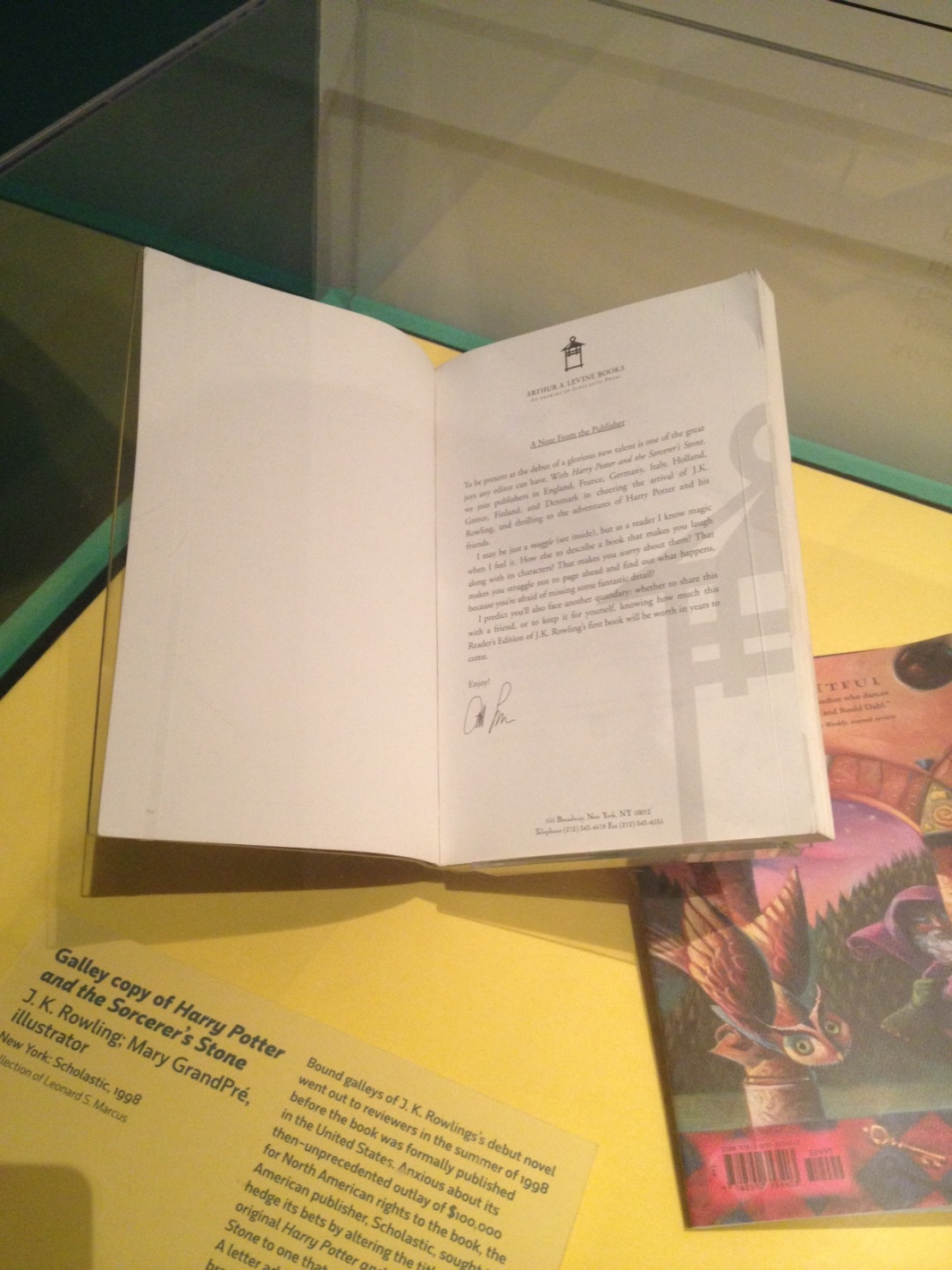
The following is the final paragraph of the galley letter for WHAT very popular book:

“I predict you’ll also face another quandary: whether to share this with a friend, or to keep it for yourself, knowing how much this Reader’s Edition of __________’s first book will be worth in years to come.”

Any guesses?

Here’s another clue. The galley letter is signed by Arthur Levine…

Written for a debut novel that his eponymous imprint at Scholastic purchased for $100,000…

And this galley mailing happened in the summer of 1998…

Being brilliant and super knowledgeable about publishing lore (as all regular readers of the DGLM blog are), I’m sure you’ve guessed that this mystery title is Harry Potter and the Sorcerer’s Stone.


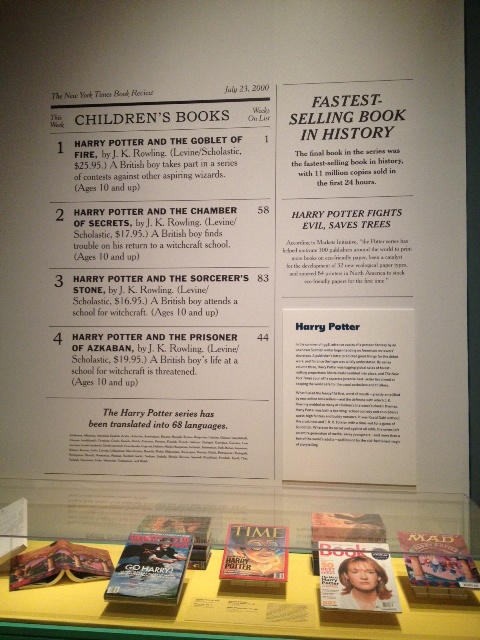
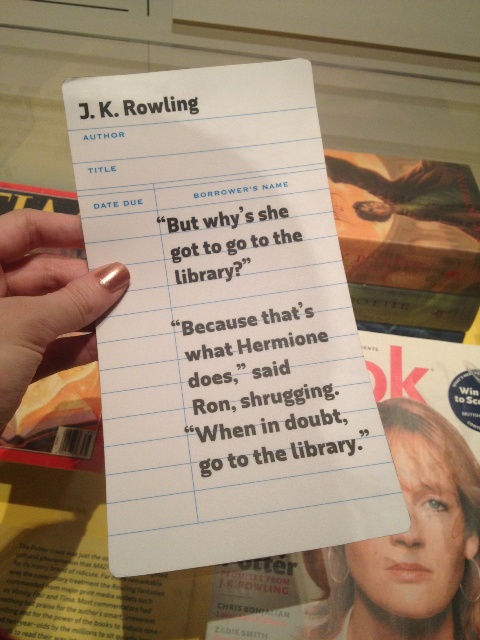
  I learned all this delightful trivia from The ABC of It: Why Children’s Books Matter, an exhibit at the New York Public Library’s historic Bryant Park branch (yes, the one with the lions out front). The Harry Potter area caught my eye, as I am currently in the middle of a delightful re-read of the series, which I only read for the first time a few years ago. (I know, I know, hush!)

Sound philosophy, even for muggles

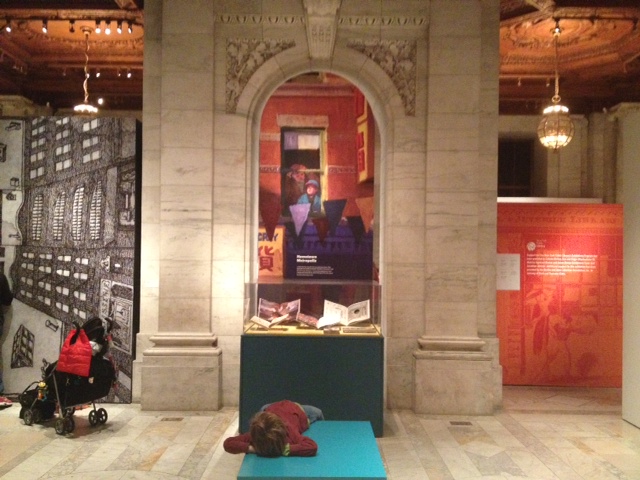
Now it’s no secret that I’m a sucker for children’s books. And the exhibit area was full of artifacts from other children’s literature. You can stop by and see the original Winnie-the-Pooh plushies that inspired A.A. Milne or Frances Hodgson Burnett’s handwritten manuscript for The Secret Garden. One display discusses classic NYC-themed children’s lit (hooray for From the Mixed-Up Files of Mrs. Basil E. Frankweiler!), and there’s even a Goodnight Moon reading nook with battered library copies of all your favorite picture books. Quite a few families were curled up on the rainy Sunday afternoon that I visited, and I was tempted to grab a Wild Thing and join them.

Not all attendees were as riveted as I was.

1

Keeping up with old favorites

I have a not-so-great confession to make: I am TERRIBLE about keeping up with my favorite authors.

Case in point: various sources are reporting that Jim Crace’s HARVEST is the favorite for this year’s Man Booker Prize. Now, I first came across Crace back in 2000 when his novel BEING DEAD came out. I guess something about the review in the Times struck a chord with my more macabre impulses, and I remember getting it out of the NYPL, devouring it, and then loudly proclaiming that he was my new favorite contemporary novelist.

So when Crace followed up with THE DEVIL’S LARDER, I actually went out and bought a copy on pub. And then… I totally lost track of him. Granted, it took a while for his next book to come out, but even so, he’s been basically off my radar until this week. And it’s not just Crace that I’ve lost track of, or other comparably literary authors. I’ve bailed on Michael Lewis for long stretches, David Sedaris, Walter Mosley, even John Green–one of these days I’ll get to THE FAULT IN OUR STARS!

The funny thing is, in other media I’m much more loyal—I’ll immediately download the latest releases from favorite bands, cheesy action movie sequels regularly appear in my Netflix queue, and I’m still watching TOP CHEF. But when it comes to books, for whatever reason—too many choices, too many submissions, too many faves, too little time—semper fi I ain’t.

So, the question: am I alone in this? Or do you often lose track of your one-time favorite authors? If it’s just me, then I’ve clearly got some reading to do.. starting with HARVEST!


3

Less is more

I judge books by their covers. Literally. And so does everyone else.

Lately, I’ve handed down some pretty harsh judgments. Not many covers have really called to me in recent months. In fact, the covers that catch my eye tend to be the least obnoxious, the ones with the simplest designs and quietest colors.

For instance, check out Boris Kachka’s HOTHOUSE.


I mean, c’mon. That’s a pretty cool cover. Nice color contrast and some fancy text. This book has absolutely everything going for it. Check out Jane’s post, and you’ll see what I mean.


What about this one?


Chad Harbach’s THE ART OF FIELDING has a pretty similar style to Kachka’s HOTHOUSE, and again, I love it. When in doubt, you can’t go wrong designing a book cover with some nice colors, and flowing script.


Once again, less is more:


One of my all-time favorite reads, too. But I’ll get to that in another blog.

Now, I know what you’re thinking: this guy just doesn’t like book covers with pictures. Wrong!


One chair leaning against another chair: that’s some real stuff. Simple yet beautiful.

And the minimalist cover to end all minimalist covers:


In case you missed it:


Who wouldn’t want to pick this book up and see what it’s about? ONE RED PAPERCLIP by Kyle MacDonald may just have the best cover of them all.

So I guess I’m a minimalist. (What would my parents think?) How about you guys? What are some of your favorite book covers?

If You Had to Choose

Very recently, I had to play that desert island game—you know the one where you’re stranded on a desert island and have to choose what to bring? It’s all pretend, of course. Just a quick little skip through Imagination Town, a vacation in make believe. Except I was forced to make my desert island choices for real. I’ll explain.

No, I wasn’t stranded on a desert island. Quite the opposite actually: I moved to Manhattan. Granted, moving into a tiny apartment in Manhattan isn’t on the same level, hardship-wise, but coming from a spacious place in the suburbs certainly made things difficult, especially when it came to choosing what books to bring.

Smaller room = less shelf space = the fewer books I can bring. It’s that simple; yet, you find yourself considering some difficult choices. Do you bring that book you’ve read dozens of times with the hundreds of dog-eared pages and even greater number of coffee stains? Or do you bring leave those behind, as painful as that is, to make room for those new books you recently acquired (say at BEA, maybe) and haven’t had the chance to read yet?

In the end, I cheated. One conference call with my soon-to-be roommates, and we worked out a way to put together a respectable library. John brings the Hemingway, while Ryan is in charge of all non-fiction. We managed to make room for everything, from the favorites like Infinite Jest right down to your political thrillers, such as a couple of Vince Flynn’s Mitch Rapp books. Oh yeah, and we have Kindles too…

What would you bring?

1

Old, but not forgotten.

There’ve been a whole lot of nostalgic lists and posts floating around the internet lately, particularly geared towards those that grew up in the late ‘80s and ‘90s. It’s gotten almost ridiculous—there are only so many times you can get excited reminiscing about Gushers, Legends of the Hidden Temple, super soakers, Dunkaroos and Jonathan Taylor Thomas.

That’s not to say the lists aren’t fun—they are—but they can get a little tired and repetitive after a while. I remember in college, if you ever were at a loss of what to talk about with a group of people you didn’t really know (that happens a lot in college), the go-to was just to bring up old Nickelodeon TV shows. The conversation was ever and always the same, but for some reason, it got everyone interested and vying to put in their two cents about Clarissa Explains it All and Are You Afraid of the Dark?

I always pretended to contribute to these conversations, but the truth is, I wasn’t allowed to watch any television growing up outside of PBS. I was one of “those kids.” I’m sure it helped a little to shape me into who I am today, but I’m not here to wax poetic about the values of a childhood not in front of screens, nor about the evils of too much TV* (‘cause I sure did get my fill of Arthur, The Magic School Bus and Zoom until my eyes near fell out). What I’m getting at here, is that the best “remember that” conversations I ever had always had to do with books.

As with television shows, there’s a commonality in the books we all read growing up. As kids and young adults, there were only so many options. Talking about favorite snacks, toys, games and television shows can only get you so far. The experiences with each of those had to have been fairly similar. With books though, as ever, there’s a real individuality for every reader. I re-read books so much more as a kid than I do now, and my connection with my favorite protagonists was fervently strong. Because it’s a subject talked about less frequently, it’s much more exciting when someone casually mentions a favorite book or character from their childhood and there’s a sudden explosive “YOU READ THAT, TOO?!?!” that comes from whomever is in earshot. The conversation, then, can be different and valuable every time.

The other weekend, a friend and I took the trip down to South Jersey, where I grew up, to spend the weekend (not exactly beach weather, but nice nonetheless). She was staying in the guest room where many of my books have been relegated over the years. As a child of an Irish mother, we spent a lot of time overseas in the summer, and it was a special treat for me to bring home books every August that I couldn’t buy in the States. Additionally, my dad would order me Irish-published books from a catalogue one or two times a year (I thought this very cool). Though many of these books became favorites as well, they’re never part of the conversation when reminiscing about old literary friends, as no one had even heard of most of the authors, let alone individual titles.

I had completely forgotten about all of this until my friend, who I should mention now is from Ireland as well, started gushing over my bookshelf. It seems that there was a commonality in the books Irish children read amongst themselves, too! “Your shelf almost exactly matches mine at home!” My friend has been in America for several years now and has surely not had anyone to talk about her favorite characters with for some time. It was a fun trip down memory lane for the both of us, and I couldn’t believe how long it had been since I’d thought of some of those titles.

While I’m sure the readers of this blog have all grown up in different eras, I’d love to know what some of your favorites were as a kid—what characters you wanted to befriend and what stories you read over and over. Unlike Froot by the Foot and Don’t Wake Daddy, I bet there’s a lot more to talk about here.

*That was definitely a Berenstein Bears book, though.

5

Lincoln Love

I can’t say that I’m much of a history buff, but there was an interesting article that caught my eye in the Wall Street Journal last week about the overwhelming amount of books there are in the market about President Lincoln. Of course it’s clear that books about Honest Abe sell nicely—just take a look at Bill O’Reilly and Martin Dugard’s Killing Lincoln or Doris Kearns Goodwin’s Team of Rivals. And according to the article, a minimum of 20 more books about Lincoln are set to be published in the next year!

But what I hadn’t thought about before that the article explained so well is how one subject—or one person, really—can reach such a wide audience. Besides for the obvious fascinating and fatal historical events, Lincoln as a man was beyond extraordinary. For one, he’s the perfect example of someone who achieved the American Dream, all while experiencing personal tragedies. But, part of what makes him so interesting is that, as the article points out, he is still mysterious: “Scholars continue to debate how and when he came to the decision to end slavery.”

But, if you’re already sick of him, the buzzed about Lincoln movie with Spielberg directing and starring the masterful Daniel Day Lewis is sure to rekindle the flame!

What about you all? Are you a Lincoln buff or is there someone else in history that you prefer to read about?

4

Bookworm=nerd (or does it?)

My son and I were having a conversation about nerds recently.  Another second grader had told him that being a nerd was a bad thing.  I explained that I was a huge nerd growing up and that his father, despite his athletic prowess and popularity with cheerleaders, was also a bit of a nerd.  My kid was intrigued.  “Why were you a nerd?” he asked, and the answer, irrefutable and incontrovertible: “I was obsessed with books.  Still am.”

Of course, plenty of non-nerds love books.  And not every nerd is obsessed with literary pursuits (just think of your friend the techie who has memorized every line from every Star Wars movie).  But, books and nerdiness have a delightfully symbiotic history.

This piece in Flavorwire made me think fondly of the books that I’ve loved in spite of and a little because of their high nerd quotient:  Borge’s Labyrinths, Celine’s Journey to the End of the Night, Sterne’s The Life and Opinions of Tristram Shandy….you get the idea.   These are not books you discuss with your girlfriends over wine and nachos like you would an episode of CSI: Antarctica.  These are the kinds of titles that cause people to roll their eyes at you in disbelief at your pretentiousness or, in a different setting, that will set off endless tedious deconstructions of literary tropes and themes.   As much as I relish my pulp fiction, my popular nonfiction, and my scandalous bestsellers, I still define myself as a nerd because of those, well, nerdy books I read.

So, what books do you love that mark you as a nerd?

7

The sense of a beginning

As we’ve discussed many times on this blog, a truly great opening line to a novel is the holy grail for those who read and write for a living.  A beautiful, evocative, powerful first sentence can mean the difference between committing to a 600-page journey or picking up the remote.  The truth is, most novels, even the ones we decree to be masterpieces, don’t have particularly memorable opening lines.

For instance:  “The madness of an autumn prairie cold front coming through.”

Or, “When the lights went off, the accompanist kissed her.”

Or, “The play—for which Briony had designed the posters, programs and tickets, constructed the sales booth out of a folding screen tipped on its side, and lined the collection box in red crepe paper—was written by her in a two-day tempest of composition, causing her to miss a breakfast and a lunch.”

These are the first sentences of three of my favorite novels of the past decade or so.  Solid openers, certainly, but nothing of the caliber of “It was the best of times, it was the worst of times.”  I believe that these three books (The Corrections, Bel Canto, and Atonement in case you hadn’t guessed) will become classics (if they haven’t already) despite the fact that Franzen, Patchett, and McEwan didn’t knock it out of the park with their first swing.

I just started reading Gone Girl and because it has been hyped to the heavens by everyone I know who’s read it, I was looking for a brilliant start.  And…it’s fine.  It made me want to keep reading but it didn’t grab me in a vice grip and drag me into the book.  To be honest, it felt a bit forced and writerly.  So far, however, the novel’s terrific and living up to the reviews.

My point, and I do have one, is that the first line doesn’t have to be mind-blowing.  It just needs to be good, intriguing, well written.  It should pique your curiosity even if it doesn’t turn you into a quivering mass of anticipation.  Ah, but the next 90,000 words need to keep you interested.   And, then you can try again—with a stunning closer that stays with you long after you’ve finished the book.

Of course, if that’s all too much trouble, you can do what these folks did and write some truly gruesome first sentences.  They will definitely grab someone’s attention.

What are the first lines from novels you’ve loved that didn’t exactly knock your socks off?  And why did you keep reading anyway?

2

The strangest thing

To me, one of the most exciting elements of children’s publishing has got to be the school visit.  I don’t know about anyone else, but I was pretty enamored with anyone remotely famous who showed up to my elementary school.  I can only remember one author ever coming to town, but he earned my undying affection for it.  I read a whole bunch of his books in short succession and managed to get his autograph on my absolute favorite.  And then I told every adult who would listen for ages that I knew a famous, important author.

And who was that man?  Daniel Manus Pinkwater, author of many truly absurd children’s books including The Hoboken Chicken Emergency.

Imagine my delight, then, to see him turn up on this Flavorwire list of the 10 weirdest children’s book authors of all time.  Weird is Pinkwater’s thing, and he’s a master of it.  I’m not sure I’ve read anyone odder before or since.

Pinkwater’s not my only beloved childhood hero to make the list.  All kids everywhere love The Stinky Cheeseman, surely.  Fighting over that one at quiet reading time was a favored pastime in my elementary school classrooms.  And Louis Sachar’s Wayside School books were the most fun a person has ever had doing math.

Maybe as a weekend treat, I’ll go pick up copies of all these now for a trip down weirdness memory lane.