Category Archives: short stories

2

Those conventional publishing rules…are made to be broken

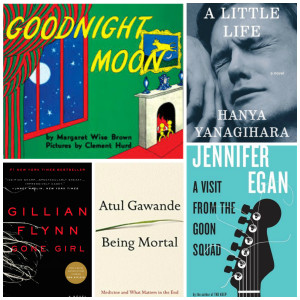
PicMonkey CollageLast week I had lunch with one of my favorite editors and we got to talking about the state of publishing and what was working and what wasn’t.  Somewhere along the line, we began to try to identify all of those “rules” which we were taught about the business—and discovered that in this ever changing world most of them no longer held.

Here are some examples:

Green covers don’t work—and then there was GOOD NIGHT MOON.

Books about dead or abused children won’t sell—now the true crime category is back and books like Hanya Yanagihara’s A LITTLE LIFE have become bestsellers.

Short story collections don’t do well.   And then along comes Jennifer Egan’s A VISIT FROM THE GOON SQUAD.

Books about death are a “no no” but what about BEING MORTAL and WHEN BREATH BECOMES AIR?

And, finally, we all know that books with unlikeable protagonists definitely don’t work, but what about those in GONE GIRL or Meg Wolitzer’s THE INTERESTINGS?

I guess rules are made to be broken and, I have to say, I am always delighted when those in our industry are.  It makes life so much more interesting.

I wonder whether you have any examples of what you have been told definitely won’t work…until it does.  Let me know.

3

Scary Stories

With Halloween just days away, I’m sure you’re already gorging yourself on candy and marathons of scary movies, skirting your reading list or half-finished manuscript to work on your prize winning costume. And that’s fine, but let’s admit there are more productive ways to get your spook on. Why not read a spine-chilling short story?

“A Collapse of Horses” by Brian Evenson is bound to freak you out. The narrator, recovering in a hospital, tied to the bed, tells the story of his mysteriously changing house, where light switches change locations, windows grow and shrink, and one day he has three children, another day he has four. After coming upon a paddock of horses lying as still as if dead, the narrator takes drastic measures to end the madness.

Or if you’re looking for a scary story with more of fun twist, check out “Royal Jelly” by Roald Dahl, in which a man attempts to cure his baby’s starvation by giving her the jelly meant to feed queen bees. Originally published in Twilight Zone Magazine, Dahl spins this weird and freaky tale with his usual hint of humor.

I hope you have a fun and frightening Halloween while using some scary stories to improve your craft. What spooky stories will you be reading this year?

6

The Thing and the Other Thing

In college I had a workshop with the writer Tony Earley, who taught us a theory of putting together an effective short story that I have never forgotten. I’m going to spend a bit of time discussing it today, because it’s fun and it might help you if you’re stuck in your writing.

Your story needs two pieces: 1. The Thing 2. The Other Thing.

To explain how it works, I’m going to just shamelessly paraphrase what Mr. Earley explained, because the details have stuck with me for almost ten years (accurately, I hope!).

Mr. Earley read to us a short story he had recently written, and explained its background: He had been fascinated by Bigfoot believers for years, and wanted to write about them – the Thing – but the story had never quite worked when he sat down to write it. Then, he read a news article about the FBI pursuing a suspect into the woods around his home in North Carolina, and realized that could be the missing piece of his story – the Other Thing. And boom. The Cryptozoologist was ready to be a story.

While Mr. Earley was focused on short fiction, I’ve found the theory of the Thing and the Other Thing applies to full-length fiction and even memoir, as well as short stories – it helps me analyze the bones of a plot when I’m when I’m assessing queries or responding to a client’s story concept. Let’s look for this concept in a few other books so that you can really get a handle on how this works.  

Twilight by Stephanie Meyers Thing: Girl goes to a new school and falls in love (yawn) Other Thing: with a vampire in disguise.

The Goldfinch by Donna Tartt Thing: Boy’s mother dies in a museum bombing and he struggles to find meaning in the rest of his life (yawn) Other Thing: while keeping hidden the painting he stole from that museum.

WILD by Cheryl Strayed Thing: Woman is grieving mother’s premature death while trying to move on from a lifetime of self-destructive behavior (like a thousand other grief memoirs) Other Thing: and hikes Pacific Crest Trail with no experience and little preparation.

The Storied Life of A.J. Fikry by Gabrielle Zevin Thing: Middle-aged widower running a small bookstore (ok, so what?) Other Thing adopts a baby girl abandoned in the store.

Now, I’m not claiming that no book ever could manage to organize itself without clear, identifiable Thing and Other Thing at all. (Bonus points for whoever can pull out the GONE GIRL T. and O.T. in the comments.) But the main idea holds up, and can even help you organize more complex projects.

Maybe you have multiple story lines, and they all have their own Other Thing, so sharing the same Thing unifies the book.  Or maybe your story jumps from era to era and each has the same Thing and Other Thing but in different form for each time and place (David Mitchell, I’m looking at you.)  And there might be a couple Secondary Things. For example, in the Donna Tartt example above, STs are that Theo’s father dies, that his best friend is a drug dealer, that he goes to live with an antiques seller and ends up embezzling from him…but none of those pieces can hang with each other without being pinned to both T. and O.T., right? (Not to mention that we can’t all be Donna Tartt.)

This is probably the longest post in the history of the DGLM blog, so I’ll cut to the takeaway: If you have an amazing idea that just isn’t working, put it in a Thing folder. And wait for its perfect Other Thing to come to you. (And then send it to me!)

4

Spooky times

Coming into mid-October it’s hard to ignore the blatant signs that Halloween is fast approaching. As a kid, I was never really into the scary aspect of the holiday as I lamely get frightened extraordinarily easily. My costumes consisted of things like ballerina, genie (three times running), jester, butterfly, Peter Pan and the like. I preferred to be silly or cute rather than gory or haunting.

Candy—gobs and gobs of candy—aside, for we all know that’s the greatest part of the holiday, I’ve always found the tradition and storytelling around Halloween fascinating. The same stories have been told for years. Classic horror tales are succinct and hard forgotten and I’m sure that kids are still getting spooked by the one about the two prom goers stuck in a broken down car, with the hook methodically tapping on its roof even though cell phones are ubiquitous nowadays.

The scariest story for me, however, was The Girl with the Green Ribbon. It wasn’t particularly chilling or really that horrifying at all. Just a story about a girl who always wore a green ribbon around her neck, referenced throughout the story of her life until the day her curious husband implores her to untie it, despite her protestations. The story simply ends (spoiler alert!) with her head falling off. No aftermath, no more to say. The simplicity of the tale might have been the part the got to me, because I remember being chilled to the bone by this one growing up.

Whenever I mention the story to friends or anyone with whom I happen to be discussing scary things with (happens all the time, guys), I’m often met with blank stares, so it was with delight that I saw the tale hitting #13 on Buzzfeed’s 14 Books That Traumatized You As A Kid the other day. I wasn’t making it up! And I’m not alone!

In the spirit of the season, what are your favorite scary stories (to tell in the dark or the light)?

0

WWYK?

I am typing this on a plane headed for Seattle, happy to be en route to the always-terrific PNWA conference.   I don’t get to as many far flung writers conferences as I did before I had children, but that makes the ones I do attend a particular treat.  I love fielding pitches, talking about the book business and listening to writers who, despite the vagaries of this difficult marketplace, are united by a love for what they do.  It also gives me an opportunity to see my Seattle-based clients, in this case, the prodigiously talented Valerie Trueblood, whose new short story collection, Search Party: Stories of Rescue, was just released yesterday by Counterpoint Press.  Valerie’s previous collection, Marry or Burn, was shortlisted for the Frank O’ Connor prize, and this one (I say without a shred of bias) is every bit as wondrous.

Trueblood writes short fiction that is mind-bendingly capacious. Whole lifetimes and histories, epiphanies and slow revelations are coiled into her stories, like DNA inside a cell. And like a double helix, their structure is impossibly elegant. She is also wonderful because, to some extent, I think she writes what she does not know, quietly flouting what Ben Yagoda in this week’s NYT cites as the third of the three cardinal rules of writing. First is “Kill your darlings” second is “Show don’t tell,” both well-worn but worthy cliches of the craft that I lean on heavily.  This third one I’m not so sure about.  Yagoda concedes that WWYK is a notion is “rightly scorned as leading to the literary solipsism that, in fact, so many short stories, novels, essays and memoirs exhibit.”   Still he argues that the “motto is nonetheless true.”  Yagoda expands the definition of “what you know” to include what you research and learn, thank goodness, but I’m still skeptical.   One of my favorite Trueblood characters is a convicted murderess, and I am pretty certain that Valerie has not done time.

What do you think? Do you WWYN? Where do you come down in your experience as a reader, as a writer? How far do you venture outside your comfort zone?


19

Love stories, in brief.

I’ve written before about my particular love for short, short, short fiction. Their poignancy is sometimes so great that a story half a paragraph long will stick with me all day or longer. I had an entirely different topic planned for today’s blog post, but just before I sat down to write, I took a minute to read some incredibly brief, yet strangely powerful love stories, perfectly appropriate for a post-Valentine’s entertainment. Especially since I just checked, and you guys it’s true, there’s no more chocolate left from the box in the kitchen and I’m feeling a little blue about it already.

Available for your reading pleasure here on the Hairpin, are just four very slight tales of love and romance, ultimately lost, rejected or simply faded away. The strength in these stories is that there is so much, so very much left out of them. There are no character names, sometimes the telling is a very straightforward “this happened and then this happened and then that happened and so there.” But somehow, as readers, we’re able to create an entire narrative arc. We can visualize the lovers, feel their hope, joy, pain, and ultimate loneliness.

It’s not just about writing a barebones plot and not saying much about anything, limiting yourself to a hundred and fifty words or so. Anyone can do that—I’ve tried. There’s a certain space that must be created. A vast emptiness between the lines where the real story lies. A good writer of short fiction can give just the right amount of information and the right type of information so that the story doesn’t feel cheap or lacking, but instead creates the feeling in the reader that they know exactly what the writer meant to be happening in the spaces left blank.

Love stories—particularly those about lost loves—are exponentially more effective when less is told. The emptiness and longing, nostalgia and regret are there simply because they are physically not there on the page. They become haunting instead of merely sad. Their brevity means they can be read over and over again, searching for any more hints of story, clues to what really happened.

I’d be interested in seeing any stories you can come up with in the comments—keeping it under 200 words.* It’s more difficult than you’d think! Otherwise, do you have a similar take on the style, or would you much prefer a long, fleshed out novel instead?


*The writer of my favorite story will be showered in cash and prizes! Minus the cash, but there is a DGLM mug in it for the winning, and you’re welcome to fill it wish cash of your own if you like.


***UPDATE***

This contest is now closed and I am pleased to announce the winner of a DGLM mug is Jan O’Hara! Jan, please email me with your information at rstout@dystel.com and I’ll be in touch!

2

The unusual places we turn to for help

My infinitely wise co-worker Michael Bourret pointed me to this great piece from WBEZ’s radio program This American Life that his client, Joelle Anthony, blogged about recently. (A big thank you to both of them!) There are two really interesting stories here that definitely deserve another post because of their relevance to publishing. The program breaks each story into an act, and in each, as well as the heart-wrenching introductory story in the prologue, we’re introduced to sympathetic characters that turn to unlikely people for help when they’re in trouble.

The first story is about a teenager, Andy, who had problems with his broken family and fitting in at school, so he decided to travel 1,000 miles—alone—to find his favorite author, fantasy novelist Piers Anthony. He impressively found Anthony’s address by piecing together clues from his books, something only a genuine fan could do. When Andy finally arrived at Anthony’s door, though he wasn’t welcomed to live there—as his great imagination led him to believe—he was met with at truly compassionate man who listened to everything the young boy had to say. And even though he didn’t get what he wanted, Andy left the next day feeling, for the first time, the hope that there was a better world out there for him. I wanted to share this tale to once again illustrate the colossal effect a book can have on readers. I’m sure that the very feeling Andy describes at the end of his story is a reason many of us have chosen publishing as a career path—whether as agents, editors or authors.

The second story beautifully re-imagines the plight of poor Gregor Samsa from Kafka’s THE METAMORPHOSIS. Gregor, having famously transformed overnight from a human into an insect, enlists the help of one Dr. Seuss to make Gregor a human again, or at least a healthy bug. I’m going to hold back on giving any more details on this one, as the letters between the two are such a delight to listen to. I will say though, that I really enjoyed the creative way the authors brought these two unlikely comrades together. A recent post of mine was on re-telling classic stories…but what’s really interesting to me is when writers can create a new story from the bones of others. I’m curious if anyone has read any of these types of stories lately. Anything you’d like to recommend?

7

“Men’s fiction”

As a self-described “men’s fiction” guy, I was intrigued by the announcement this week that Esquire is launching an e-book series aptly titled “Fiction for Men.” A collaboration with e-book publisher Open Road Media, the first volume launches in June with short stories from Aaron Gwyn, Luis Alberto Urrea and Jess Walter. According to the Times, a new volume will follow every few months.

To my mind, any new attempt to showcase fiction is to be commended. But I was struck by the idea that the anthology is partly an attempt to answer the question “what is men’s fiction?” It’s a question I’ve certainly pondered as an agent. Yes, it’s reductionist, but “Women’s fiction” is a pretty well-defined category in publishing—if I have a novel that I think falls under the “women’s fiction” banner, I have a good idea of the editors I would approach for that. But “men’s”? Not so easy to suss out.

Now, I know that part of the reason for the lack of definition is that “men’s fiction” often falls into other pretty well-defined categories—thrillers, suspense, mystery, sci-fi, horror, etc. And then there’s the “literary” tag, which often neatly avoids gender-specific designations, though what makes a book “literary” is an even knottier question. But what do you do with a book that’s about men, mostly likely written by a man, yet doesn’t fit into any of these boxes, and to call it “literary” would be a stretch?

Well, on first glance, Fiction for Men doesn’t really help matters. Yes, they’re showcasing some pretty heavy hitters, but wouldn’t Gwyn, Urrea and Walter fall under the literary banner, rather than “men’s”? On the other hand, in the June/July print issue, Esquire has works by Stephen King and Joe Hill, Lee Child, and Colum McCann—Two horror guys, a suspense writer, and yes, a man of letters (i.e, literary!). Of course, who knows what they’ll actually write, but ostensibly, it seems like Esquire is just as confused as I am. Then again, maybe that’s the point…

Perhaps once Fiction for Men gets going, we’ll have a better idea of what Esquire means by the category. And from there, maybe we’ll see if it has any effect on how publishers define their lists. Meanwhile, I’ll throw the question out there–what does “men’s fiction” mean to you?

2

And then her head fell off.

Ghost stories and other scary tales have been a part of Halloween long before candy and fake blood were necessary. You don’t need sugar and theatrics to be properly scared if the mood is right and the words themselves are eerie enough to raise your hair without any help. The classic spooky story is short and told in a voice just above a whisper (except when a shout to surprise is necessary, of course). They don’t need to be complicated or detailed in any way—in fact, the simpler they are, the scarier with lots of room for the imagination to run wild and fill up all the left over space.

I remember being petrified of “The Girl with the Green Ribbon,” though for what reason, I couldn’t say. Locally, the tale of the Jersey Devil haunted me far longer than I care to admit, and thinking about it for too long too late at night still gives me chills.

Classic ghost stories stick through the generations and eventually, everyone knows what the outcome of a particular tale will be right from the very first “It was a dark and stormy night.” The scare comes then from the atmosphere, excitement and anticipation rather than from the story itself. Over at The Morning News, readers were asked recently to submit alternate endings to “The Monkey’s Paw” by W.W. Jacobs, which is a story I am sure I read in every English class every year until I graduated high school. It’s not just scary—it’s grotesque. Some of the new endings are equally (if not more) horrifying, while others take a different, more humorous route.

Whatever the change may be, it got me thinking about how difficult it is to write something that’s actually scary as opposed to campy and overdone. While Halloween often is all about camp, there’s nothing scarier than the quiet, creeping suspense that a good ghost story can offer. Goosebumps, bated breath and a look over the shoulder are the hallmarks of a true spooky tale. What are your favorites? What is it about them that makes them so scary?

4

Once upon a time in a land far, far away…

It’s hard today to find anything newsworthy to read bout besides the royal wedding over there in England, and while all the pomp and circumstance is enjoyable, I don’t fully understand the huge draw the ceremony has for anyone who has no personal relationship to the UK. That doesn’t mean that I didn’t watch the horribly cheesy, not quite so-bad-it’s-good Lifetime original movie, William and Kate last weekend. I mean. Um. I didn’t say that.

Regardless, I suppose that there is something to the appeal, whether or not these particular nuptials have any effect on my life. It’s the idea of princes and princesses. Despite that in reality modern monarchies are nothing like we read in fairy tales, the charming princess and dashing prince living in a palace in the middle of a valley with a drawbridge and courtiers fresh returned from battling dragons is the image that comes to mind. Especially in America, where there has never been a king, queen or anything of the sort ruling on domestic land, this idea is prevalent. And the allure doesn’t elude me, either!

Despite their non-importance in “serious” literary debate (they are specifically banned for entry for the National Book Awards, e.g.), I will always enjoy a good fairy tale. I had mentioned in a previous post the book, My Mother She Killed Me, My Father He Ate Me, which is a modern retelling of fairy tales and a book of short stories that I read voraciously. There’s just something about the ethereal tone that always surrounds a fairy tale (I wish I could describe in words the voice that automatically plays in my head as I imagine them being read aloud—but probably you know it, or have one of your own, anyway) that makes it ever-appealing. Surely there is literary merit in the telling of a fairy tale just as there is in the creation of any story, but I’m not qualified to judge. It does have something to do with the fact that the sources of inspiration are, by definition, unoriginal—I would think, however, that the retelling itself would be proof enough of creativity and talent.

Loosely based on, or completely authentic, what are some of your favorite fairy tales? (I know the ones of my own that I’ve started to write (and abandoned, of course) nearly always have to do with princesses, but generally the fairy tale of inspiration is merely a backdrop to the story I want to tell.) Is there any serious writing to be found here?

Most importantly, who wore the best hat to see William and Kate tie the knot?