Category Archives: optimism

2

Boats against the current, borne back ceaselessly into the past

I read today that, over the weekend, the house that some believe to be the inspiration for F. Scott Fitzgerald’s The Great Gatsby was torn down. The property, located on Long Island’s Gold Coast, will be subdivided and replaced by five houses, each with a ten million dollar price tag. The 25-room mansion, sitting on thirteen acres of land, belonged to a Gilded Age of the roaring twenties, a period of artistic and cultural vivacity, and was the site of countless parties, many as described in Fitzgerald’s fantastic novel.

I’m a sucker for period architecture, so it’s sad to see a beautiful house with a storied history get reduced to rubble. But at the very least, it’s nice to see it live on in the pages of a novel that certainly claims a firm spot within American literature.

4

The Children are Our Future

I spent much of last week at the Romantic Times Booklovers Convention in downtown LA. It was, as one would expect, delightful. I won’t bore you with all of the details of the conference. Suffice to say it’s thrilling to spend time surrounded by dozens of bestselling authors; the Mr. Romance pageant was cheesetastic fun; and Bottega Louie has amazing éclairs.

The most heartening aspect of the event for me was the massive Sunday book fair which then rolled into “Teen Day,” a separate event with the RT young adult authors being led through a day of activities from reading selected short pieces to rotating through groups of teen readers for chats. Authors seem so much more accessible than they ever did to me as a teen. While I’m sure there were author tours and events when I was a teenager, the reach of information via author sites and outreach and the scope of the events themselves seems ever greater. I don’t think I ever even thought about writing to an author. They seemed like distant, near mythical beings. Working in publishing divested me of that feeling pretty quickly! I kid, I kid. The point is, from the outside, it appears that teens are much more engaged in the reading process than they ever were before.

Maybe because I’m a ridiculous optimist about publishing in general, but given the growth of the young adult market and the fact that there is a generation raised on blockbusters like Harry Potter and Twilight, I have a completely unscientific hunch that reading is becoming a more popular pastime then it was when I had my nose buried in Fear Street and that there will thus be more adult readers in the next generation than my own produced.

What do we think? Are there going to be more readers buying books in the coming years? Is there job security in publishing after all? ARE the children our future?

12

The Ultimate Lesson

With all of the negative talk about the future of book publishing and what is going to happen to reading and writing, I was reminded this week of a lesson I learned early on: Never give up!

So often during the course of our work, we get discouraged.  Publishers don’t see the proposals or manuscripts the way we do, Authors are depressed when we can’t sell their work right away and we become exhausted by rejection.  Indeed, when I first started out as an agent I would take this rejection quite personally.  Then I had a chat with myself and realized that if I continued to do that, I might as well find another career.

Over the years, I have had my fair share of rejection, but I have also experienced many instances where, after trying and trying to sell something I believed in and refusing to give up, I’ve ultimately succeeded and seen the book I sold become a huge success.  Some examples:  The Simplify Your Life series, In Memory’s Kitchen, Artisan Bread in Five Minutes a Day.

This week I sold a novel I had shown to over 40 publishers.  I believed in this novel and in its author and I decided I simply wouldn’t give up; the author continued to encourage me to keep going and I did.  Finally, last Thursday afternoon we had our offer and we completed our deal on Friday.  The novel will be published next April.

Once again, my confidence in the value of persistence was renewed.  I’d love to hear your stories of grit and perseverance.

9

The future of publishing

I ran across a fun article this week in McSweeney’s entitled “The Future of Books” which I thought I would share with you. There is no question that this is written tongue-in-cheek, but I found it particularly meaningful in a week when some big events happened that certainly are representative of the exciting things that are transpiring in our business.

First thing was that Barry Eisler decided to cancel a half-million-dollar, two-book deal with his publisher to self-publish, primarily electronically.  This played out in the media and during an interesting and enlightening conversation between Eisler and our client Joe Konrath. Then, later in the week, Amanda Hocking who has been selling her young adult paranormal books very successfully online decided that she wanted to auction her new series to a traditional publisher rather than self-publish, saying that she feels that self- publishing has its limits.

This is a subject that is going to inspire debate and probably some significant change in the way publishers, agents, and authors do business over the coming months and years. Everything in this area seems to be moving very fast.  In my opinion, all of this change is interesting and exciting in a business that has been more or less stagnant for many years.  As I have said before, I think reading will be on the upswing as will writing—hopefully good writing.

I would love to know what you think.

10

Fears and hurdles and send buttons

In my daily swim through queries, I’ve noticed an interesting trend in opening sentences—something to the effect of “I feel that now is finally the right time to send this your way,” or “I’ve been sitting on this novel, too afraid to send it out until now.” Which leads me to believe that as many people as there are that email me telling me they’ve gotten over the fear of reaching out, there are just as many–if not more–who are still hesitant to hit the Send button. In past blog posts I’ve talked about the query process, but today I wanted to dig a bit deeper and reach those who haven’t yet cleared that first hurdle.

My question is: what’s holding you back? Maybe it’s timing, maybe it’s perfectionism. And I’m willing to guess it also rests in that highly inconvenient fear we all experience throughout our lives of rejection.  But I won’t deny that you also probably feel the odds—technical, rather than emotional—stacked against you.  If you’re keeping yourself informed and involved, reading blogs, and doing whatever you can to learn more about the industry, there’s no doubt that you’re hearing different advice from different sources: “do this” or “don’t do this” or “text attached” or “text included in the body” or “spell check.” Everyone remembers spell check, right?

The fact is, it’s competitive out there, and a realistic attitude is an imperative. And expectations are inevitably high because we want to see the absolute best that you have to offer. It’s a tall order, I won’t deny it.  But here’s the thing: sometimes you have to tune out the noise and dive in. Of course you want your work to be as perfect as it can be, but you also can’t wait forever for that perfection to happen.  At a certain point, you have to go for it, because you never know what could be waiting for you on the other end.

Are any of you out there are feeling this? I’d love to hear your thoughts.

1

The young and the famous

By now you regular blog readers know that I am the agency’s eternal optimist. I’m always interested in and often talking about the uplifting, inspiring stories of authors finding their way or books making a positive impact on people. So I was happy to see this nice piece by Charles McGrath (Riverhead editor Sarah McGrath’s dad) in yesterday’s New York Times which highlights not only the author, Téa Obreht’s (age 25), amazing success with her first novel, The Tiger’s Wife, but also calls attention to the young agent who sold it, Seth Fishman (age 30), and the young editor who acquired it, Noah Eaker (at age 26, as his second acquisition). Thanks, Charles, for pointing out those important behind-the-scenes players! It’s so refreshing to see success stories from young people just getting started in their careers, and it looks like this is quite an auspicious start indeed. The novel has received unanimous praise and reviews that describe the novice author as talented well beyond her years. I am eager to read the book, and look forward to submitting my own projects to her editor, who (not surprisingly) was recently promoted. I think it’s a pretty good guess we’ll be seeing the novel on bestseller lists in the coming weeks. Who’s your favorite young author with an old writing soul?

7

Hold the handbasket

Because I spend much of my time poring over unpublished manuscripts, my timetable for reading recent releases can be erratic. Sometimes I’ll read a galley and get a jump on the books of the season, but more frequently I play catch up with the bestseller lists.  Only a year or so after it hit the NYT list and months after Stacey pointed to it as an example of superb nonfiction, I got hold of the paperback edition of Rebecca Skloot’s The Immortal Life of Henrietta Lacks. Perhaps it is more accurate to say that the book got hold of me. “Gripping” is rarely a word associated with narrative science, but Skloot’s book is powerful, provocative and moving, and I stayed up until the wee hours to finish it. I’ll leave the reviews to the reviewers, adding only an “amen” to each rave, but in TILOHL, I found not only a tremendous literary achievement, but also an  occasion to bask in the happy feeling brought on when Good Things Happen to Good Books. I don’t mean to go all Polyanna here, but we are all involved in an industry renowned for its dire self-assessments and apocalyptic predictions (here in Bookworld, The End is always near) so it feels especially nice to encounter a project that signals that the publishing business is not so bankrupt, moribund or rigged as it is often accounted. Rebecca Skloot’s book was obviously a monumental effort, a ten-year project underwritten with credit cards and student loans as she attempted to reconstruct the life of a woman whose cells—taken and used without her consent—have contributed to most every medical advance of the past 50 years. A worthy subject, certainly, but also, given Skloot’s close involvement with the Lacks family, a messy and unpredictable tale that is not easily folded into a single, cogent book. That this richly deserving read about a raft of difficult subjects—cancer, biology, race relations, biomedical ethics, just to name a few—made it to press (this is a story in itself, involving three publishing houses and many editors) and has been such a resounding success might offer a moment’s respite to the literary pessimist/eschatologist in each of us. Surely we’re not headed to hell in a handbasket if books like The Immortal Life of Henrietta Lacks can triumph.

Are there any books that you’ve read recently that, even for a moment, restored your faith in the book business?

1

The future of our industry and those who will make it work

This last Wednesday, I spent a couple of hours selecting the winners of the 2011 Dystel Publishing Fellowship.  The Fellowship—named for my father Oscar Dystel, a well known leader in the publishing industry and former CEO and President of Bantam Books—consists of tuition scholarships awarded each year to outstanding graduate students in publishing. It is part of the Master of Science in Publishing program at New York University’s School of Continuing and Professional Studies.

The Fellowship recipients are selected by a group of distinguished professionals in the publishing community:  Irwyn Applebaum, former president and publisher, Bantam Dell Publishing Group; Jane Friedman, CEO and co-founder, Open Road Integrated Media; Martha Levin, executive vice president and publisher, Free Press, Simon & Schuster, Inc.; Robert Miller, group publisher, Workman Publishing; Sara Nelson, book director, O, The Oprah Magazine; Stephen Rubin, president and publisher, Henry Holt & Co., Macmillan Publishing; Lorraine Shanley, president, Market Partners International, Inc.; William Shinker, president and publisher, Gotham Books, Penguin Group USA; Daniel Slater, senior manager, author and vendor relations, Kindle Content/Amazon; and Peter Workman, president and publisher, Workman Publishing Company, Inc.

In the past, we have presented the fellowship to one student but this year the committee was so impressed with the candidacy of two young women that we elected to present a fellowship to each of them:

Joana Costa Knufinke is a Fulbright scholar and a native of Spain where she is a PhD candidate at the University of Barcelona; she is currently working as a marketing and sales intern at Vintage/Anchor Books, a division of Knopf Doubleday Publishing Group at Random House.  She envisions a career as a publisher of fiction either in Spain or the United States and also wants to pursue teaching opportunities in publishing.

Kristin Vorce, is a project editor in the professional/trade division of John Wiley & Sons.  A Magna Cum Laude and Phi Beta Kappa graduate of the University of Delaware, Kristin aspires to achieving a publishing position in either professional or trade books and employing creative digital initiatives to deliver customized content on multiple platforms.

I found both of these young women to be incredibly smart, creative and thoughtful and I am hoping they will one day help to lead our industry in new and exciting directions.  Being a part of this fellowship process is one of the most exciting things I do each year; it enables me to know that I am contributing to the future of an industry I truly love.

I know you will join me in sending congratulations to both Joana and Kristin!

7

Convention time with the kid lit crew

This weekend was the Winter Conference for the SCBWI. That’s the Society of Children’s Book Writers and Illustrators. I was super excited to be invited to participate and was asked to give three one hour sessions on the state of the marketplace, how to get published, and all that jazz.

At the cocktail party on Friday night, I started to try to suss out how other presenters were doing things. After the first person I asked told me that she hadn’t prepared much, “just two or three pages of notes,” I realized I probably needed to get planning. So that night I went home and wrote copious notes about potential speaking points. Notes that I ultimately referred to not a once!

I ran each of my sessions as a q&a and happily had lots of thoughtful questions that allowed me to ramble on which is pretty much my favorite thing to do. My favorite exchange went something like this: “You seem really optimistic about publishing.” “Yup.” “Is that the general feeling in the industry?” “Nope!”

As one of the attendees told me after my session, everyone knows how hard it is to get published. No one needs it crammed down their throats. The fact is, things are challenging for everyone, but great books still sell and still break out. I’ve never thought of myself as a terribly optimistic person, but even in this time of flux, we’ve had some great luck, so it seems crazy to be depressed all the time about changes in the way books are published and sold.

One of the best things about spending the weekend with children’s book authors is that they’re often quick-witted and entertaining. Someone in one of my panels brought up that I say I’m looking for “underrepresented voices,” a phrase that I know trips up a lot of people. To clarify, I said, “Look, I represent a lot of thirty-something white women. And that’s great. I love my clients. But there are other voices out there.” After the panel, someone hung out to talk with me and opened with, “Hi, Jim. I’m brown, and I’m old. Interested yet?” Super cute. Someone else stuck around and told me I was so funny that I should be a stand-up comedian. I told her that flattery will get her everywhere and handed her agency agreements on the spot.

It wasn’t ALL sunshine and happiness. The post-lunch crowd seemed a little less energetic than the first two sessions. As one attendee noted, “It must suck to follow R. L. Stine.” He did not get agency agreements.

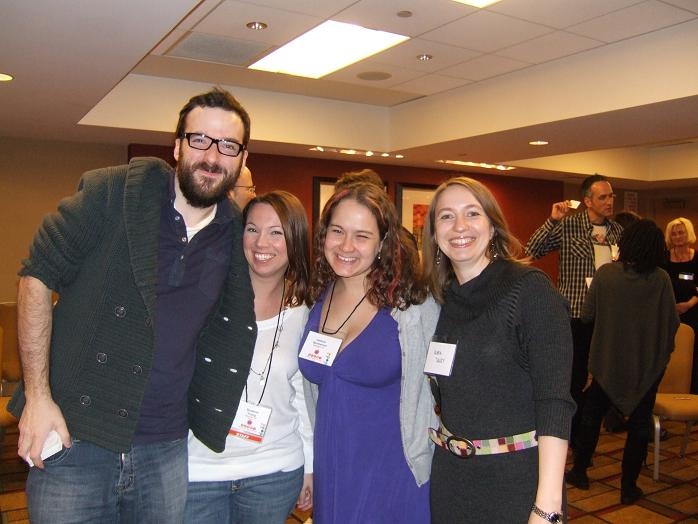
And most importantly, I got to hang out with some of my clients, one of whom I met for the first time this weekend! Look at us all—I’m a giant! That’s Suzanne Young being swallowed by my sweater, Jessica Spotswood in royal blue, and Robin Talley with the fancy belt.

22

A Bestseller’s Rejection Story

by Stacey

You all probably know by now how I like to share success stories on occasion from authors who have had their share of rejection. It’s pretty much a guarantee as a writer that you will be faced with rejection in one form or another at some point during your writing career, and it’s likely that even if you do find yourself one of the lucky ones to find an agent and/or publisher, there will still be rejection in your future. Many bestselling authors have remarkable stories to share about their paths to publication and this one from Costco’s magazine highlights the path taken by Tatiana de Rosnay and her now bestelling SARAH’S KEY. I like reading this magazine’s publishing section because it offers readers a peek into what the mainstream Costco buyers think their customers are looking for, so there are usually a mix of commercial fiction and nonfiction titles highlighted, and they often share a more intimate interview with an author they are promoting through giveaways (in this case, 50 signed copies of the book). Tatiana de Rosnay’s is an inspirational story to tuck away for those hard days when the rejection letters feel insurmountable. If you know of any great books that were at first rejected before finding a publisher, let us know. We all like to hear about positive behind-the-scenes stories that keep us motivated too!