Category Archives: Jane

3

Thanksgiving is a time to give thanks!

I know it sounds hokey, but every year at Thanksgiving, I really do think about all that I have to be thankful for.  This year is no different.

I am thankful for, first and foremost, my family: my wonderfully supportive husband, my two incredible children Jessica and Zachary and my granddaughter Elena.  All of you bring so much love and laughter into my life.

I am thankful for my smart, energetic and ever curious staff who keep their sense of humor and continue to contribute so much to our company during challenging times.  I am especially thankful for my superb business partner, Miriam, who offers her wisdom and good counsel every single day.

I am thankful for my clients because we’re able to work together to bring out the best in each other.  Without each and every one of you, we wouldn’t and couldn’t continue to thrive.

I am thankful for all the people I work with on the other side—those colleagues at the publishing houses who are so devoted to helping writers be the best they can be.  Many of us came into this business because of the people who participate in it—we all care so much about good books and spreading the message about the importance of reading.

And finally, I am thankful for you, our readers—without you we wouldn’t be in business today.  You are the creative backbone of what we do.

What are you thankful for?
Welcome, Morris Shamah!

I am delighted to welcome Morris Shamah as the newest member of  the Dystel & Goderich Literary Management team.  Morris joins us today as our royalties manager. He is also going to begin building his own list of clients.

Morris graduated from New York University and previously interned at two literary agencies where he acquired some well rounded experience in our business.  He is interested in thrillers, mysteries, men’s fiction, mainstream super hero illustrated novels and up-market graphic novels.  He is also interested in Judaica.

Please join me in welcoming Morris to our “family.”  And be on the lookout for his first blog post which will be up later this week.

12

What would you like me to write about?

I find it extremely difficult to come up with a fresh and interesting topics to blog about each week and, so today, as I was pondering yet again what I should write about, I thought I would ask you, my readers, what you would suggest for me.

I am very eager to hear from you about what topics you’d like to see me prattle on about.  I look forward to receiving your suggestions.  So, bring them on!

And have a great week.

6

When good books don’t work

One of the most disappointing parts of my job is having a very good book published to lukewarm sales.  Many times, we can point a finger at the publisher and say they didn’t do x, y, and z.  But sometimes—like earlier this month with one of my incredibly talented authors who has written a fantastic book—there is nobody to blame.  The book has been published and it simply isn’t selling. And nobody knows why.

In cases like this, where the book is really very well done and where seemingly everything possible has been done by the publisher and the author to generate sales, I try to develop new ideas for marketing.

In the case of this particular book, I have met with the author and asked him to pull out all the stops in terms of using his contacts—both to garner reviews and to set up additional interviews and book signings.

I am also pressing on to see what if any film/tv rights we might be able to sell.

I am working with the book’s publisher to see what can be done to coordinate solid electronic sales of this book when the paperback is launched as we believe that e-book sales can help drive up print sales in the right formats.

Finally, I am talking with my client about moving forward and thinking about the next book.  He is a fantastic writer and rather than having him dwell on something we cannot control, I am encouraging him to begin something new.

The fact is that ours is a business of surprises, good ones and bad.  This is why many of us do what we do—serendipity can be quite seductive.

So, again persistence has to be the lesson here.  When a good book doesn’t work, and all avenues to make it work have been exhausted, it is time to move on to the next one.

Do you agree?

17

Book promotion sure ain’t what it used to be

In “the old days,” as recently as five years ago, it used to be that book publishers were instrumental in helping  authors with their publicity, promotion, and (for the major authors) advertising.  But, sadly that is no longer true.

Very few publishers these days do anything substantial to support their authors in these areas.  Especially their first time authors.  This lack of support often results in minimal sales and then, of course, the publisher doesn’t pick up their author’s next book because the last one didn’t sell.  It’s a frustrating and vicious circle.

So in this really troubling climate, what is an author to do?

Last spring, my client John Locke wrote and self-published a book titled How I Sold 1 Million eBooks in 5 Months.  In a nutshell, this book describes John’s marketing system for becoming a bestselling author.  Among other things, he includes information about how an authors needs to identify their audience even before they write their books; how to create a memorable and creative website; how to use Twitter effectively; how to create a simple, no-nonsense blog; and how to write life-changing blog entries.

John’s system worked for him and for many, many he has shared it with.  I strongly believe it can also work for those who publish their books more traditionally as well.

Just last Friday, one of my publishing colleagues, an editor at an established publishing company e-mailed something that I have found to be very important and I think it worthwhile that I quote him here:

“About the digital and social media outreach, the one thing I’ve learned from experience is that it’s a little too late when the book is just launching to start an initiative.  You build those followings over months, even years and then blast them when you have a new product.”

I hope that all of those currently writing books will pay attention to this sage advice.  In this day and age where publishers are pulling back this kind of very important support, the authors themselves must step up to the plate.

Of course, I am always eager to hear your thoughts.

19

A “Sure Thing”?

Last week while I was following up on a proposal I had out on submission to publishers, I heard back from a senior editor at one of the top six publishing houses.  This person is someone who I consider to be very smart and who has great taste.  I had sent him a proposal which he acknowledged was very well done and which covered a subject he was interested in.  In turning it down, he sounded discouraged and demoralized as he said that the higher ups in his company were no longer allowing him to buy mid-list titles that in the past he had been able to turn into bestsellers.  Rather, he said, they were only allowing him to buy “sure things,” which I took to mean books that can’t fail.

This thinking is incredibly narrow minded, in my humble opinion, and could, if it continues, spell the downfall of any publisher who seriously pursues it.  Why?

Because (1) publishers can’t be “sure” of that “sure thing” and (2) they tend to overpay through the nose in order to get that sure thing and often end up losing money that could have been better spent.

The other and perhaps more serious consequence of this approach is that publishers who think this way – and there are a number of them – are forgetting that a strong backlist is the key to their continuing success.  If they neglect this very important part of their publishing program, they will ultimately fail.

This subject – publishers’ recent inability to keep their eye on that backlist ball – is something I have written about it the past.  I am doing so again today because I am so very concerned about the future of this business that I love.

I hope publishers will “wake up” and remember why we are all in this business.  You cannot remain successful publishing only front list titles.  You must have depth and breadth in your publishing program.

I would love to hear what you think about all of this and whether you can offer any suggestions to our colleagues on the publishing side.

3

Curiouser and curiouser

Last week Publisher’s Marketplace as part of the E-books for Everyone Else conference at NYU ran a panel for agents and others who are involved in the new digital publishing revolution and Michael Cader and Michael Shatzkin invited me to participate to explain how we are navigating this exciting and, to many, confusing  new world.  I was very honored to be included with agents Scott Waxman and Robert Gottlieb on this panel and pleased that the DGLM online publishing initiative has garnered so much great attention.

Our panel was attended primarily by agents—I ran into my old friend Bob DiForio, saw Barbara Lowenstein, and Lois de la Haba—but I was delighted to see others like Mark Coker, who we once represented and who is the founder of Smashwords, one of the new e-tailers.  There were lots of people there whom I hadn’t seen in a long time.

It was clear to me from what was being said by some, that many of those in attendance really didn’t fully understand or embrace the ramifications of what is happening.  For instance, one agent was amazed that it takes Amazon 90 days after a digital book is uploaded to begin paying authors.  But, wait a minute, traditional publishers take six months and many of them longer to begin sending statements after they publish a book.

During our lively panel discussion, I pointed out the value of backlist and how these books, properly marketed by their authors, are going to be the meat and potatoes of our digital publishing program along with original manuscripts which clients, both old and new, are asking us to help them self-publish.  Scott, because his backlist isn’t as deep as ours, is depending more on original titles and he is actually publishing them for his clients as opposed to helping them self-publish while acting as agents, as we are (for this, the author pays him 50% of receipts).  Robert didn’t talk very specifically about the topic at hand (perhaps because his agency had just announced a program and there had been a detailed press release about it).  He did tell some entertaining stories about Cary Grant, about why the big agencies used to charge a 10% commission for so long before they went to 15%, and about the importance of  authors having insurance when they self-publish (he illustrated this with a story about how the deck of his house collapsed as a result of hurricane Irene and that his insurance company claimed that though his house was protected against hurricane damage, his deck wasn’t—I think I need to review my home owner’s policy.)

In any case, there is no doubt in my mind that this is a whole new area for many authors to explore and maybe find great success.  Next week I plan to blog more about this; meanwhile, though, I would love to hear what your current thinking about authors self- publishing online is.

9

Vacation, a great generator of book ideas

We agents are always looking for new book ideas; we look everywhere, read as much as we can, and often find them in some pretty unusual conversations.  When I go away on vacation, however, I try to veg out and am less on the hunt than usual.  But then, they are always around.

Over the last couple of weeks, my husband and I traveled throughout Israel and Jordan and had some incredible experiences.  Here are just a few, which may or may not ultimately spur me to come up with some new book concepts:

A trip to the Dead Sea and then a climb to the top of Masada where the last Jewish soldier committed suicide by throwing himself on his sword in order to avoid being enslaved by the Romans.  It was formerly thought that this was an act of heroism, but was it really?  Now the scholars might be changing their minds.

A stay at the incredible Kind David Hotel in Jerusalem where the famous and infamous have signed a walk of fame running down the main corridor of the lobby.  There, I run into friends I haven’t seen in over 20 years.

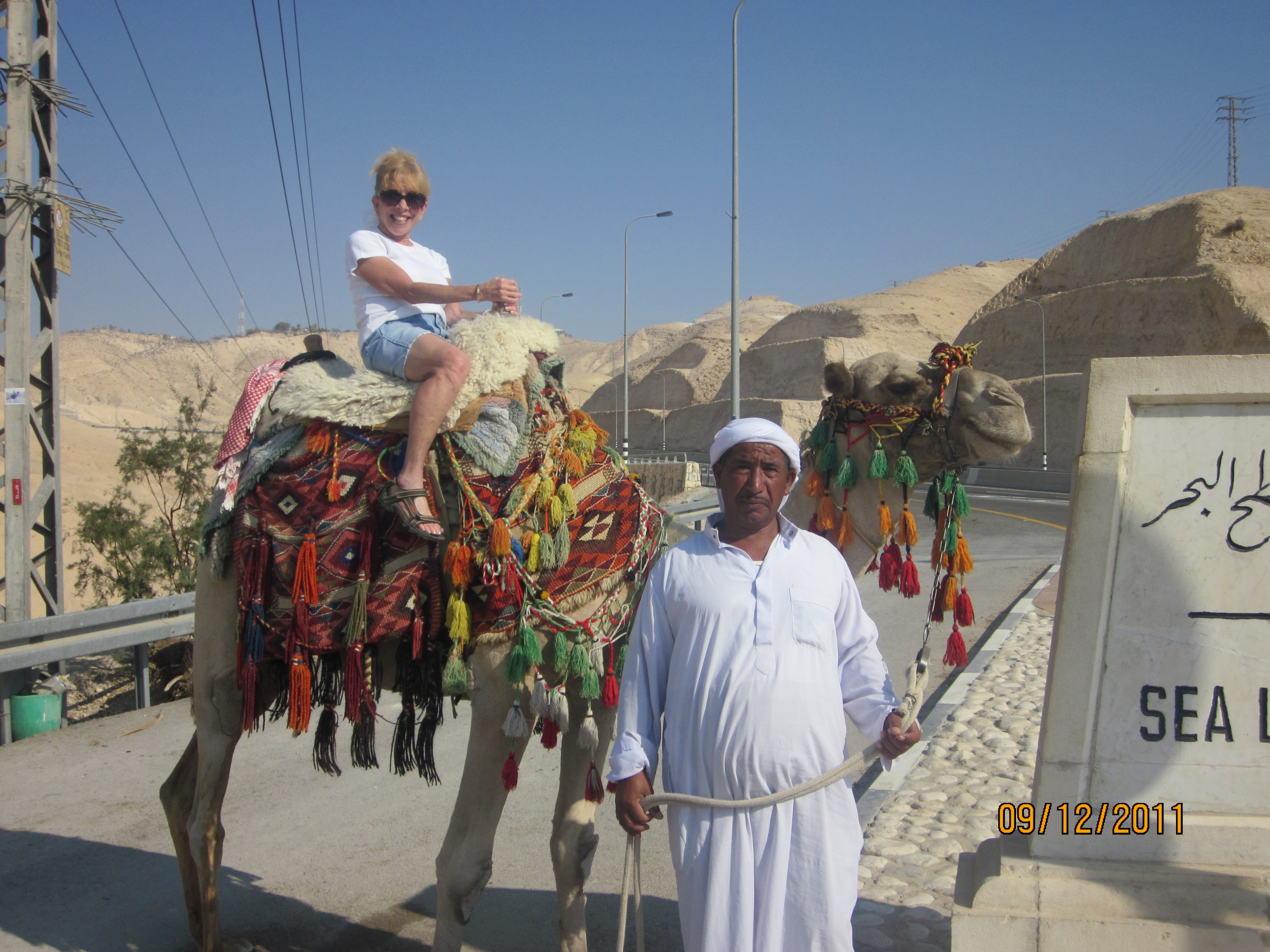
My first camel ride along the road leaving Jerusalem.

My first camel ride along the road leaving Jerusalem.

The incredible hotel we stayed at in Tiberius, the Scots Hotel which used to be a hospital and which has a long and colorful history.

The solitary walk, just the two of us with our luggage across the border from Israel to Jordan through “no man’s land.”

The amazing trek into Petra, the land of so many civilizations and the setting for Steven Spielberg’s Raiders of the Lost Ark.

Getting lost in Amman trying to find a restaurant and being literally walked all the way to where we needed to go by a lovely Palestinian gentleman.

And finally just before leaving our hotel to go back to the airport and home, being invited to partake at a Moslem wedding just because we were “there” and everyone was “welcome.”

I wonder, have some of your ideas for books come while on vacation.  What were your experiences and what ideas resulted from them?

14

Time to read finally, but what will it be?

So I have to be the very last person in the universe who is going on a summer vacation, and I am not actually leaving until the evening of September 6th.  This isn’t going to be a beach vacation, nor is it planned to be the least bit restful, but there will be at least three very long flights and some potentially long airport layovers—I sincerely hope they aren’t too long.

I have been so busy all summer reading proposals, signing up new projects and getting material ready for the fall, that I haven’t had a second to consider what I might read for pleasure on this trip.  So, I thought for my last blog entry of the summer, I would ask our readers what they would recommend.

First some parameters:  I spend a great deal of my work time reading nonfiction and so, though there is some which has been published in the last year that I would love to read, I don’t want to do that on this vacation. I am looking for fiction that will capture my attention and be totally absorbing; I am looking for good stories, memorable characters, and wonderful writing.  Is that too much to ask?

So, if you have time in the next several days to send me your suggestions and why you are choosing these titles for me to read, I would be very, very grateful.

I look forward to hearing.  Thank you in advance!

26

Those overrated books

So, last week I found a piece on Slate about books that people read because they were highly recommended by a teacher or a loved one or a friend and which were found to be incredibly disappointing.  This made me think word of mouth is traditionally a very good way of getting people to read, but how many times do books that come highly touted disappoint us?

I, for one, have been disappointed by some huge bestsellers in recent years.  Maybe it was the hype, which is usually over the top, and maybe it was actually the book itself.  I remember being away on a Christmas vacation when it seemed that everyone in the resort I was staying at was reading The Corrections by Jonathan Franzen.  And so was I.  The book was discussed and discussed some more by perfect strangers; most loved it, but I remember thinking when I came to the end, “why did I bother?”  It was so incredibly depressing. To me this was a big disappointment.

Then there was The Story of Edgar Sawtelle by David Wroblewski.  Initially, I really liked the premise, but the book didn’t know when to stop; ultimately, despite its huge advance and huge success, I simply didn’t “get it.”

And, finally, Let the Great World Spin by Colum McCann which every single one of our staff absolutely loved.  I tried; I really, really did.  And I understand what McCann was doing.  But in the end, it just didn’t resonate and I think, as a result, I was more disappointed with myself than I was with the novel.

So I wonder, what recent bestsellers have you been disappointed in?  And what about those classics that we all had to read as kids—did any of those knock your socks off?