Category Archives: first books

7

Baby Library Must -Haves

This weekend I attended my cousin’s baby shower and while every other person brought adorable gifts and essentials for the new mom-to-be, I came bearing books. Why? Well, why not? But really, it’s mostly because I have taken it upon myself to help build my little cousin’s first library.

Seeing as I don’t have any knowledge of what goes in a baby’s library past my personal favorites, OH, THE PLACES YOU’LL GO and HORTON HEARS A WHO by Dr. Seuss, I thought I’d enlist your help in completing this little project of mine. 
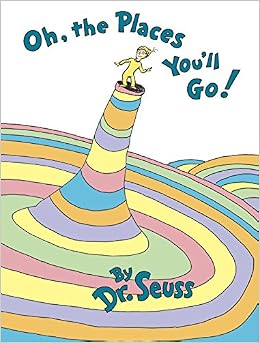
So what are the must -have books that should be included in every child’s first library? To start off, I took a poll around the office and this is what everyone had to say:

Jane suggested BROWN BEAR, BROWN BEAR, WHAT DO YOU SEE?­­­ by Bill Martin and Eric Carle, and Jessica seconded that and added GOODNIGHT GORILLA by Peggy Rathmann.

Miriam and Michael both went with Dr. Seuss and Miriam suggested a couple more titles: THE VERY HUNGRY CATERPILLAR by Eric Carle and GUESS HOW MUCH I LOVE YOU by Sam McBratney.

Stacey’s daughters have loved TAP THE MAGIC TREE and TOUCH THE BRIGHTEST STAR by our very own Christie Matheson.

Jim’s go-to baby gift is Lane Smith’s IT’S A BOOK and IT’S A LITTLE BOOK.

Lauren suggested the hilarious classic ALEXANDER AND THE TERRIBLE, HORRIBLE, NO GOOD, VERY BAD DAY, and Lisa Brown’s amazing mommy gifts BABY MIX ME A DRINK, BABY MAKE ME BREAKFAST, BABY DO MY BAKING, and other entertaining titles in the Baby Be of Use series. 

As well as the classics- Sendak, Carle, McCloskey, Rosemary Wells, etc., John also enjoys ALL THE WORLD by Liz Scanlon, which is enjoyable for both parent and child. He also made a good suggestion about getting board books, so babies can play and chew on them!

 Eric added MADELINE by Ludwig Bemelmans to the list, and Mike  and Sharon love THE LITTLE ENGINE THAT COULD, GO DOG GO, and the Llama, Llama series.

Amy went with GOODNIGHT MOON by Margaret Wise Brown and Erin suggested the amazing classic, WHERE THE WILD THINGS ARE by Maurice Sendak.

Thanks to my wonderful DGLMians , I am off to pretty good start!  Are there any other titles you would like to add?

0

Scholars going trade

I’ve been running between conferences—there have been three this month (I’m still not sure how I managed to schedule that) and remiss in posting.   I have, however, been talking myself hoarse, so I thought I might repurpose some of the material I’ve been presenting–in my newly gravelly voice–here on the blog.

Last week I had the good fortune to head down to Emory University, where the campus was in full and spectacular bloom, and I had the opportunity to meet with faculty in various stages of the book-writing process.  Some were at work on scholarly  monographs aimed primarily at an audience of their peers–the tenure book, the promotion book, etc–but others were at a point in their careers with the ability, freedom or inclination to reach out to a broader audience of smart but non-expert readers.  And that’s where I came in–explaining the role of a literary agent, discussing the market, and dispensing some advice for scholars interested in writing for a general or “trade” readership.

I used the elements of a  nonfiction proposal as the scaffold for my talk. I feel like the proposal is a good lens for understanding what publishers are looking for, and as difficult as good proposals are to write (weird hybrids that they are: part argument for the book, part blueprint, part marketing document), each discrete piece has a purpose.   The presentation, given in conjunction with Eric Schwartz, Editorial Director  of Columbia University Press, is reported on in detail here, but I’ll mention a few points that crop up again and again, and not just with clients with many initials behind their names.

First, lead with the story.  Too often I find that authors cannot resist the opportunity to analyze their own project—to immediately let me in on the tropes they’re subverting or the universal themes they’re tackling to explain: What.The.Book.Means.  To which I say: not so fast.  Before we get to the broad brush and the big ideas,  I want to be rooted in the particulars of the tale—true or fictional–the writer is telling. Tell me the story, and start, if you can, with the exciting bits.   Also, that story must be written in lively, lucid prose, scrubbed of the passive voice, double-scrubbed for jargon (including but not limited to: “trope,”  “problematic” used as a noun, “legitimate” as a verb, etc). I let writers know that it’s really okay to use the first person, to deploy some levity in their discussion, and above all, to establish a voice that is uniquely, unapologetically their own.  I’m a firm believer that scholarly integrity and readability are not mutually exclusive.

I love working with academics, experts, scholars—it’s thrilling to be exposed to first-class thinkers, big ideas, and dizzying levels of expertise.  It can take folks a bit of practice to shrug off the conventions of their discipline, but if they can figure out how to deploy their theory lightly and channel deep reservoirs of knowledge into fluid, clear writing, then more often than not, they’ve  got the makings of an extraordinary  book.


Be careful what you wish for?

So, I came across this piece in Buzzfeed about the dark side of being a debut author and, man, did it depress me.  Not just me, either.   Sharon tells me she found it to be a total downer, too.  Courtney Maum’s message of isolation and despair is positively Hobbesian.  It makes me feel guilty about all the debut authors I’ve had a hand in throwing into this bottomless pit of misery. 

Which is not to say that Ms. Maum doesn’t make some valid points.  The comedown after years of intense yearning for the pot of gold at the end of the publishing rainbow can be vertiginous.  As with most of the things we covet, success, as represented by a first-time book deal, is not the cure-all for all our problems nor the magic carpet ride to a suddenly fabulous life. 

And, yet, I think that celebrating the validation of oftentimes years of chipping away at one’s craft should be the greater impulse than bemoaning the problems that come with a new state of authorial life.  No, having your novel published isn’t the ticket to nirvana you may have hoped and dreamed it would be as you sat in your roach infested apartment eating ramen noodles at every meal while your parents relentlessly hinted at you to get a real job…with insurance.    But, it’s a pretty great accomplishment and, hopefully, the beginning of a long publishing career.   And, even though (to quote the immortal lyrics of Taylor Swift) haters gonna hate, writers, both published and un- are a lovely community to be a part of.

What’s your take on being a debut author—both from the wishing-that-was-me to the been-there-done-that-and-survived perspective?

Writing strong characters

Many years ago, I was working with my very talented client, A.J. Hartley, and he sent me pages for a new thriller with a female protagonist, the first female protagonist he’d ever attempted. I read the opening section and tried to be diplomatic in my feedback, but I basically told him that the lead character was not likeable or sympathetic enough and that she came across as very defensive. He took the criticism graciously, went back to the drawing board, and delivered a revision that nailed the character so well that when the book was later published, Publisher’s Weekly had this to say about her: “Hartley has created an enduring heroine in Deborah, who’s courageous, loyal and smart enough to learn from her mistakes.” He has since gone on to write many wonderful books with both male and female protagonists, but that first one paved the way. See first edition cover image below.

I recently came upon a piece on Tor.com’s blog about strong female characters that I wanted to share. The author, a writer named Ilana C. Myer, brings up an important point about writing characters in general, regardless of gender. What is most important is that they have empathy. Focus less on whether they are a man or a woman and more on the character’s feelings, their pasts, their sense of humor and a fully realized character will emerge.

What are your tips for writing strong characters? Any pitfalls you try to avoid? The stereotypes are easier to fall back on, but when you get past that and create really memorable, enduring protagonists, gender can be the least important factor of all.

3

Let’s all learn something by being quiet

This is something I think about often surrounded by kids, extended family, friends, and colleagues. We live in a loud world that moves way too fast. I’ve always been a naturally social person, and most people who know me would say I’m an extrovert (with a capital E). But, I have also tried to learn to be comfortable with myself, and enjoy what little quiet time I can find.

I’m really into Susan Cain’s book right now: Quiet: The Power of Introverts in a World That Can’t Stop Talking. It’s her first book, it took her seven years to write, and it’s been a huge bestseller. She’s not a doctor or a journalist. She’s a former lawyer turned writer with a long history and love of reading who wrote about a subject that she can relate to from experience. I admire what the author has done with Quiet, and from a publishing perspective that she has taken a seemingly simple subject and turned it into this interesting, accessible, and highly commercial book that so many people are eager to read.

Last night I was talking with the girls about introverts and extroverts explaining the differences which members of our family fall into which category, and Alea (who is six) blurted out that she thinks my dad is a “sleepovert” because he likes to sleep a lot. That got a good laugh!

I came across this article in biographile.com which discusses her TED talk last year that has now been viewed almost four million times. It is one of the top ten TED talks of all time. It’s worth watching to learn more about her subject, but also to see an example of a little book that has struck a chord with the general public in a big way.

It leads me to wonder what other untapped subjects are out there that are poised to be the next Quiet. Anyone have any ideas or subjects you’d like to see explored in this way?