Category Archives: diversity

3

Required Reading

In high school, I usually finished out the school year by going home with a list of required reading for my English classes the following school year. Most were typical reading assignments—Catcher in the Rye, Ethan Frome (still my least favorite book to this day), Lord of the Flies —but my junior year, my English teacher surprised me with a mix of contemporary and classics for our summer reading list. I remember reading Extremely Loud & Incredibly Close by Jonathan Safran Foer and The History of Love by Nicole Krauss that summer, as well as Heart of Darkness  by Joseph Conrad.
 
Eight years later (yes, I’m a baby), some of my teacher friends are puzzling over their assigned reading lists and wondering how they can introduce diverse and more contemporary books into their required reading. Given our discussions, this is a conversation I’ve been hearing a lot about and mulling over myself. Some other friends have said that required reading in high school and college turned them off to reading in general. I understand—to a degree—the importance of reading classics, but I do have to wonder about our staunch adherence to the Western canon—which tends to be primarily full of white male authors. Our society is rapidly diversifying and I wonder what it might do for teenagers and young adults and reading culture in general to also see literature taught in schools that reflects their experience or culture.
 
Nicholson Baker’s article in the New York Times Magazine was an interesting read that ties into this conversation. He writes that, “All teaching takes a toll on what’s taught, but high school is wondrously efficient at making interesting things dull.” I slogged throughEthan Fromeas a sophomore in high school, but loved the more contemporary Foer that I was assigned junior year—I had never encountered writing quite like that before. There are so many things available that could spark a love of reading past the classroom, which can help raise reading assessment scores, among other things.
 
One of my friends who works for Teach for America shared that his high school kids were reading at a way lower level than they should be, with no school library, and only the curriculum reading to really foster their reading habits. He gave one girl the first Harry Potter book and she fell in love. Since then, he’s been giving her books from his personal stash at home, and she’s been devouring them. She told him she never knew reading could be fun.
 
What benefits do you think introducing more contemporary or diverse literature into classrooms could have? What is something you wish you’d read in high school? What books are, in your opinion, integral to the high school reading list?

0

Storytelling

As I look with something akin to terror at the icon telling me there are 24 manuscripts in my Urgent to read folder, I’m thinking, as I have been so much lately (this week, this month, this year, this last few years), about what it means to be an agent. When I moved back to New York after grad school, I only applied to two kinds of jobs: non-profits and publishing. You all know where I ended up (insert joke about profitability of publishing here), but I like to think that I’ve built a career where I can achieve the goals both those types of jobs represented: trying to do some good in the world and working with the written word. Beyond the ways in which books do, as a whole, make the world a better place, I also work hard to tailor my list to something that Alternate Universe Lauren who runs a non-profit would be proud of, whether I’m looking at serious non-fiction or commercial fiction and everything in between.

And in working on that project–on trying to make sure that my client list and the books I represent do good in the world in addition to telling compelling, enriching stories–I find myself coming back repeatedly to this Ted Talk by Chimamanda Ngozi Adichie on the danger of a single story. It’s from 2009 and many people have seen it, but if you haven’t, I urge you to watch. It’s an important facet not just of publishing and reading, but of existing in a world that is in so many ways, from politics to news media to social media to advertising to memory to relationships, constructed on stories. As a person who commodifies stories for a living, I try to do justice to them, and the complex people behind them, and the complex people reading them. And I’m grateful to Adichie for telling this story in such a way that it’s crystallized in my brain to guide me.

0

The Rise of Iceland In All Things – Even Publishing

For the past year or so, every time I open my Facebook home page, I’m barraged with another set of glorious vacation pictures from Iceland. I’m pretty sure fifty percent of the people I know have been to Iceland now—even Miriam went there. I’m jealous. It looks gorgeous, but mostly I’m fascinated with the way a tiny country has become popular in so many ways. And now, thanks to the amazing performance of their soccer team in the 2016 UEFA European Championship, there’s an even bigger acceleration of interest. And according to this article, their book trade has seen a boost from it.

It stands to reason that people would want to get to know the people of this amazing country that has become so popular, and what better way than through literature?

After taking a course in grad school covering translated literature, I’ve made it a point to read more translated works. I learned through the class how little I know about other cultures, and that the bulk of the books I was reading focused on American culture. Books are supposed to broaden your horizon, and yet, I was being fed the same stories over and over again, learning very little in comparison to when I read about different cultures. I found that through these completely foreign books, I could travel to another country from the comfort of my own home (and without the ridiculous flight costs). I developed a broader love for foreign rituals and traditions, discovered wars and conflicts I never knew existed, experienced new landscapes following characters that know them best, and most importantly, I became a better writer. Maybe even a better person.

So knowing that more Icelandic books will be translated thrills me. Reading an Icelandic book will take me one step closer to my dream vacation! Or at the very least, I may finally understand why Iceland is so cherished.

Reaching out

For most of the time that I’ve been in publishing, I’ve found clients in one of four ways: the slush pile, referrals from clients, seeking out authors for ideas I’ve come up with, or convincing a person I’ve come across to write a book. I’ve long been reflexively skeptical of supposed innovations on the query system—everything I tried for a long time turned out to be a huge waste of time that generated no better results than just letting the slush come to my inbox.

But four or so years ago, I looked at my list and my slush pile and realized how heavily they both skewed toward a narrow range of voices. And as I looked for ways to fix this problem I listened to a lot of wise people (including the fine folks at We Need Diverse Books) on the perils of any system in which gatekeepers simply wait for things to come their way.  So now I try to actively participate in things happening outside my inbox, making sure that writers know that my door is open (and my list inclusive).

Authors looking for an agent have a lot of great opportunities now not just to seek an agent, but to reach out to the best possible fit for them and their work. Many wonderful agents participate in these new ways to find clients (and quite a lot of them were on the bandwagon before I got my head out of the sand). And for me, they’re a good way to proactively seek submissions from a diverse pool of authors so I can make sure that my client list supports a wide array of voices.

TwitterLogo_#55aceeTwitter pitch parties like Brenda Drake’s PitMad still involve authors querying agents, but it means I get to find those projects that seem like a good fit for my list and invite the authors to send their queries my way.  And resources like Manuscript Wish List, co-created by Jessica Sinsheimer and KK Hendin, allow me to highlight book concepts that I’d love to see, which gives me a chance to proactively seek a broader and more balanced list, both via the Twitter hashtag and their fantastic website (for which you can find my profile here).  And I’m really excited about the upcoming Twitter event #DVPit, which Beth Phelan created to “showcase pitches about and especially by marginalized voices.”  If you’re a writer from a marginalized community looking for an agent, I strongly encourage you to check out that link before Tuesday, because it looks like it’ll be a great event!

I’d be lying if I said that I wasn’t overwhelmed by the sheer volume of emails in my Weekend Reading folder, many of which come from sources like the above. I look at my To Read list right now and tremble in fear. But I love knowing that the chances that I’ll find a gem that I have a vision for among those projects is far higher, since I’ve already done some of the work in getting authors who have written the kinds of books I’m looking for to reach my way.

0

Between the World and Me

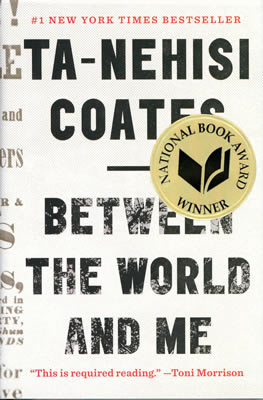
As most of you know, the 2015 National Book Awards winners were announced this week. I did a quick skim of the list and was incredibly pleased to find that Ta-Nehisi Coates had won the non-fiction category. I had read his book in short bursts on the subway to and from work—a small volume, but one that I could only read in small doses. Reading his work, I was reminded of a class I had taken my senior year in college, titled “Black Apocalyptic Fiction.” We had discussed a question similar to what Coates asks in Between the World and Me: “What is it like to inhabit a black body and find a way to live within it?” My final paper for that class focused on art and scholarship and how so much art and literature was focused on eventually creating a kind of scholarship that people used to dehumanize African American bodies.

So I was particularly interested when I noticed Coates’s answer to the question that the NBA posed to each finalist and winner: “In the process of writing your book, what did you discover, what, if anything, surprised you?”

Coates answered, “I discovered how hard it was to make the abstract into the something visceral. My goal was to take numbers and stats and make people feel them with actual stories. It was to take scholarship and make it literature.” (emphasis mine)

nf_coates_win

I have immense hope—despite everything—that scholarship will continue to emerge through literature created by people of color and that a new art will emerge as a reclamation of the body and self.

Watch Ta-Nehisi Coates’s acceptance speech:

What did you think of this year’s winners? What do you think about the future of diverse authors?

0

Something for everyone

As a general rule, I’m wary when someone thinks that a book is for everyone.  It’s usually a red flag that people don’t know their market or haven’t thought about their category.  But in a different sense, it’s critical that books be for everyone, as this incredible piece by Mira Jacob illustrates.  (It’s fantastic. Go read it. I’ll wait here till you get back.) We need to have books for everyone. Books that reflect everyone’s experience.   Not all books need to be for all people, but no one should be unable to find themselves reflected back on the page.  And no one should be unable to love and enjoy and identify with a book only because it’s not written explicitly for them.  Ta-Nehisi Coates’s Between the World and Me is pretty explicitly for his son and about the experience of being black and male, but it’s still one of the best books I’ve read this year, even though I am neither black nor male. We’re all drawing from the same well of human experience: joy, anger, fear, alienation, community, love, loneliness, etc.  There are things in the book I identified with, and things that were alien to me, but those too had value for me as a reader.  People need to be seen, and they also need to see.  People need to be heard, and they also need to listen.

The tie kills me.

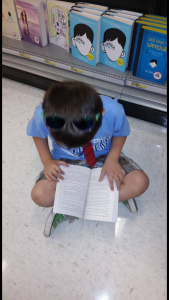
Fidge looking for my name in the back of The Maze Runner.  He was delighted when he realized that my name is in books!

To that end, for the last several years I’ve made sure to take this into account when I consider who I want to represent.  I’m very interested in underrepresented voices, and if that describes you and you’re reading this in the course of your search for representation, I hope you’ll consider querying me.

There largely aren’t specific underrepresented voices I’m looking for, but I am on the lookout for books for young readers and middle graders featuring protagonists who are on the autism spectrum.   My nephew (I call him Fidge) is a voracious reader, one of my two favorite people on this earth alongside his little brother, and on the spectrum.  Reading is kind of our thing.   I already know he’s capable of loving books that don’t reflect that aspect of him, but I’d love to help bring books to the market that he would be able to find himself in.  He’s one of the world’s two best people—surely he deserves to feel seen and heard.