Category Archives: authors

6

Blocking the block

I think it’s safe to say that most writers have, at some point along the way, felt stuck in their writing. It’s never a good feeling, without a doubt. So what is a writer to do? I thought I’d pass along  some thoughts to help you get moving again.

  • Take a step back: Time away from your work-in-progress can be a very helpful way to gain some clarity on any issues you may feel are plaguing your writing at any given time.
  • Revisit: Going over the parts of your writing that flow smoothly can often help unblock the problems in other areas.
  • Get a second opinion: Show your writing to a friend, writer-friend, or critique group member—anyone who will be objective and give you their honest opinion.
  • Read: There are always lessons to be learned from reading someone else’s writing.

Do you have any special tricks for beating writers’ block?

8

Conquering the crazy

I think most writers would admit—but correct me if I’m wrong—that at some point along the way they’ve faced moments of crazy.

You know what I’m talking about: That feeling you get when you begin to wonder if you’re spending too much time on that one manuscript, you feel like you’ve read it so many times it’s imprinted on your retinas; or maybe you have ideas for multiple novels, and you’re trying to get them all down on paper at once before they escape your brain; maybe your family and friends are beginning to wonder exactly what it is you’re doing; and you have no firm idea whether your book or books will ever reach publication.

I think this is a natural feeling for those who are in the midst of writing novels, but it can also be a potentially dangerous thing that could inhibit future writing.

So what I want to know from you is: how do you handle the crazy and keep yourself writing in spite of it all?

1

Baby pictures of your favorite authors

It’s fall in New York (my favorite season), and my obsession with pictures, especially of my kids (first day of school, with pumpkins, in costumes!), continues as I start to think about holiday cards.

This won’t get you published, but I thought it was worth sharing this fun link tweeted by a client of mine that shows baby pictures of a number of famous authors. It’s kind of neat to see writers like Salinger and Fitzgerald (looking like an adorable baby girl!) captured in images of their youth.

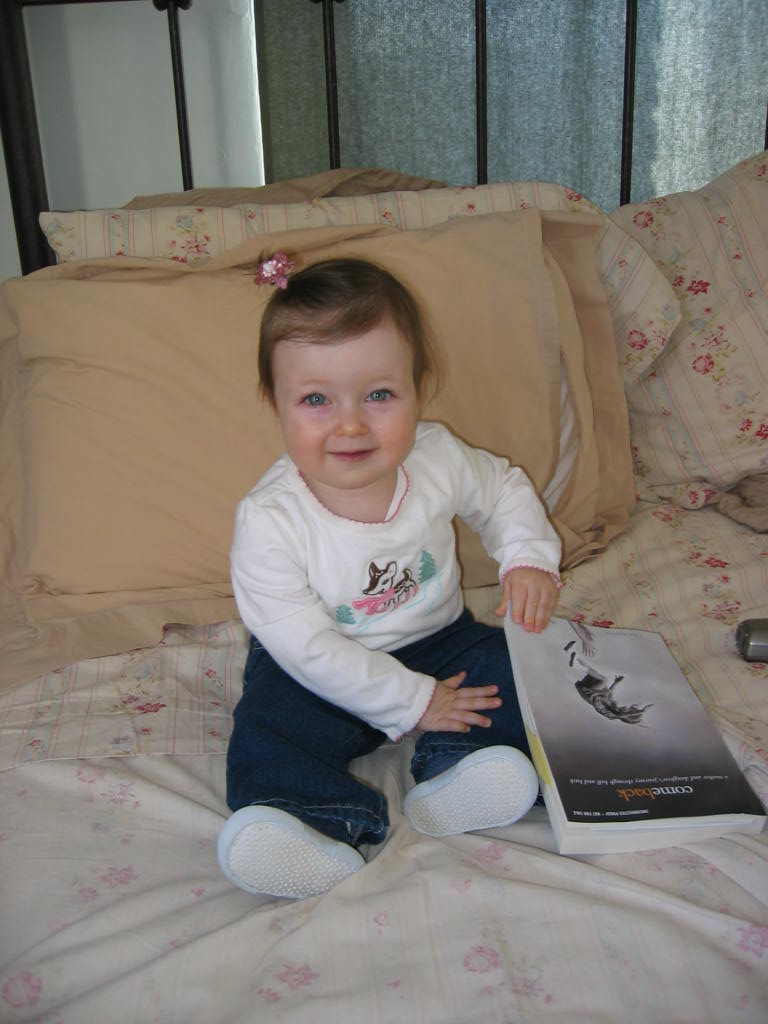
If any of you aspiring authors achieve this level of fame and success, do you have a picture from your childhood you’d like to share with your fans? Send them our way. I’m conjuring images of my own kids captured in photos when they were small glancing at their books, sometimes staged with my authors’ books, sometimes upside down, but at least we are trying to encourage a love of reading and books at a young age!

My oldest daughter with a galley of one of my books in 2006

6

“If it be not now, yet it will come…”

We all know that the last part of that quote is “the readiness is all.”   Words to live by, no?  So, why is everyone in such a hurry?

Specifically, I’m talking about the hurry to get a half-baked manuscript in front of an agent, the hurry to start the next book when you’re still writing the first one (and, by the way, you have a looming deadline for that first one), the hurry to get a new contract before the current book has been published, the hurry to get all of your writing published at once (something currently made much more possible through electronic means), etc.  We’re all in too much of a hurry.  We cut corners like we cut off other drivers—because we have to get somewhere five minutes ago before someone else beats us there.  We’re so obsessed with being done that we don’t do things well.

Sure, we’re in a hurry to make money and see our names up in lights and there’s nothing wrong with that (see Jim’s recent blog post on the subject of art vs. filthy lucre).  Without those incentives, we’d still be sitting around in caves eating leftover mastodon while wearing unfashionable fur coats.  But the rush to get rich and famous (or even just published) needs to be offset by a nice dose of readiness.  Your manuscript or proposal needs to be ready—edited and re-edited before even submitting to agents, polished for submission once the agent has taken you on, proofread so that most if not all “it’s” and “its” are as they should be.  You need to be ready to take on the unglamorous, thankless part of the process—writing query letters, sifting through rejections, following up patiently and courteously, starting all over again after a promising early read leads nowhere, being a savvy business person who reviews  his/her contracts and asks relevant questions of his/her agent and publisher, laying the groundwork for the platform you’ll need when you have a publisher and a publication date, and, of course, being a denizen of “the waiting place” while the publishing process unfolds with all the alacrity of a snail on downers.

So, yes, it’s a bit of a “hurry up and wait” conundrum.  On the one hand, you need the fire in the belly that gets that germ of an idea out of your head and into print.  On the other hand, making sure your work is ready for public consumption is not a process that should be rushed.  Write well, edit carefully, do your due diligence in getting published (know your audience) and then have patience with the publishing process—learn your lessons before rushing out to get the next one and the next one and the next one out there.

And, of course, readiness is a relative and somewhat intuitive term.  Seems to me that Danielle Steel’s work is ready a lot faster than Cormac McCarthy’s but that’s why there are different categories of fiction.  How about you guys?  How do you know when your work is ready?  And, do you sometimes hurry the process along in a way you know you shouldn’t?

10

The inspiration in strife

The act of writing definitely evokes a feeling in people, that’s for sure. In the past, I’ve covered what you write, how you write, and why you write. But something that I’ve always wondered is how a writer’s external world can affect his or her writing. This funny post from the Thought Catalog makes the point that it’s often easier to write when one is feeling more on the melancholy side of life. I have to believe that there is basis for this. After all, some of history’s greatest writers endured some pretty rough times and undoubtedly wrote while in the midst of them—think Edgar Allen Poe, Charles Dickens, Mary Shelley.

So now I ask you: do you find that it is easier for you to write when you are sad or upset? Or do you find it easier to write when you are happy? Or is this something that doesn’t factor in to your motivation levels?

11

You Can’t Always Get What You Want

Presuming you’re all authors or aspiring authors, let me ask you an ugly question: what are you in the game for—the art or the money?

My lovely and wonderful client Saundra Mitchell loves to be unlovely and unwonderful sometimes and sends me links to publishing stories that she knows will rile me up. It’s very: Give a man a fish, he’ll eat for a day; give a man a soapbox, he’ll rant for hours. That’s the saying, right?

Point is: Saundra sent me a story about an author who, by the sounds of it, breached their contract’s non-compete clause and then let out an unholy caterwaul when her publisher took issue. She lives for her writing, you see, but she also has to earn a living. So she should be able to publish whatever she wants whenever she wants. Otherwise, it’s censorship! It’s the blocking of free trade! She all but cried, “Word genocide.”

Here’s my thing: if the terms of an agreement are so disagreeable…disagree. No one has ever been forced to publish their book. It’s not like publishers are breaking down people’s doors and stealing their manuscripts because there’s not enough supply out there. This author hated the terms of her agreement. So she shouldn’t have signed the contracts. She could have kept on writing and spreading her work however she wanted to with no one stopping her. As we know, there’s an ever increasingly diverse number of platforms authors can use to move their material. And as she said, this author lived to write.

But she also needed the money. And that’s where things get tricky. Bottom line: she was offered an amount of money to allow someone to publish her books for profit. And she took it. Once she realized that taking the money meant agreeing to the terms on which she took it, that’s where it got ugly for all involved.

Listen, I’m not saying every writer needs to sell their soul to the devil. Just the published ones.

I kid, I kid. Publishing is a business, as I’ve said over and again. There is a corporate machine that authors are part of, and there is a bottom line. Is that an ideal system in which to create art? No. But it’s a pretty solid one to make money in.

Now, I know I’m being snarky and that, realistically, this isn’t a simple binary where you choose integrity versus cold, hard cash. Which is something that we also face as agents. Let’s say a book comes across my desk and I know I can sell it for a million dollars, but I don’t personally think it’s something that needs to be out there in the world. Do I sign it anyway, take my commission and run? I’d love to say no, but if there was that kind of financial guarantee there, could I turn away? If I was offended by the book, sure. If I just thought it was unnecessary or unrewarding…the question gets a lot slipperier. Which is simply to say that it’s a constant struggle to figure out how to balance art vs. commerce and that I know I’m being reductive, but sometimes you do need to be able to put your foot down about what you can and will do for certain financial rewards.

Acknowledging that, I wonder: as authors and writers, how do you (or how do you plan to) strike that balance between integrity and the ability to put food on the table?

8

Spiders, Planets, and Islands

Apparently last month I missed Publisher’s Weekly’s PWxyz blog’s round up of some bizarre things named after writers.  I’ve actually been to the James Fenimore Cooper, Joyce Kilmer, and Walt Whitman rest stops in Jersey—I always support going to the writerly rest stops over the random historical figures.

I think Stendhal wins, though.  Stendhal Syndrome is “an illness that’s caused when an individual is exposed to art, particularly if the art is overwhelmingly beautiful.”  Though it refers to an experience of his, not to the beauty of Stendahl’s written art, it’s still a pretty great thing to have associated with your name.  (Bonus points for Gabe Habash’s excellent link choice in that paragraph.)

Since I missed the first round, I’m so pleased they followed up with some more this week.  I didn’t know that the term “quark” comes from Finnegans Wake, but it’s pretty impressive.  There’s something about a scientist of significance enough to be naming quarks also being the sort of literary mind who reads Finnegans Wake.  I mean, come on, no one reads Finnegans Wake.  Most people are only pretending to have read Ulysses, and that one uses actual words and sentences.  In AP English, when we presented end-of-year projects combining author bio with analysis of two of the author’s works, I boldly selected Joyce, Dubliners, and Finnegans Wake.  I quickly realized my error when I tried to read the latter and ended up presenting on Joyce’s life, Dubliners, and a reading of nonsensical passages from Finnegans Wake along with the admission I hadn’t read it and an interview Joyce gave about how he was deliberately screwing with the heads of readers by writing such a non-book.  But at a minimum, Mr. Gell-Mann, quark namer, was browsing the pages.  Perhaps he just pretended that’s where it came from, knowing no one would ever catch him.  I’m certainly not going to fact check him.

I’d be less pleased to have that creeptastic spider named after me if I were Bram Stoker, but I imagine he’d be cool with that (as would some of my clients, I bet).  So, pray tell, what would you like to have named after you, authors?  I might quite like something astronomical, if I were a writer.  Maybe a newly discovered moon?  Probably not an ugly cement building housing a Cinnabon, McDonald’s, and infrequently cleaned bathrooms, but hey, it’s a nice gesture on New Jersey’s part.

3

Handle with care

While Jane’s off gallivanting around the Middle East riding camels and taking in ancient history on her very well-earned vacation, I’ve been holding down the fort here at DGLM.  Really, the fort runs pretty smoothly on its own, but given the general state of my piles (I turn my back on them and they procreate), I find myself a bit more overwhelmed than usual this week.

So, instead of one of my lengthy, ruminative blog posts that I know many of you look forward to like the season finale of Dancing with the Stars (right? right?), I give you this link I came across a couple of weeks ago on the Huff Post.  It’s about the care and handling of agents, once you bag one, but I think it applies to most professional interaction, which mostly boils down to “don’t be annoying.”

Certainly, not being annoying is something we at DGLM are always striving for with abysmal levels of success.  And, we really do understand and empathize with our more neurotic clients when their craziness overwhelms their common sense, but we are also absurdly grateful when writers are well behaved and pleasant to interact with.  So, take a look at the piece and let me know which of these areas you find most challenging.

4

Syllabi

Yesterday, as I headed north on Broadway toward the 125th street entrance to the West Side Highway in a downpour not seen since, well, last week when gregarious Irene was paying a visit to the entire East Coast, I found myself stopped at a light in front of the main gates of Columbia University, my alma mater.  The street was teeming with rain and fresh faced freshmen looking vaguely shellshocked.  Watching them hurry to cross the street before the light changed and the homicidal cabbie in the next lane hit the gas, their overstuffed backpacks and grim expressions sent me into a reverie about my long ago school days.

One of the reasons I chose Columbia was its mandatory humanities courses—philosophy, literature, music, and art survey courses composed of the “canon” of great works.  As those of you who read this blog regularly know, most of us here at DGLM love a reading list and what better reason to go into thousands of dollars worth of debt than to emerge with a reading list full of masterpieces chosen by…old white guys, reflecting the ideology and intellectual tradition of…old white guys.  Wait!  Even with the occasional nod to a woman or person of color the canon really was rather limited and limiting in its choice of authors. All these years later, it still is.

Don’t get me wrong, I loved many if not most of those canonical choices, but I wonder what I would have changed in that syllabus for my lit hum class.  Instead of the Iliad, perhaps One Thousand and One Nights?  Borges instead of Dreiser?  Zora Neale Hurston instead of F. Scott Fitzgerald?  How about genre literature?  I know I would’ve traded a great mystery novel for the millions of pages on whaling by the esteemed Mr. Melville in a heartbeat.

Obviously, there’s no right list of classics, but if the idea is to shape young minds that will then go out and shape the world, what would your reading list include?

4

“She woke at 6:30 A.M., ate breakfast in bed, and began to write.”

I woke up late today. Not too late, mind you. No, I still had time to shower, dress, get a cup of coffee (or two) and work on the crossword before I left for work this morning. But still, it was later than usual. Later than I’d like. Later than I’m accustomed to waking up, because if there’s something I take comfort in, it’s routine. It’s only when I do silly things like sleep too long, or important things like make doctor’s appointments that still throw my normal schedule out of whack, that I notice how much my routines mean to me. Especially in the morning. Even if I have enough time for things, it’s that they happen at the usual time that matters. I want the same sort of time that I would always have, and if I get to the coffee shop in the morning and someone else has the Arts section, I’m seething for a few minutes. It’s not that I don’t have a perfectly good book in my bag to entertain me, but it’s that mornings are for the crossword, in my mind.

I console myself with the reassurance that I am hardly alone in my preference for the familiar. There are a good amount of people that I see in the same coffee shop, sitting in the same place (it had better not be my table) at the same time daily—we’ve become the sort of chatting, waving and smiling acquaintances that rituals tend to allow for. When I bike or walk to the train, I pass the same people on the same blocks, biking or walking to their destinations. Waiting for the subway, I get on the same car with a familiar group of people every day. It’s nice, in a way, and assures me that I’m on time and doing things correctly.

It’s not just everyday people who gravitate towards this self-imposed schedule. Creative types revel in them, too. I was introduced to Daily Routines a couple years ago, which chronicles the routines of “writers, artists, and other interesting people” both in the past and present. While it’s been awhile since the blog as been updated, the content is still pretty neat. Emily Dickinson’s 12:00 PM calisthenics and Truman Capote’s penchant for lying down to think, smoke, conceive ideas and drink bring forth an insight into how these venerable literary figures organized their days. Without these routines, the creative juices might trickle instead of flow or for some, refuse to work at all.

As writers, readers, artists and workers, what sort of rituals do you feel you must partake in daily? Are there activities you don’t feel complete without or perhaps it’s a timing thing. Or do you revel in a routine-free lifestyle?