
 April 22, 2016
  Amy Bishop
As a kid—before computers were widely available, and before I was allowed to use a computer without a strict time limit—I always equated pens and penmanship with being a Writer. There was something so thrilling about sitting down with a new notebook and a pen and filling it up with my story ideas. (I also just liked to look at my handwriting, to be honest.) I’d start a lot of stories in class (usually during math) and go for pages and pages, the scratch and flow of pen on paper so much more satisfying than equations and formulas. It will probably not surprise you that math was unfortunately my lowest grade in high school.
That love of writing by hand hasn’t gone away as I’ve gotten older. I’m picky about the writing utensils I use, whether they’re for professional, academic, or downtime purposes. There are only three kinds of pens I’ll use for writing letters, and I’ve stocked the DGLM office with my preferred inky brand (Precise V-5s, if you were wondering). But with most people writing on computers these days, I have to wonder: do people use pen and paper to write stories anymore? What are the pros and cons of writing on a computer versus writing by hand? I confess to having converted to the digital side; I occasionally will draft poems using paper and ink, but mostly prefer my laptop, to get spacing and line breaks more precise on the first go-around.
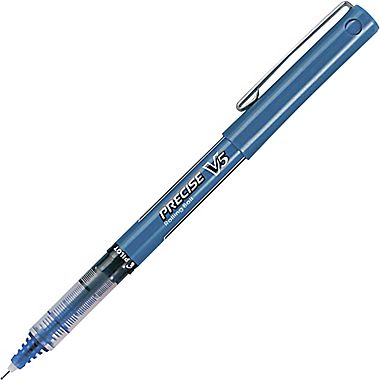
The king of all pens.
I will say that writing using pen and paper tends to make me a more careful writer. I’m more conscious of the words I’m putting down, and it’s often a useful way to get a first draft, even if I hate that first result. It’s so easy to simply backspace over something on a computer and forget the original idea that might come in handy later. With pen and paper, you see every staggering, stop-and-go moment of the process, every cross out and idea. Of course, it’s not the most efficient way to write—especially if you have deadlines looming and 200 pages to go.
But what do you think about writing by hand? Do you think it’s dead? Do you think it’ll ever truly go out of use?
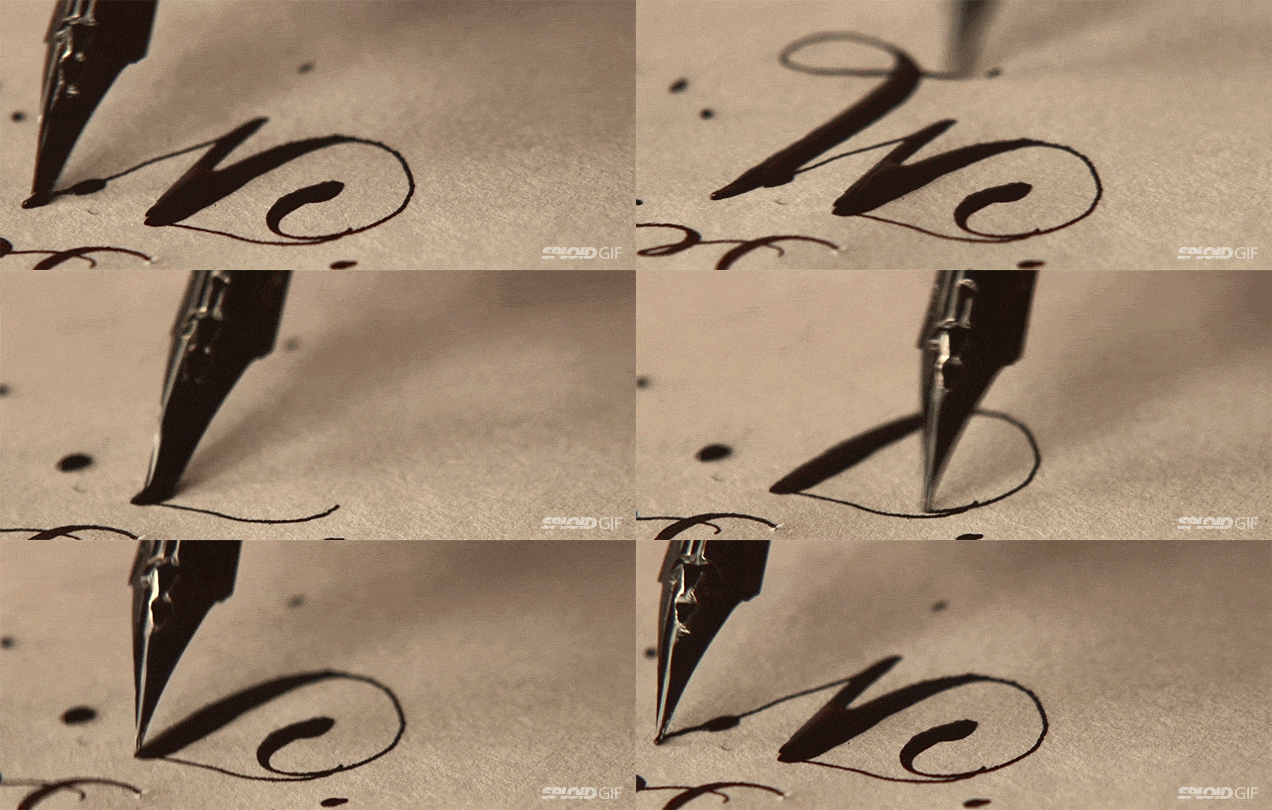
*swoon*
 Tags:
Tags:
Amy, thanks for this. I wish I could write my reply in cursive script. I love writing a first draft of a novel in pen, in an increasing pile of notebooks, never looking backwards but always moving forwards. I can barely read my own writing, so editing along the way seems a bad idea anyway. The pros are exactly that, you have to keep moving forward. The story can change as you go along; that\’s why God created second, third, hundredth drafts. Also, as you say, I think you become more careful with your word choices and sentence structures… you think more. The cons – well, you have to go back and try to read what you wrote in the first place. It\’s a laborious task. But hey, all writing is, so people like me love it anyway. Computers are wonderful of course but there\’s one big sucker trap. \”I spent the day writing!\” \”No you didn\’t, you spent the day going over and over the same paragraph/page/short chapter.\” Right now I\’m spinning my wheels doing exactly that, and wish I\’d started this new work with pen & paper. The next one, definitely. Got the pens & journals ready!
Also, you can then justify buying more pretty pens & journals. Win-win!
I used this EXACT pen earlier today (the Precise V5)!! Love!!
I write poetry and music by hand, and also brainstorm/outline with a pen, but I write novels in Scrivener. There is an entirely different thought process, IMO, when you write by hand. It does make you more “careful.” I admire people who write novels with a pen.
Lovely post! <3
Glad to find another V-5 fan Thanks for your kind words!
The V-5 stole my heart years ago! The way it glides across the paper makes me swoon. <3
Many thanks for this article, Amy, and greetings from Brisbane, Australia.
Typing on the computer is great and I need my box of technology for changing the order of things, making corrections and editing, and I do use it right from the start for some projects – but there are days when the moving fingers do not type fluently. Curled up on the couch, in some spine-wrecking position with pen and paper, can then get me back in the flow.
I am the author of two books for children and four on calligraphy (for older children and adults), and with a collection of mss completed and in progress. When I arrived here I was just researching prior to possibly sending a query :). But though I have been a professional calligrapher for years, my handwriting is rarely neat when writing stories or books, and it is only ever seen by me. Yep, reading it can be difficult, but at least picture books are short. Calligraphy is drawing letters, not writing – totally different.
For me, writing by hand can be likened to the dancer projecting himself in the rhythm and pattern of the dance. I love it! The well balanced writing instrument, the feel of a pliant pen nib or a supercharged rollerball racing machine or gliding soft pencil, the warmth and softness of a pad of perfect paper, the easy flow of the ink or graphite… they all seductively affect the release of thoughts and the flow of feelings. I just become more alive when writing by hand (most frequently in pencil, but I love my Lamy 2000 ballpoint, too). Even scribble becomes a tactile and emotion charged creation in response to the tension, love, flamboyance or whatever emotion I am writing about. It helps me to live the situation. The size and letter shapes change and words flow better than if I was typing. And yes, I can scatter thoughts and insertions around the page and doodle, and I love that draft phrases and sentences are never lost.
And striking out with vehemence is far more satisfying than hitting ‘Delete’.
Then there is the place to write. I can never write anything worthwhile on our kitchen table. I have several favoured places around the house – different days, different moods, different places.
Hi Peter, thanks for your thoughtful comments! I too, tend to move around a lot when writing (or reading). Glad to see I’m not the only one who enjoys pen and paper every now and again!
Maybe more people would enjoy writing by hand if they were taught differently in schools in their formative years. I understand why teachers regiment this, but without the ability to inject personality into their handwriting students/adults feel that the style doesn’t belong to them. It’s like forcing someone to wear another’s out-of-date clothes – it’s ‘not me’. Satisfying handwriting needs to reflect the way we feel and the way we feel about ourselves.
I have recently returned to writing by hand in my writing process. After taking multiple workshops where I wrote longhand, I noticed a distinct difference between my first-draft writing on paper vs. in the computer–and I the paper first draft was better. There’s a depth, a sensuality to it that my early computer drafts lack. There is no doubt my mind works differently when I write by hand. So back to the pen and copybooks I go!
Sometimes the tried and true “old-fashioned” approach can be the best one!
I’ve always felt daunted by the idea of writing a book by hand, but when I wrote my forthcoming novel, Speed of Life, it came so fast I had no choice because I could carry a notebook with me. I wrote at all times, which I don’t normally do…I wrote in the forest, on the couch while my husband played guitar (which I normally can’t do) and even on the ferry. To avoid being overwhelmed by typing, I wrote a scene, typed it up, wrote a scene, typed it up over and over until I was done.
Interestingly, not only did I write it in 13 days (after thinking about it for two years), but it was the tightest writing I’d ever done and required the least amount of editing. I actually had to expand it by ten percent rather than cut twenty percent like usual.
Since then, I’ve written another book and I’m working on one now, but I don’t feel the urge to write longhand again. Maybe it was just a one-off. Sometimes, when I do get stuck, I sit down and write it by hand. It seems like I really only end up with the essence of the scene this way instead of wandering off and writing a bunch of stuff that doesn’t work in the end! I’m a fan of the uniball vision elite, but I might try your pens too!
I just heard an interview with John Irving who writes AND edits by hand. He said he used to write the first draft and then edit on the computer, but he’s decided that hurts his writing because he moves too quickly on a computer.
That’s so interesting–thanks for writing, J.M.! Sometimes different books require different processes! (I’m also a fan of the Uniball Vision Elite…the second of three pens I’ll consider using for letter-writing. Fine tip though.)
I’m going to be the odd man out, here: I prefer the PC.
If I know where the story is going (that is, have the episode outlined in detail in my head) I can write 1,000 words an hour, with minimal revision necessary, and most of that revision relating to where the episode falls in the story arc, not mere wordsmithing.
I do carry notebooks, always, and take advantage of plane rides and waiting rooms to write sections of my stories. But I find it very disappointing to transcribe pages and pages of notes and end up with only 500 words. I also think that the “voice” is affected by whether I type or write longhand. The latter is too much like writing in a diary: the words used are not the ones I would choose if speaking to strangers, the jokes are incomplete, the allusions too oblique. Writing by hand, I am talking to myself; writing on the PC, I am communicating with the world.
At least, I like to think so
I’m also a big fan of the Precise V5, with black, blue, or green ink. I tend to go back and forth between keyboard and pen, but at the moment, it’s yellow legal pads in a clipboard using a green V5, sitting in a gliding rocker on my front porch (ah, bliss!). The only drawback with writing out longhand is eventually having to transcribe it. Ironically, the need to transcribe frequently makes me write more. I look at that stack of full legal pads and think, “Do I want to tackle that, or write something new?” Writing something new usually wins. When it’s time to finally bite the bullet, though, I dictate from the legal pads into my computer, using Dragon Naturally Speaking, and then edit when I go through the transcript, correcting whatever the software got wrong.