Category Archives: Michael

7

They did name it Kindle

by Michael

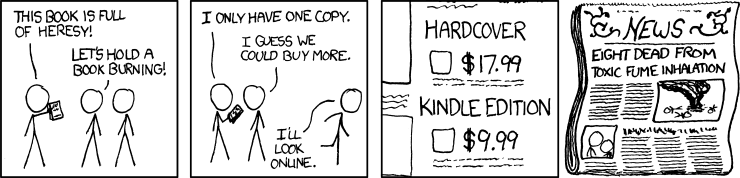
As you may have learned from a previous post, a few of us at DGLM are fans of xkcd. This comic that ran the other day really tickled my funny bone.

But it also made me wonder: in this age of digital media, what will be the equivalent of book burning or record smashing (I guess this one has been CD smashing for a while)? How will outraged preachers and parents show their disapproval?

19

For the forgetful

by Michael

I don’t know about you, but I have a hard time keeping track of all the books I’ve read. I’m pretty sure I’ll never again be able to recall everything I read in high school and college, and as I read more and more submissions, books just slip from my brain. We do a book club here at work, and I’m often surprised when I read the coverage I did—I’d say I forget about a good third of the books.

But now there’s an app to help me remember! The BookLover app lets you keep track of the books you’ve read, what you’re currently reading, and what you want to read. It’s really simple, but seems pretty helpful. If anything is keeping me from buying the app, it’s that “currently reading” section. I’m afraid every book I start but don’t finish will live there forever, quickly eclipsing the books I’ve finished!

Do you need help remembering the books you need to read? Or are you all elephants?

10

LOST in a good book

by Michael

It’s BEA week, and I’m in New York, in a hotel, exhausted by my day of standing around. But my mind keeps drifting back to Sunday and the finale of LOST. As I said to friends, I laughed, I cried, and I was completely caught up in the moment. I will miss the show, flaws and all.

What’s this got to do with books, you ask? LOST had many literary allusions throughout the show, and this LA Times blog post  goes through a bunch of them. Interestingly, the producers and I like many of the same books. Are any of the LOST books on your favorites list?

17

Collateral damage

by Michael

I really feel for authors. Partly because it’s my job, but also because I work with them closely and know how hard the business can be. I wrote a bit about rejection the other day, that being rejection from editors, agents and other “gatekeepers.” But then there’s rejection from the buying public. Sometimes books just don’t sell—the book doesn’t find its intended audience. Worse, sometime people buy the book and then explain to the world, via blog, or tweet or Amazon review, why they hate it. Those reviews sting. But I think there’s something that has to be even tougher: when readers reject your work, without having read it, because of a decision made by the publisher—in fact, they may boycott the book to make a point. But as John Scalzi smartly points out on his blog, the one getting punished isn’t the publisher, but the author.

There have been a couple of major brouhahas that caused readers to consider boycotting books from certain publishers. Earlier this year, there were calls for a boycott of Bloomsbury books over their perceived whitewashing of covers, and there’s quite the Amazon backlash to titles not available in the Kindle format. As Scalzi rightly points out, when one boycotts a publisher, authors are hurt, not the publisher. The author benefits more from one book sale than the publisher suffers from a lost one, as the publisher has an entire list (and probably several other imprints, or even other businesses) from which to make money, while the author has just the one book.

Now, I know what you’re thinking—authors don’t have to be published by any one publisher (I’ll ignore that it’s often the case that only one publisher is willing to publish the book), so they have some say in the situation. But in the two examples above, the controversies didn’t exist when the author signed the contract, and in both cases, the authors had no control over the perceived malfeasance. Authors have control over so little in the publishing process, that singling any one book or author out just doesn’t make much sense.

Maybe you all disagree, and I’m open to hear your thoughts. I just hope people will think twice about who’s getting hurt.

7

It’s not a bestseller if no one bought it

by Michael

It seems that Amazon finally caught on to the fact that the top 10 books on the Kindle Bestseller list were all free books—they’re now creating two lists, one for paid books, and one for free books. As the LA Times Jacket Copy blog notes, at the very least, the “bestseller” label won’t be a misnomer any longer.

This is also as it should be. Comparing the downloads of free books to the download of paid books never made much sense—the whole point of making the book free is to entice people who aren’t willing to pay for the work in the first place. Without payment, it’s not a sale, it’s a gift. Including both paid and free books on the list is comparing apples to oranges, and I’m glad they’re making the distinction—as Apple does in their App and iBook stores. With more than half the books on the Kindle Bestseller list being free, it’s going to be interesting to see which books now appear in the paid list.

With more information about the paid books, I’m curious to see how pricing affects sales. We know that free books are frequently downloaded, but is there a big different between $12.99 and $9.99? Or $9.99 and $4.99? A quick look at the iBookstore bestsellers shows only 7 books under $9.99 in the top 50, and those books are not new and priced to move, but rather backlist titles available in mass market formats. But the titles in the iBookstore are much more limited, so it’s hard to really draw conclusions.

So what do you think? Was it a good idea to divide the lists? Or did lumping free and paid ebooks onto the same list tell us something important?

4

You like “i,” you really like “i!” *

by Michael

Depending on your feelings about the Apple iBookstore and iPad, this may or may not come as a surprise. According to a report on Publisher’s Marketplace (subscription required), ebook sales through the iBookstore have been robust, comprising “12 to 15 percent of all ebook sales.” This makes the iBookstore the #2 ebook retailer only a month after opening, and with Random House still holding out. (And, if you ask me, a terrible, terrible user interface in the iBookstore—it’s a wonder you can find anything.) As the report notes, with income lower on a per-book basis under the agency model, ebook sales need to increase 20 – 30 percent in order to make up the difference. It looks like that may just be happening.

The report also notes: “At least two publishers were certain that iBook sales so far have been incremental, growing the overall ebook market rather than taking share from other accounts.” This is even better news, as there was worry that ebook sales would just shift from one store to the other. Growth is good — especially with the news of declines in print book sales.

Publishers have to be thrilled with this news, as moving to the agency model was definitely a short-term gamble. They sacrificed the money they were making from Amazon off loss-leaders for the chance to open the market to another major player. And it looks as though that might be paying off. That said, it’s only a month out, and it remains to be seen if people will continue to purchase their books through the iBookstore.

So does anyone else have an iPad? Anyone buying books with it? So far, I’ve read Lowboy on it, along with many, many submissions, and while I hate the iBookstore, I love the reading experience. How about you?

*For the record, I know this isn’t the correct Sally Field quote, but it’s how most people remember it!

7

A day at the printer

by Michael

A recent post over at MobileRead led me to this amazing graphic about how books are made–not the editorial stuff, but rather how a physical book is taken from digital file to printed copies. It’s quite educational, and very, very geeky. When I shared the link with Lauren, her reaction was the same as mine: it looks like a Richard Scarry book! And like Mr. Scarry’s A Day at the Airport would keep me occupied for hours, I have a feeling I’ll be spending a lot of time with this!

18

When less is more

by Michael

I think we all probably suffer from information overload, and I know that those of us who work in publishing are often even more inundated. At this point, I’ve stopped adding to my RSS reader, and I’m actually taking off all the things I never get around to reading. And, though I love technology and all it affords us, I’m generally trying to pare down. So I was fascinated by this Ars Technica article I found this week. To sum up, Oxford University Press has created a scholarly, peer-reviewed search engine that allows users to find worthwhile articles on specific subjects. Now, instead of wading through pages and pages of Google results to find out what to read on, say, Menander of Athens, you can find out what the authorities think you need to know. And with the curators of each section listed, you can decide for yourself if they’re expert enough to trust.

And while that’s publishing-related enough to mention, it brought to mind some of the ongoing discussion about the future of trade publishing. There’s been talk lately that publishers are on the way out, as authors can now just publish directly through several ebook and POD options. But with statistics like the most recent ones from Bowker stating that over 1,000,000 titles were published last year, I believe publishers and editors become all the more necessary. No one has time to find what they want out of a million titles, so readers will expect someone to help direct them and narrow their choices. That job is going to fall to publishers, their imprints and their editors, all of whose names will be more important in the future as readers will expect that each name means something. It’s not just the amazing editorial, design, publicity and marketing that publishers bring to the table; it’s also the simple act of separating the wheat from the chaff. In a world of information overload, it’s hard to put a price on that service.

But am I just being a publishing Pollyanna? I’d love to hear your thoughts on the matter.

5

All together now!

by Michael

Back in 1998, super-librarian Nancy Pearl launched “If All of Seattle Read the Same Book,” the first city-wide book club. The success of that program led cities all across the country to get together and read collectively. (Our own Lorene Cary’s The Price of a Child was selected as the inaugural One Book, One Philadelphia pick in 2003.) The NEA has their own version of the program, called The Big Read, which has a list of books that communities can choose from, each with related guides and ancillary materials.

Now comes One Book, One Twitter from Wired writer Jeff Howe, in which Twitter users help select a title by April 27, then will read and discuss the book via Twitter. I’m curious to see how this experiment turns out. With the One City programs, there were ways for small groups of people to get together to discuss the book. I wonder how much listening will actually be done in this case. But there’s only one way to find out!

The only book on the list I haven’t read is American Gods, so I’ve voted for that. Anyone else care to join?