Category Archives: Michael

4

The medium is the question

by Michael

I was very taken by this article I read on mocoNews.net yesterday. It features an interview with Scott McDonald, SVP of Market Research at Condé Nast, who talks about the results of the surveys of iPad users. Some of the results were a bit surprising: people spend more time with the iPad version of the magazine that a print one; most people leave their iPad at home, making it more of a personal computer than a mobile device; people didn’t understand what in the magazine was interactive or how to use it.

This interests me for several reasons. First, hearing that the device is not a mobile device for most people changes how developers and content providers should be thinking about their material. How you craft your material for someone on the go is very different from what you’d make for someone sitting at home. For instance, it seems that location-based apps or features aren’t as necessary on the iPad, whereas on mobile devices, they’re pretty much required. Travel publishers, it seems would be better off spending their time developing their material for the small screen than the big one. I think that’s actually pretty big news as we all consider what the future holds for “content providers.”

The other part that really stood out was that people didn’t know how to use the interactive features and ads, and they need to be taught how to interact with them. As publishers begin thinking about how to add value to e-books through doohickeys and gizmos, this is something they need to keep in mind. We know that e-book readers are not all techies and kids, and publishers should think very carefully about their audiences as they consider “enhancing” books. I know I’ll be thinking about it as we discuss new avenues for our authors.

5

More Banned Books Week

by Michael

As Jim pointed out earlier this week, it’s time to celebrate those books that others have tried to silence. I’m excited by the response that readers and authors have had to the situation with Speak by Laurie Halse Anderson, and by the fact that the attention garnered by book-banning tends to help raise the profile of said book. While keeping a book out of a library or school is a terrible thing (especially an important and amazing book like Speak), I’m grateful that the ensuing controversy makes the book all the more prominent.

One of the bigger controversies of the past few months was the one surrounding Ellen Hopkins and the Humble, Texas Teen Lit Festival. When Ellen was “disinvited” from the festival, her fellow authors decided not to appear, and the festival was cancelled. It’s terrible for the teens who didn’t get to have the event. Representing teen authors, I’ve seen first-hand how important these authors are to the readers. I’ve seen more than one kid crying and thanking an author for what they’ve written, how their life has been changed for the better. It’s hard not to get emotional about the impact books can have. But it’s important to make a stand, and I hope the teens understood the difficult decision those authors made.

But, this post was really an excuse to link to Ellen’s fantastic Anti-Censorship “Manifesto,” which you can find here. It’s short, powerful, and well worth the read.

4

Crystal balls

by Michael

I love the future. Not the actual future, but the idea of the future. I love watching footage from the old World’s Fairs or reading about futurists like Buckminster Fuller, and my favorite part of Disneyworld was Epcot, where I learned that the “future” would be all about maglev. Predicting the future is a tricky thing, what with all the variables that life has, but that didn’t stop us in the past, and it’s not stopping us in the future of today!

But how does this relate to books, you ask? I stumbled across this Gizmodo post the other day that contains video from a company called IDEO. In it, there are three different approaches to the future of the book, all of them interactive and social. Some of what they present is very compelling, and I could see parts of it being implemented—for instance, being able to share books and documents within an organization or group in an easy, visual manner. In fact, the second concept (by far my favorite), “Coupland,” seemed almost organic to me. How convenient! And the first concept, “Nelson,” could be very helpful in an education context, with its ability to show commentary, criticism and the connection between works. The third, “Alice,” is a fun idea, but I don’t think it’s necessarily the future of the “book.” The level of interactive storytelling described here, while compelling, exciting and definitely futuristic, isn’t a linear, immersive reading experience. And with fiction, frankly, I think that’s what a lot of readers want. It’s not that there isn’t a place for this concept (though the costs needed to develop something like this makes me think this kind of storytelling would be tough), but I’m not sure I’d call it a book.

What do you think? I fear I’m suddenly sounding like a technophobe!

6

Excuses

by Michael

I don’t really like excuses, as my authors know. But, I’m making one anyway! While my blog entry last week was tough because it was a slow news week, this week it’s tough because everything exploded. Ok, not really exploded, but things have gotten very busy very quickly. Just staying on top of my inbox is getting challenging, and it’s clear that all of those vacationing publishing folk are back in town. So things here are busy! And I best you’re busy, too, so I won’t bore you with a long blog entry.

Instead, I’ll point you to this fun collaborative novel that’s being overseen by the one-and-only Nancy Pearl. The really fun part? The writers (36 of them, including two clients of mine) are writing at the Hugo House in Seattle, where you can go watch them work—and can even possibly contribute ideas. They’re doing this all in six days, and then the book will be published electronically immediately afterward, with the proceeds going to charity. I have to say, I wish I was going to be in Seattle for this. Looks like a lot of fun!

1

Another outlet for a Franzen review

by Michael

It’s another slow week in publishing, with Labor Day and Rosh Hashanah causing a great calm before the storm. But even in this slow week, there’s big news: The Wall Street Journal will launch a weekly, stand-alone book review section later this month. With so many other papers closing down their book reviews, this is great news. The more book coverage, the better, and I’m eager to see how the Journal will compare with the New York Times Book Review.

5

Blogging is hard!

by Michael

Especially on the Thursday before Labor Day! I’ll admit, part of the problem is that I’m distracted getting some great submissions together for Fall and, of course, by the action at Flushing Meadows. It’s my favorite two-week stretch of the year! Sad to see Roddick and Oudin lose yesterday, but I’m happy to cheer on the many Americans still left in the draw. I actually like so many tennis players that I often get confused about who I really want to win. But today, I’ll say I’d like to see Clijsters and Fish win. Just don’t expect the same answer tomorrow.

In e-book-ish news, Samsung finally admitted what the tech world already knew, that they’ll be releasing the Android-powered Galaxy Tab tablet later this year. It looks like a nice device, with that front-facing camera (and a less interesting rear-facing one) that everyone expected the iPad to have. The book reader is powered by Kobo, and it looks quite nice. As the Engadget video review mentions, the pixel density is better than the iPad, so I’m curious to see it in person. Let the tablet wars begin!

Ok, enough of my rambling. Hope everyone has a great Labor Day weekend. Enjoy!

9

From the Vault: Don’t quit!

Happy summer, everybody!  For the next while, there are going to be some absences from the blog as we take vacations, but we’d hate to leave you guys hanging.  It’s no secret that we blog much more now than when we started this baby, and there are far more of you reading than there were way back when.  So we thought we’d bring back some blog entries of days gone by that you may have missed if you just joined us in the last year.  We’ve cued up enough, but if you have any favorites you think your fellow readers might enjoy, give us a shout below!

by Michael

It’s most authors’ dream, isn’t it, writing for a living? Being able to leave the grueling, monotonous nine-to-five grind for the glamorous world of publishing; sitting at home in a bathrobe, warm cup of coffee in hand, ever expanding manuscript at foot; calls about sequels and movie options; big packets about promotion and publicity arriving daily. It’s a nice dream, even if it doesn’t reflect the reality of most stay-at-home authors, many of whom will tell you that it’s often lonely, nerve-wracking, and just as soul-crushing (if not more so) as a “normal” job. (For a cheerier take on this subject, see Michael Prescott’s blog entry.) But let’s ignore the plight of those who write for a living for a moment, and focus on the other 95% of authors.

Very, very few novelists get to stay home writing all day. The truth is, many people get one book published, and then find that if the first book doesn’t work, the second becomes very difficult to sell. And, with advances for first books seemingly getting smaller every day, one book sale isn’t enough to live off of for a year, much less retire on. I know my view of things is colored by the rather high cost of living in New York, but even authors in the smallest towns can’t survive on $5,000 a year.

So what’s a first-time author to do? My advice is to keep the day job–the benefits are more than financial. Let’s go back to the writer sitting at home. Publishing is not glamorous; it’s hard work. The full-time writers I know work harder and longer than their peers. They spend much more than eight hours a day writing, thinking about their writing, wondering what their agent is thinking, pondering the loss of yet another editor, desperately trying to refrain from e-mailing their publicist again about that review in the Sioux City Herald, talking with other writers (about their agent, editor, and publicist), blogging, and generally praying that they won’t have a coronary before the end of the day. Authors who have day jobs are often able to put things in perspective: there’s more to life than their book(s). They get to leave a large part of the worrying to us agents (it’s part of what we’re paid to do – see Jane’s latest blog entry here), and that’s as it should be.

My take on this aside, I decided that I would speak to somebody who actually did leave work to write rather than just commenting from up here on my perch. Sara Zarr, the author of the forthcoming Story of a Girl, quit her job as an administrative assistant a few months after we sold her book. She had a lot to say. “If you get a book deal and are thinking about quitting your day job, there are a lot of factors to consider. Of course, it depends on what your day job is. If it’s a career job, if you’ve invested years of time and energy into it and it fulfills some part of you that writing can’t, keep it. If it’s a minor job that you don’t care too much about (or you hate), and you’re reasonably hirable in the current job climate, quit and try the full-time writing thing. You can always go back into the job market if you need to or if you find you don’t do well sitting home all day. Quitting does free you up to travel and promote your book if you need to, which is nice, but not mandatory.” Her last piece of advice struck me as particularly important. “It’s not necessarily all or nothing. My employer let me scale back my hours while I was working on revisions. You might be able to arrange something more flexible at your current job or find part time work.”

I know it’s tough to write and work at the same time while also keeping up with family and social commitments. I understand that working full-time as a writer seems glamorous, but writing for a living is something that only a handful of people are able to do, both for financial and psychological reasons.

When that final offer comes in from the publisher of your dreams and your excitement is tempered by the fact that you can’t quit counting beans, don’t panic. Your book is going to be published, and you’ll get to keep your sanity. It’s the best of both worlds.

I really welcome comments from authors about this one.

Originally posted in November 2006.

3

Numbers!

by Michael

For someone who never liked math much (past the age of 16, that is), I have a thing for numbers. I like things to be tangible and real, and while dealing in the abstract is great for artists, it doesn’t make much sense in business. In all of the discussion of e-books, I find very few articles and blog posts contain numbers, and when they do, they tend be rounded and squared and averaged and guesstimated. So I was pleased to see this great post from Mike Shatzkin today, which looks more closely at the nitty-gritty of author compensation from e-books under the agency model. The results make sense, and in some ways bear out both the arguments of agents/authors and publishers. There’s still some guessing here, but this is the closest to something I trust that I’ve seen thus far, and it’s worth a closer read and further thought. Interesting times.

8

Kids these days

by Michael

It’s one of my favorite times of year! It’s the annual Beloit College Mindset List. Since 1998, the college has been helping their professors understand what the cultural differences are between them and the incoming freshman class. The list is new each year, which means there’s an awful lot of fluff on it, but some of the entries really make you think. (I recommend going back and looking at past lists, since much of those still apply.) A couple that stood out to me this year:

32. Czechoslovakia has never existed. (I still remember teaching myself how to spell it when I rather impulsively chose it as the Olympic competitor country to do a report on in 5th grade.)

67. Ruth Bader Ginsburg has always sat on the Supreme Court.

46. Nirvana is on the classic oldies station.

That last one gets me the most. Now that I live in LA and have to drive, I listen to music radio again, something I hadn’t really done since high school. It was definitely a shock hearing Nirvana on the “classic rock” station.

So, how’s this relate to publishing? It’s important as publishing professionals to be aware of who our audience is, and reading this list always makes me stop and think about the kids picking up my authors’ books. And it also makes me project into the future: In a few years, there won’t be a kid who’s been to a Waldenbooks. They won’t remember a time before Amazon. They’ll live in a world that’s full of widely-available, instant-access e-books. And this is just a few years down the line! Any thoughts on what generational changes the future might hold for publishing?

4

Oddly, this isn’t from the Onion

by Michael

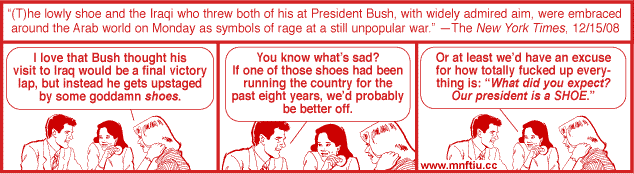
At first, I thought maybe it was April Fools’ Day. I mean, I know we have artisanal everything these days, from foods to furniture to mining, but this one just seemed a little less useful: artisanal pencil sharpening. But it’s quite real. For $15, you too can have your pencil lovingly sharpened by David Rees, creator of the brilliant comic Get Your War On (my favorite being the, “What if our president had been a shoe” panel). Your pencil comes back very well-packaged, along with the shavings, too. As he says, they’re your shavings!

It’s conceptual art, I think, and the whole thing kept me more engaged than I imagined I would be when I first started the Jacket Copy post. As one who loses writing implements on a daily basis, though, I think I’ll pass on the sharpening. Any takers?