
 June 01, 2011
  Miriam
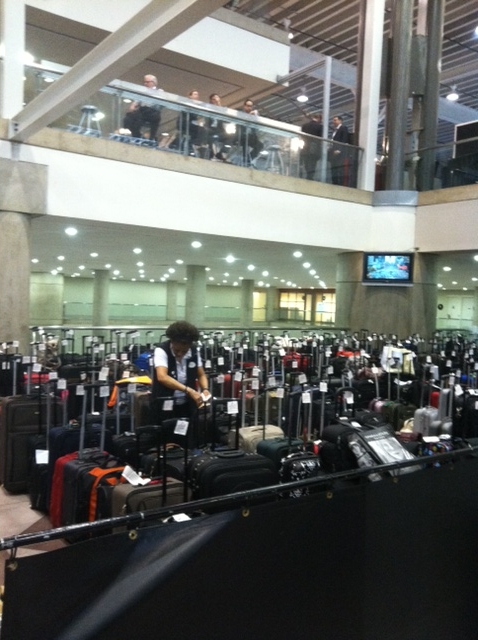
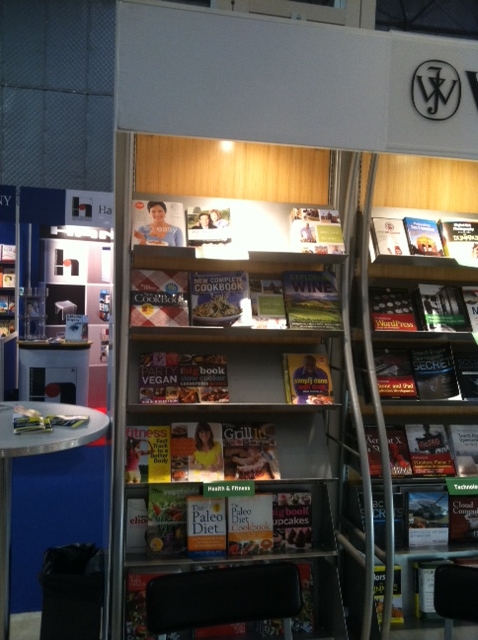
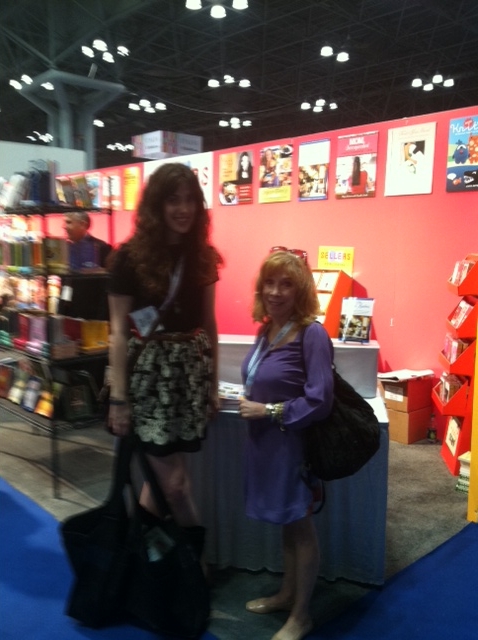
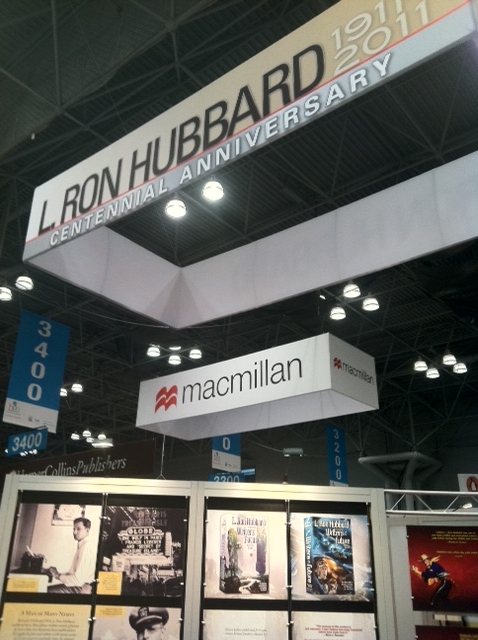
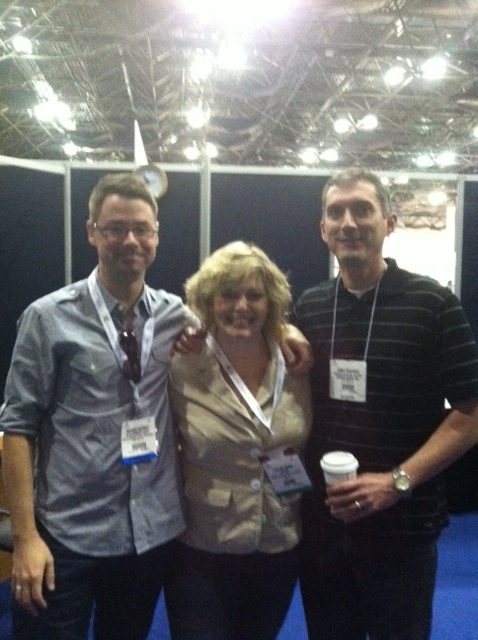
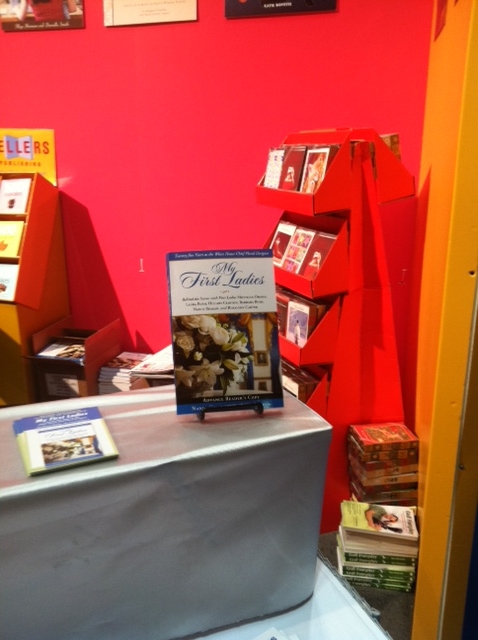
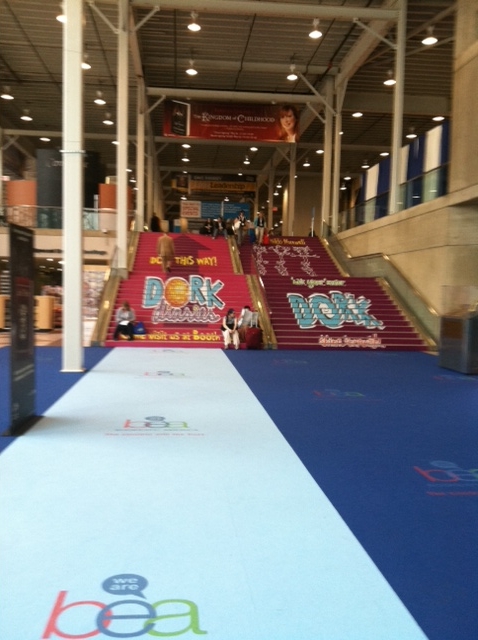
Some scenes from BEA. Jane, Rachel (their picture below cracks me up–Rachel’s statuesque, while Jane is, er, twee) and I trekked over to the Javits center last week on Thursday, which was the last day of the Expo. It was comforting to see that L. Ron Hubbard still has the biggest booth. Lovely to see our authors’ books on display. Heard a rumor that the “Dork” stairs cost the publisher $25,000. Then, we ran into Michael (is he squinting?) with his clients Lisa McMann and James Dashner and we chatted with Liesa Abrams of Aladdin (who edits some of Lisa and James’ books) about her Batman-themed wedding. As we were heading out, we saw the sea of suitcases and hoped that they all found their way to their rightful destinations.
Category Archives: Jane
Do I have to like an author to enjoy reading their work?
This week there was a big brouhaha over Philip Roth winning the Booker prize.
How could someone so unlikeable be celebrated in such a prominent way, many asked.
This made me think—does a writer’s personal reputation affect the opinions of those who read him or her? Two examples came quickly to mind:
The first is Jonathan Franzen. When I picked up The Corrections, it was right in the middle of Franzen’s refusal to go on Oprah after she picked his book for her book club. How dare he? But I read the novel anyway. It was indeed brilliant, but I have to say that because of my take on the author’s arrogance, I didn’t love it. And despite the fact that friends and colleagues have raved about Freedom, I have absolutely no desire to read it.
And then there is James Frey. I never read A Million Little Pieces and after the news that much of it was fabricated came out, again, I had no desire to. But I was curious about his novel, Bright Shiny Morning. I did read the book, which I thought was interesting and well done, but I didn’t fall in love. I think one of the main reasons for that was the author’s personal reputation.
So what do you think? With all the wonderful books to choose from, are you affected by the author’s notoriety?
This month’s selections at the DGLM book club
As many of you know, we have a book club here at Dystel and Goderich Literary Management. Every month or so, we pick a category (of fiction usually) and each of us selects a different title in that category to read. On the designated day, we meet after work and each of us presents our evaluation of the book: first, we pitch it as if it were something we were representing, then we describe what we really thought and, finally, we talk about how the book sold, its reviews, awards it was nominated for or won, and anything else we can find out by bugging the editor who worked on it. In this way, over the years, we have all learned a lot about these categories and what is currently going on in our business.
This month we are doing something different—each of us is reading one of the top 100 bestselling e-novels from the kindle store. We are curious about whether these books differ from those sold to traditional publishers and, if so, how.
More and more these days, books are being sold electronically. There are now e-book bestseller lists in The New York Times and some of these titles are exclusive e-books—not published traditionally in any format. We are trying to learn more about this phenomenon for our existing clients and maybe identify future clients as well. It is a whole new era in the world of publishing, and we are going to be very much a part of it.
Are any of you published exclusively online and, if so, what has your experience been?
About that edit memo
The other day, one of my clients said he thought the process of editing was negative. That comment really surprised me as I have always felt that an editor’s intention is to make the material he or she is editing better.
Indeed, I have many clients who are really troubled when their editors don’t touch their manuscripts (and frankly, I think they should be). These authors welcome their editors’ comments and work with them to improve their material.
In the end though, I advise writers to remember that their work is their work and that if they feel strongly about the edits they are receiving, they can always respectfully disagree. The process of getting a manuscript into publishable shape, however, should be collaborative and thinking that editing is negative is not the right attitude, in my opinion.
Check out these humorous and fun thoughts about editing.
I would love to hear how you feel about the editorial process, whether you think it is positive or negative and why.
Writing for love
I have always felt that if you love what you do, no matter what your profession, the money will follow. Perhaps this is idealistic, but I have seen it happen numerous times. I truly love helping writers develop their work and their careers and think this has resulted in some exciting business successes. I have also seen this phenomenon time and again with my own clients in their writing.
When she began as a novelist, Mary Doria Russell took ten years to create her now-classic work The Sparrow with little expectation that she would become a bestselling author. I know the same is true of Jacqueline Carey who has produced an amazing nine-book fantasy series. David Morrell, a former college professor wrote out of pure love for his craft, and has developed incredibly memorable stories and characters, most notably Rambo. Indeed, David told me recently that when he speaks to groups of writers, he is always talking about writing for love as opposed to money. He agrees with me that this very often results in real successes.
Then there is one of our newest clients, John Locke who self-publishes electronically. John does not consider that he is a professional writer and yet he truly loves creating the tales he does. And his is an incredible success story with close to 800,000 copies of his books sold just this year.
Indeed, as I was thinking about all of this and looking for other examples, I found this one which says it all. Bloggers begin by writing because they love writing and not to sell books necessarily, but look what happened here.
What are your writing for love stories?
Memoir writing revisited
Last Sunday night, right after I completed my blog post on memoirs, this report about Greg Mortenson appeared on 60 Minutes. Once again, an example of memoir writing gone very, very wrong.
Here is an author (in this case a philanthropist who raises money for an important cause and who apparently takes advantage of his contributors) who has allegedly fictionalized his life experiences. As was the case in the James Frey scandal, this not only hurts the author, his publisher and his readers but also everyone who might want to write a memoir. In my opinion it is morally and ethically reprehensible and totally unacceptable.
To respond to a question I was asked regarding last week’s entry, and which is particularly relevant in light of these new disclosures, memoirs are meant to be true stories about the author who is writing them. Except in rare instances, they should not be written anonymously and never “fictionalized” in any way. Because of the James Freys and Greg Mortensons of this world, every memoirist is under closer scrutiny by publishers.
Good, effective memoir writing is a responsibility—of the author and of the publisher. Here’s hoping Greg Mortenson’s “story” won’t be repeated any time soon.
I think I’ll write a memoir
Have you noticed that so many writers these days are writing memoirs? There are some modern classics:
Eat, Pray, Love by Elizabeth Gilbert
Dress Yourself in Corduroy and Denim by David Sedaris
There Are No Children Here by Alex Kotlowitz
One L by Scott Turow
And then there is the current New York Times hardcover Non-Fiction Bestseller list (April 17/11):
# 1: Onward by Howard Schultz
# 5: Red by Sammy Hagar with Joel Selvin
# 6: All My Life by Susan Lucci
#13: Decision Points by George Bush
#14: Come to the Edge by Christine Haag
#15: Blood, Bones and Butter by Gabrielle Hamilton
And perhaps the ultimate, a memoir by the White House janitor.
The problem is that those considering writing about an emotional point (or points) in their lives, and in many cases, that is what a memoir is, don’t consider seriously enough whether they are ready to do this. Are they ready to open themselves up and truthfully tell this story, which will expose them to a large audience in a way they have never been exposed before? Are they ready to deal with probable criticism from those close to them about what they’ve written?
The point I am trying to make here is that before you think about undertaking this most difficult and personal effort, you should give very careful consideration to whether you can accept the results. If not, then move on to an easier and safer undertaking. If so, then go for it. Writing your emotional and hopefully fresh and inspirational story might be the best thing you can ever do for yourself.
Have any of you ever thought of writing a memoir and decided against doing so? What went into your decision making process?
The importance of reading…even for us!
Recently, I was looking to see what my son’s schedule was going to be at the end of his college semester (he is in the second term of his freshman year at the University of Michigan) and I saw that he had a reading week before his final exams. “A reading week,” I thought, “what a wonderful idea.”
As agents, we are so busy reading proposals and manuscripts from clients and prospective clients, as well as trade articles for our information and education that we simply lose perspective on what else is going on out there in the world. But, during our work weeks—and I tend to work until 10:30 every night at least—there is simply no time for anything else.
And so, I have decided to take a reading week this week in order to read for pure pleasure. Ironically, the first thing I am reading is a manuscript from a client’s soon to be published book, and I am just loving every minute of it. Next, I plan to finish this month’s DGLM book club book, THE FINKLER QUESTION, then it’s on to Vanity Fair and, after that, I am just not sure.
I wonder if any of you have recommendations for other fiction I might read during my reading week. And, what would you choose to read if you were to do what I am doing?
The Ultimate Lesson
With all of the negative talk about the future of book publishing and what is going to happen to reading and writing, I was reminded this week of a lesson I learned early on: Never give up!
So often during the course of our work, we get discouraged. Publishers don’t see the proposals or manuscripts the way we do, Authors are depressed when we can’t sell their work right away and we become exhausted by rejection. Indeed, when I first started out as an agent I would take this rejection quite personally. Then I had a chat with myself and realized that if I continued to do that, I might as well find another career.
Over the years, I have had my fair share of rejection, but I have also experienced many instances where, after trying and trying to sell something I believed in and refusing to give up, I’ve ultimately succeeded and seen the book I sold become a huge success. Some examples: The Simplify Your Life series, In Memory’s Kitchen, Artisan Bread in Five Minutes a Day.
This week I sold a novel I had shown to over 40 publishers. I believed in this novel and in its author and I decided I simply wouldn’t give up; the author continued to encourage me to keep going and I did. Finally, last Thursday afternoon we had our offer and we completed our deal on Friday. The novel will be published next April.
Once again, my confidence in the value of persistence was renewed. I’d love to hear your stories of grit and perseverance.
The future of publishing
I ran across a fun article this week in McSweeney’s entitled “The Future of Books” which I thought I would share with you. There is no question that this is written tongue-in-cheek, but I found it particularly meaningful in a week when some big events happened that certainly are representative of the exciting things that are transpiring in our business.
First thing was that Barry Eisler decided to cancel a half-million-dollar, two-book deal with his publisher to self-publish, primarily electronically. This played out in the media and during an interesting and enlightening conversation between Eisler and our client Joe Konrath. Then, later in the week, Amanda Hocking who has been selling her young adult paranormal books very successfully online decided that she wanted to auction her new series to a traditional publisher rather than self-publish, saying that she feels that self- publishing has its limits.
This is a subject that is going to inspire debate and probably some significant change in the way publishers, agents, and authors do business over the coming months and years. Everything in this area seems to be moving very fast. In my opinion, all of this change is interesting and exciting in a business that has been more or less stagnant for many years. As I have said before, I think reading will be on the upswing as will writing—hopefully good writing.
I would love to know what you think.